Help!! Do you guys sand your barstock flat before profiling the blade? Do I need to?

Joined
Feb 6, 2010
Messages
1,427
I just started to grind my own blades from cpm 154 and the hollowgrinding is going ok but I wonder if my barstock is flat enough for a tight fit to the bolster and the scales. I HAVE ORDERD A 3 PHASE 1 HP MOTOR AND A KBAC 24 D DRIVE that I will mount with a 1 degree offset 9 inch disc to sand my barstock flat and clean up bolsters. Am I doing the right thing ? I want to make professional quality full tang knives. Any advice woud be appreciated. Thanks, Larry Lehman, Bakersfield, CA
 
I normally forge blades, but if profiling from a bar, even if it appears dead flat, I hit it on the platen and if the knife will have bolsters, I lap it flat by hand on sandpaper over polished granite or glass. I do the same with the inside of the bolster stock before epoxying and pinning. That way the resulting joint has no gap, it appears as though the bolster was seamlessy welded or soldered onto the tang.

I usually make tapered tangs, often with bolsters. When hollow grinding the tang in preparation for tapering flat on the platen, I run the hollow all the way up to just short of where I have the front of the bolster marked on the ricasso. I run the flat taper up only to the dovetail area at the back of the bolster. Since I did run the prep hollow all the way of to the front of the scale however, it's very easy to lap the bolster and ricasso area nice and flat with each other.

Short answer- yes, grind the bar even flatter before mounting scales and bolsters. I personally do this after profiling, there is less surface area to clean that way.
 
Short answer- yes, grind the bar even flatter before mounting scales and bolsters. I personally do this after profiling, there is less surface area to clean that way.
Same here. If you're going to do tapered tangs, which are the bee's knees, just remember to do your drilling beforehand while it's flat. Makes it easier to keep things lined up later.
 
I am afraid to use my platen on my kmg. I need to make a jig or a block with magnets. I may just lap the blades on 220 grit on marble for a while. When I build my variable speed disc maybe that will make super flat stock or profiled blades. Thanks for taking the time to give your opinion. Larry Lehman
 
James, thanks for the advice. Do you use a platen to flaten your blade and what grit do you usually use. I am still shaky on using the platen on my new KMG. Thanks for helping me with this. Larry Lehman
 
I use 36 or 50 grit blaze belts for tangs, and I keep a sharp belt for it. It's just easier on you and the tang comes out flatter. You'll get a flatter surface without excess pressure and a sharper belt lets you cut this way.

You might try wearing a welding glove on your holding hand to flat grind the tang lengthwise on the platen. That way if you hit the top wheel with your hand, the glove gets eaten, not your knuckle. Or, I brace my hand near the top of the side of the platen, holding the tip of the blade, and kind of rotate the steel in from the side to flatten. I use a push stick against the tang.
 
You might try wearing a welding glove on your holding hand to flat grind the tang lengthwise on the platen. That way if you hit the top wheel with your hand, the glove gets eaten, not your knuckle.

No, NEVER do that. No gloves anywhere near the grinder. Better to lose part of your knuckle, than to have the grinder grab your glove and mangle up your entire hand.
 
To flatten tangs i use a magnet from any knife supply place and hold it vertically to the platen. I've also used some gorilla tape to make little "tags" to hold onto. Gives some more control.
 
Seems a bit reactionary. With a heavy welding glove, and in that position, any danger of getting caught by the machine is minimal. I've actually saved my knuckles many times doing that.

That's the only grinding operation I've ever used gloves for. Heck, I'd like to see my machine TRY to eat my hand with a welding glove on it.

A lathe or power machine for instance would be a different matter altogether.
 
No gloves ever when my hands are anywhere near the moving parts of power tools. EVER. Flesh gets scuffed and your instincts will make you jump away from the danger, gloves get grabbed and pull your precious fingers into the tool.

Tang grinding is every bit as important as blade grinding. Don't be skeered, you may goof up a couple but that's just experience. You may want to practice on mild steel to get the hang of it... the tricky part is to bring the workpiece evenly to your platen or disc so you don't get a big OOPS on one side; many makers align their work against the platen/disc first and use a footswitch to turn the machine on. I used to leave my tangs slightly oversize and grind away goofs on the edges later; as my skills improve this is becoming less necessary.

I have a "pyro-ceramic" face on my belt-grinder's platen and I love it. I hold my workpiece with a welding magnet when flattening/tapering. I start with a dull 50 or 60 grit belt to start the "bevel" and knock most of the mill scale off. That stuff will knock the crisp edges clean off a new belt. Whenever possible, spend a couple extra bucks and have your barstock precision-ground, it will pay for itself in time and belts.

Then I use sharp, fresh belts to get the tang to the dimensions I want. I work right up to A45 Gator (approximately 320-or-so grit) just like on the blade itself. When the blade is HT'd and ready for assembly, I roughen the tang with a 50 or 60 so the epoxy has more places to "grab" it.

Lapping the tang as Salem described is an excellent idea.
 
I don't see a need to sand barstock flat until it needs it, so just to profile a blank, no.

To etch a center line yes, but I only do it enough to get a reasonable center line, not to get every unevenness out of it.

I don't go for really flat and blemish free until after the blade is beveled and the bevels are cleaned up ready for heat treat. Only then does it pay (IMHO) to be sanding the flats. Doing it this way helps to make the top grind mark stand out as if I were a good knife maker who knows how to grind a blade. Nor am using up my belts to lev el a section of steel (the bevels) that will ultimately be ground away.

I have yet to put a bolster on a knife so that would take you to a higher level of precision than I normally work with. Never the less, I don't see a need to make the tang precision flat until after the blade is beveled and all cleaned up prior to heat treatment. I clearly don't know what I'm talking about so I hope someone will straighten me out. A little bit of knowledge is a dangerous thing.

- Paul Meske, Wisconsin
 
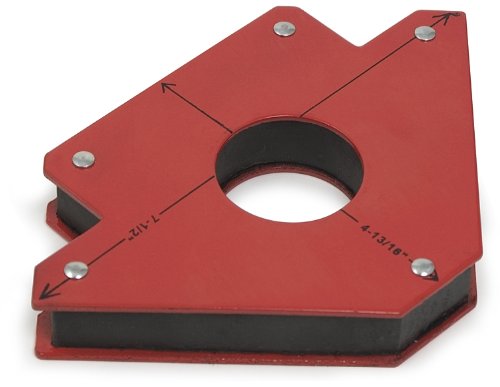
Use one of these to hold the blade against the platen:
41RrCfPeLsL.jpg
Simple and safe.
 
Last edited:
The magnet trick makes for a pretty decent "home made surface grinder" effect. With that said, if you are using steel like ATS 34, why not just buy precision ground stock and you will be halfway there?
 
Salem, another problem with watering welding gloves is that if you are grinding a hardened blade and you have to wait until you can feel the heat through welding gloves, then you are probably letting it get to hot.
I use 36 or 50 grit blaze belts for tangs, and I keep a sharp belt for it. It's just easier on you and the tang comes out flatter. You'll get a flatter surface without excess pressure and a sharper belt lets you cut this way.

You might try wearing a welding glove on your holding hand to flat grind the tang lengthwise on the platen. That way if you hit the top wheel with your hand, the glove gets eaten, not your knuckle. Or, I brace my hand near the top of the side of the platen, holding the tip of the blade, and kind of rotate the steel in from the side to flatten. I use a push stick against the tang.
 
Back
Top