
-
The BladeForums.com 2024 Traditional Knife is available! Price is $250 ea (shipped within CONUS).
Order here: https://www.bladeforums.com/help/2024-traditional/
You are using an out of date browser. It may not display this or other websites correctly.
You should upgrade or use an alternative browser.
You should upgrade or use an alternative browser.
help with Cattaraugus knife scales
- Thread starter dave307
- Start date

- Joined
- Dec 19, 2006
- Messages
- 8,210
The knife has been cleaned up some but the covers etc look "right" to me. Not all Cattaraugus knives had Roger's "Indian Trail".
- Joined
- Dec 19, 2006
- Messages
- 8,210
"cleaned" is sort of a euphemism. The metal surfaces have been refinished a bit. An abrasive was used on the blade and you can see the grit lines running lengthwise. This is common on refinished blades. Knives weren't made that way at the factory. If you are buying old knives, you will want to learn by example to identify real crocus and glazed finishes. Often refinished blades are misrepresented as new so it is important to know the difference. In addition to the blades, the bolsters and shield have been polished up.... probably by buffing. Buffing bolsters is sort of like polishing off the VIN on you car because you don't like the looks of it. Since buffing bolsters is a finishing step on a parts knife, buffing bolsters creates unnecessary confusion. The original finish has historical value that is appreciated by collectors who preserve old knives. Even on a user, I prefer original finish or normal wear instead of resurfacing. But it seems like lots of folks like to polish old knives and put patina on new knives. Doesn't make much sense to me except if people just want mess with their knives one way or another. Fakers love that novices are compelled to polish knives since their knife sculptures have the same finish--they blend right in. That's an unfiltered ramble.... but I hope it helps

Old Engineer
Gold Member
- Joined
- Nov 30, 2014
- Messages
- 10,192
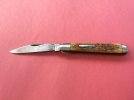
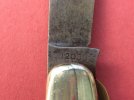
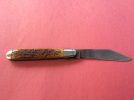
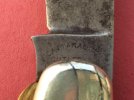
I just picked up some cattaraugus knives. I have a ? about this one, it is pattern 1099 . Do the scales on this look right. It has brass pins. All I know is this isn't the traditional indian trails on the bone scales. Thanks
View attachment 686621View attachment 686624View attachment 686627View attachment 686629View attachment 686630
I have looked your knife up in the Cattaraugus Catalogue and they do have the 12099 showing on Page 42 . Your Blade matches the picture . Your Bolsters match the picture with the pivot bolster being larger than the but end bolster. the catalogue name shown is Large FH Jack . I believe that the FH in this case stands for Folding Hunter .
You did not indicate the folded length but I expect it is in the area of 4 & 3/8 to 4 & 1/2 inches in length . The picture in the catalogue Does Show Indian Trails in the jigging . The last digit in the number of 12099 indicates that it is Rogers Jigged Bone . It does show in the catalogue that there is not anything in the numbering system to indicate that it should or should not have Indian Trails in the jigging . Everything about your knife looks right enough to me that I would have sure gone for it . I like it a lot . I also have a Large FH Jack number 11849 and it is a very solid knife which I really like . Enjoy your very nice find Sir!!
Harry
- Joined
- Dec 19, 2006
- Messages
- 8,210
His knife is a 12099L (locking) rather than a 12099. It's on page 11...of the second section IIRC... of Dewey's catalog reprint. The description and blade etch are "Deer Slayer". 4 1/2 in closed.

Campbellclanman
Platinum Member
- Joined
- Mar 10, 2007
- Messages
- 16,008
Nice information both Harry and Jake.
- Joined
- Dec 19, 2006
- Messages
- 8,210
Thank you, Duncan. Dave, it sounded like you bought more than one Catt and I'm sure we'd all enjoy seeing the other(s) as well. So post them up! The "deer slayer" is a nice pattern. Are you going to carry it or have you gone down that dangerous road  and started collecting?
and started collecting?First off thanks for the information. I bought a collection of cats 29 total. I picked out one to carry.The rest in a glass display case (I'm going to have to build another) I will be posting them in the next few days. I have a very bad cold so I'm moving kind of slow.

- Joined
- Dec 19, 2006
- Messages
- 8,210
Good to see you, Eric !
Dave, That's a good size collection ! I look forward to enjoying the photos :thumbup: Hope you feel better.
Dave, That's a good size collection !
I look forward to enjoying the photos :thumbup: Hope you feel better.