Help with "first" hidden tang...

Joined
Jun 29, 2009
Messages
942
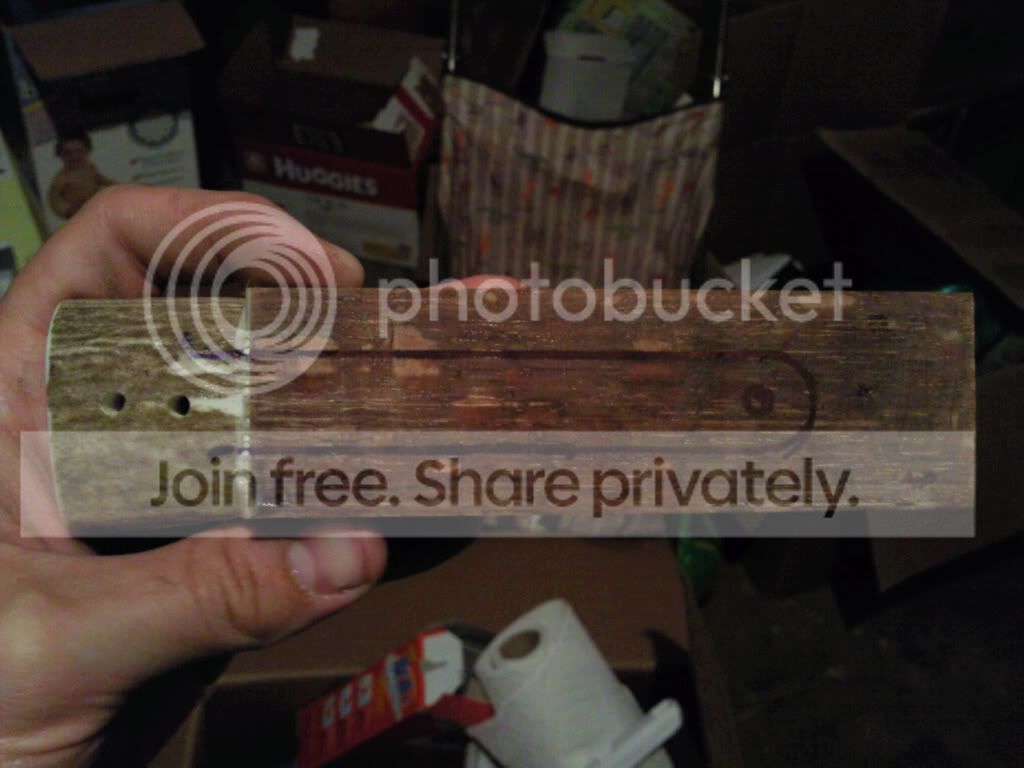
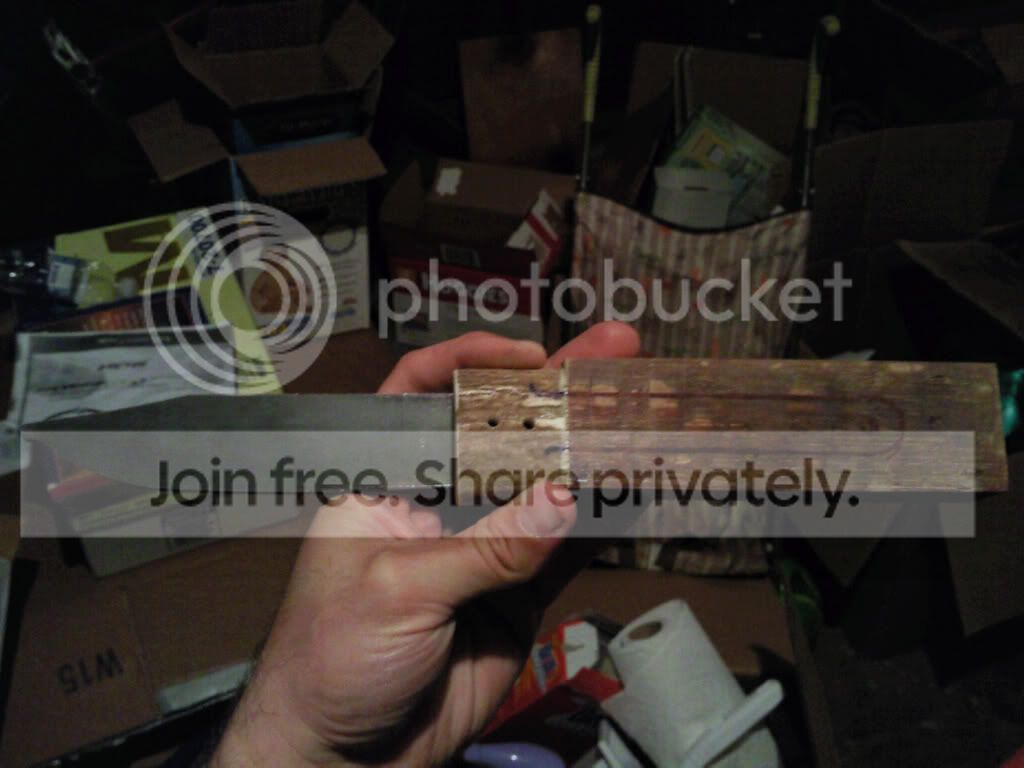
Hey guys, school is out for 2 weeks for me and I have a block of lacewood from Burl Source and a cold steel blank that I want to use to play around with making a hidden tang. I had an idea in my head as to what I was going for and epoxied an antler bolster with a brass spacer to the lacewood. After I glued them up I really got looking at the blank and pulled out the calipers and there is quite the difference where they ground off the CS logo from the blank. The grinding marks go pretty darn far forward and I was hoping to be able to have the bolster cover them up completely but I don't think it's going to be possible. In the first pic the yellow box is outlining the area that had the logo that was ground off.

Anyway, the first knife I made was a hidden tang that will probably sit and collect dust in a drawer so nobody can ever see it and I'm pretty darn intimidated by them. I am hoping that somebody out there might be able to help me a bit with the design and handle shape so I don't try to just do my own thing and screw this up completely.

Also, any recommendations about the grind marks? If I had a surface grinder it wouldn't be an issue but being as I don't...

I am going to do 2 1/8" brass pins in the bolster, should I go through the steel or pein them to the steel or is there really no difference in strength between the two options?

I know this is a lot of different questions, I'm just pretty nervous about doing a hidden tang and am kindof wishing I would have had Mark cut them into scales so I could use the lacewood on a full-tang knife like I'm used to...

Thanks guys, here are the pics:

Cold Steel blank:
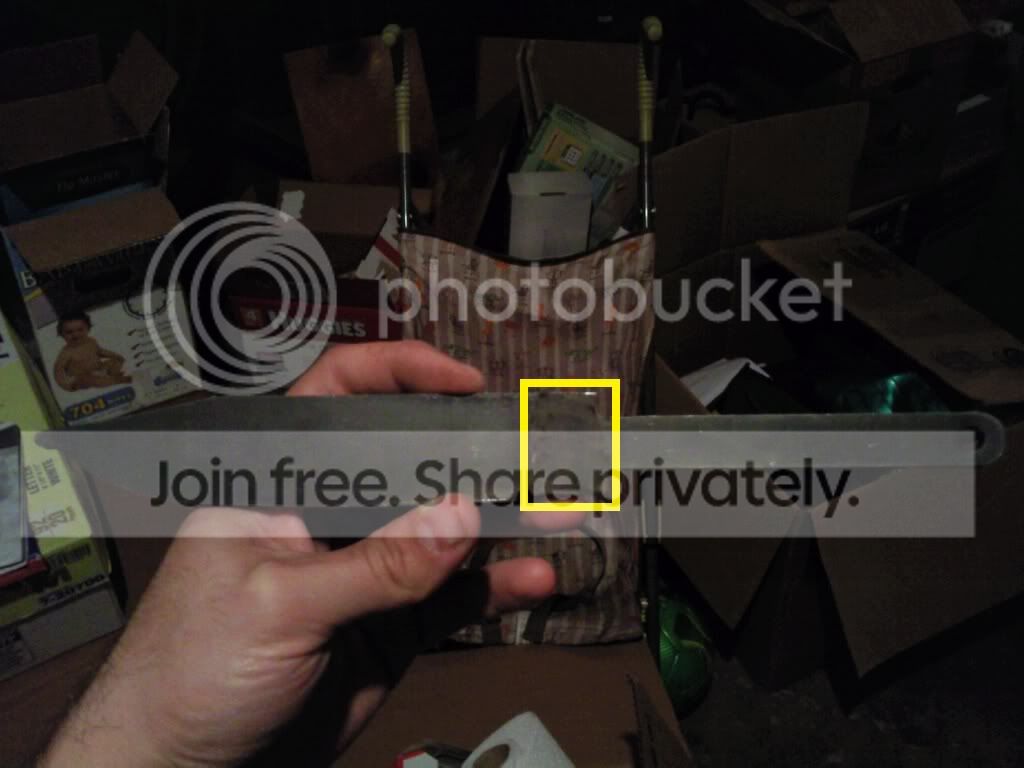
CS-1b.jpg


antler/brass/lacewood for handle:
CS-3.jpg


steel under handle materials:
CS-2.jpg


Please excuse the messy garage - we just moved so it's quite the disaster zone!
 
Last edited:
First, is this a user knife or a wall-hanger? If you plan to use it, what do you plan to use it for? What the knife needs to do will play a large part in how you shape the steel.

Secondly, that handle you've laid up is waaaay long if the picture is anyway accurate. Knives don't generally have a handle/bolster combo that's measurably wider than a man's hand. Figure about 4.5" for a decent balance between looks and function.

This isn't to say that the antler/wood combo won't work, just that you might want to rethink your proportions.

As for the blade's scratches, it looks like you only have a blank that's been profiled. That's a super easy thing to fix! Those grind marks where they removed the logo might completely disappear by the time you get some 220g sandpaper working to level and clean up the surface.

Before you go any further with the handle, take some time to think about what you want this knife for. If you plan on using it, could you stand to loose some of the blade's length if that's what it took to get rid of the deep grinds?

Take your time to think about what you want to accomplish, and remember that all you have is a simple blank. There are at least a dozen different knife styles waiting for you inside that piece of steel! :)
 
Don't ever buy a gateway laptop, their freaking touchpads are the bane of my existence. I just wrote up a huge friggin reply and somehow touched the pad just right to make it go back 3 pages and lost the comment. Seriously, I hate their touchpads.

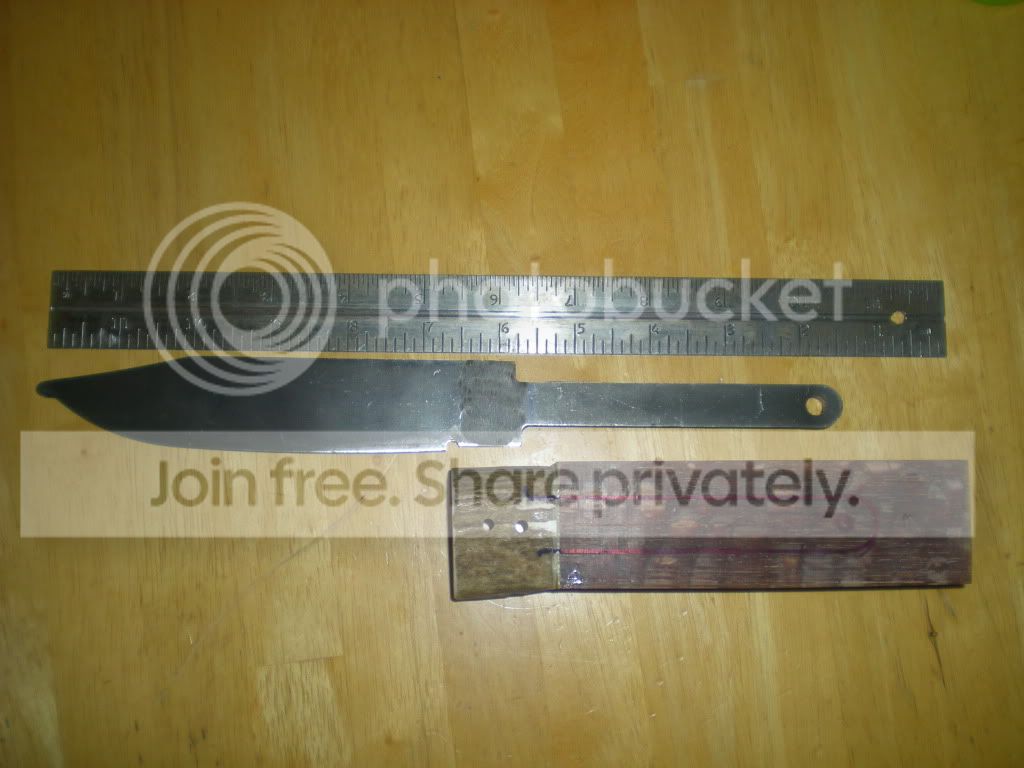
Anyway, this will likely be a shorter reply but here's some more info and another pic of the knife.

The blank is one of Cold Steel's SRK models with a 3/16" x 1 1/4" x 5 1/4" blade. In the Cold Steel version there is about a 1" section between the plunge line and the guard but that is where the Cold Steel logo was that had to be ground off - and they had to grind deep enough to remove all traces of the stamp so it has some deep gouges. I don't have a surface grinder otherwise that would be the simple answer to the problem.

I don't really know what to do about the antler bolster since it's elk and does have quite a bit of pith so I will be quite limited on shaping it without going into the pith. I just don't know what else to do about that ground up area since there's no way I could get a good even finish with the tools I have at my disposal.

The pictures definitely do make the wood and steel look gigantic but I attached a *hopefully* better picture with a ruler for scale (ruler is a typical 1" x 12" ruler). The antler is about 1 1/4" and the lacewood block is 5 1/8" long x 1 1/2" wide.

DSCN4121.jpg
 
If the steel is annealed, you should be able to filedraw the grind marks out. That's what I sometimes do after profiling. If you have a angle grinder with a coarse sanding disk/pad...that'll probably work to, just be careful when you get near the tip of the knife since it can grab and be sure to have the blade clamped down tightly.

As for the pins, I would say go through the steel then peen them.
 
Amcardon,

A couple things here before you go any farther. First, do you know what kind of steel the blade is? And do you know whether or not it's annealed?

If it is annealed, then you should be able to grind/file the bevels and drill the holes for your bolster with basic tools--files, drill or drill press, etc. However, to have a usable knife you will have to have the blade heat treated to acheive proper hardness. Otherwise, you are just looking at a wall hanger. That is why you will need to know what steel this is--Carbon V, 1095, 420 stainless, etc.

If the steel is not annealed, then you run into some different problems. The steel will be too hard to file the bevels if you don't have some sort of grinder, and if you do have a grinder you could run the risk of ruining the heat treat if you get the blade too hot. If you do grind the bevels, it will be difficult to get a good hand finish afterwards. Also, you will not be able to drill the holes for your bolster or finish out the area where they ground out the logo.

Either way, a surface grinder will likely not help the grind marks on the ricasso if they are especially deep as you could end up thinning that part of the blade more than you really want. You could disguise that area--if you have a Dremel or similar rotary tool available then you could use a round burr to make divots over the area to cover the grind marks and give the blade a faux hammered look. Instead of bolsters, add a simple guard and give it the same treatment to match things up.
 
First, I commend you for making an effort to do something before seeking advice. I personally find that slogging through problems is a better way to learn than just getting people to tell me what to do.

I agree with a previous comment that the handle is too large. Based on the ruler in the picture, it seems to be 7.5 inches long, but I also note that 1.5 inches of that is the antler bolster, so it's not as bad as it may seem. The handle can be reduced once fitted, so you really want to start with it being too large, so you have room to shrink, so to speak.

I'm concerned by the comment that the antler piece has a lot of pith, limiting your ability to reduce that component. That leads me to believe it isn't necessarily the right piece of antler for the task. When you look at the knife from the point (as if it was pointed at you), what will you see? A gaping hole around the ricasso? A big dark mass of unstabilized pith? How will that area hold up over time? The side view is important, of course, but it isn't the only way your knife will be viewed.

In the end, you'll want to be able to shape the handle to match the lines of the blade. If your material won't allow that you should consider selecting another material.

- Greg
 
yea u need a guard for sure, is the blank hardened,if so you have a great tim drilling holes in it!! it just looks profiled only
 
The blade is annealed 1095 - I have a heat treating oven so I'll be doing that myself. The comment about the pith was mainly because it's elk so the cortical thickness is roughly 1/8" with 1/2" or so of pith. I have nothing to lose drilling out what I have to see how I think it works with the blade so I think I'll work on that today.

Thanks for the coments, i will post updates as I have them.
 
One easy fix for the antler problem is to cut off the end of that wood and move it to the front.... so you end up with the antler in the middle of the handle. That's rather common and looks good.

Use some cheap spray-on glue to stick some 120g sandpaper to a block of wood and go to town sanding the flats. Sand the entire blank on both sides, going to finer and finer grits til you get to around 400g. I'll bet a plug nickel that those grinding marks will disappear.

Or, if you want to shorten the blade for a more functional all-around knife, simply file/grind the blank to make the tang longer. By moving that shoulder forward, you shorten the blade length and increase the tang length, putting those deep scratched under the handle. You can always cut off the end of the tang that you don't need.

This also serves to make the knife more 'custom' because the profile is no longer an SRK that you simply stuck a handle on.

Putting a guard on it? Sure, why not. If you have the tools and such, it wouldn't hurt and could add to the overall look.


Before anything, though, I'd sand the surfaces with a sanding block to see just how bad those scratches are!
 
Hey Armcadon :

Turn the touchpad off in the BIOS of your laptop.

Looking at your blank, here is what I am thinking... Just throwing out ideas.

Those scratches on the ricasso are deep... they look to be hollow scratches as well, maybe made by a wheel. (Going on one pic here, might be wrong)

Maybe you could grind away some of that ricasso and make the blade a little shorter. You have to put some bevels on there anyway.

Also, the tang looks substantial.... maybe change up the handle design to be two halves glued together with a channel cut into each for the tang. (Not sure what these are called) Could maybe do a pseduo bolster that way.

Good luck whatever you end up choosing to do.
 
Hey Armcadon :

Turn the touchpad off in the BIOS of your laptop.

Seriously thought about that! I can turn it off with one of the LED buttons above the keypad, it's just a pain to turn it off and on. I have a mouse for it but the touchpad is hard to forget to charge ;)

I have started grinding the handle and the blade is ready for heat treat which will be done today. Gonna mess around with some refractory clay just for the heck of it. I know it's 1095 (or close to it) so not much of a hamon will show, if any, and that's fine, more than anything I've never used it before and want to see how the clay itself behaves. I'll be heat treating about 10 blades today and I'll do clay on all of them (different steels, some 1080, 1084, 1070, 5160, 1095 and O1) just to play around.

I am leaving the antler as is and will be cutting off about 1 1/2" from the block of wood to shorten the lengthy block. I played around with another piece of antler to see how much I can thin it while still maintaining cortical bone and was surprised at how far I could go. I'm sad that I lost most of the bark but that's okay - it was from a shed found while hiking.

Thanks again for the comments, I'll post pics once I'm able to get the handle drilled out (had to get new drill bits - none of mine were long enough to drill the hole for the tang).

Oh, and I thought about doing a "sandwiched" handle but I don't have a bandsaw and didn't want to try and do a perfect cut by hand because it would result in a wasted block of some pretty lacewood!
 
Back
Top