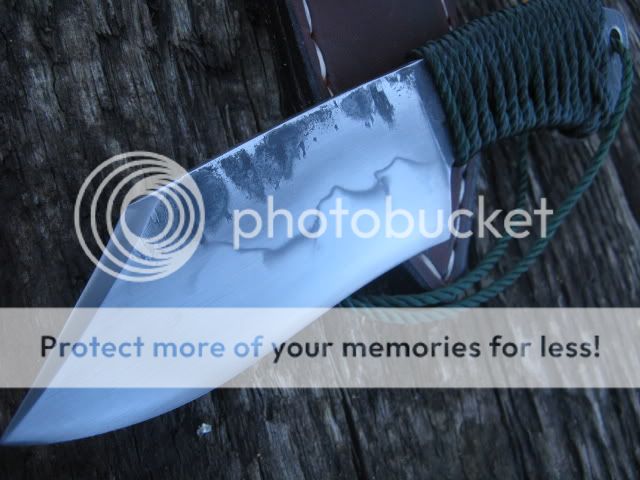
help with temper line etch.

Joined
Oct 13, 2011
Messages
377
I've got a new skinner that I've started and I was wanting to etch the temper line. I hand rubbed the blade to 1500, then heat treated. I'm using warm vinegar and submerging the blade for 30 seconds at a time. In between dips I'm putting it in water with baking soda to neutralize the vinegar. After about 15 dips I polished it with 1500 grit paper and then used 3000 grit polishing compound. I've gotten a very faint kind of "ghost" hamon. Is the hardened area of the blade supposed to get matted by the etch? So many questions. Any clarification would be mucho appreciated.
 
I dont go above 400 grit, I used ferric chloride etchent from radio shack, I mix it half and half with water and rub the blade for a minute of so and then polish, Heres what they look like after, Hope it helps alittle bit?
TretterBladevideos020.jpg
 
What blade steel, and how was it hardened? There is a difference between a temper line, quench line, and hamon.

When trying to polish out a hamon created via clay quench, I sand to 1500, and then etch in dilute ferric chloride for around 15-30 seconds. Vinegar will also work, it just takes longer. You may try longer soaks in the vinegar. After etching, I polish using red rouge (basically iron oxide) shavings dissolved into a shop towel with WD40. This helps gently remove the oxides and bring out some detail in the hamon. I repeat etching and polishing until I'm happy with the results.

For guys just etching a quench line, many just brute force it using a strong etch to get the line to show, forgoing most of the finer polishing because of the lesser activity seen in such lines.

--nathan
 
I harden with a torch, so I get a variable zoned hardening. The differences are very apparent when I'm etching, but most of the color differences go away when I hand polish. Am I going too high in my initial polish?
 
Wow, big thanks to bladsmth and Mr. Wheeler. That video was a huge help. I guess i wasn't letting the blade etch long enough. Next time I will try the ferric chloride.
 
From ALL of my experience...1500X PAPER, will wipe your vinegar etch right off. :eek:

And jumping from 1500X paper to 3000X powder isn't going to get you what you want either. IMHO :) Many folks don't know this (I didn't until I started messing around with them) but powdered abrasives do not cut like paper or stone abrasives. An equivalent grit powder will cut MUCH MUCH finer than its paper backed cousin. If you stop at 1500X paper, and then etch, I'd recommend 1200 or 1500 grit POWDER as your follow-up. Ebay has all these things at your fingertips. ;) :)

If you did a real deep etch with Ferric Chloride, I think you MIGHT be able to follow it with 1500X paper... but I'd still recommend powder, or 2000X paper. And if you use paper after the etch, make only very smooth, LIGHT, single direction pulls... no aggressive back and forth sanding.

I'm not a professional polisher, but I did stay in a Motel 6 next door to a Holiday Inn once. ;) :D

Oh, and you need to remove the oxides BETWEEN each etch. If you don't, then you're not giving the etchant a nice, clean surface to "bite into." :)
 
From ALL of my experience...1500X PAPER, will wipe your vinegar etch right off. :eek:

And jumping from 1500X paper to 3000X powder isn't going to get you what you want either. IMHO :) Many folks don't know this (I didn't until I started messing around with them) but powdered abrasives do not cut like paper or stone abrasives. An equivalent grit powder will cut MUCH MUCH finer than its paper backed cousin. If you stop at 1500X paper, and then etch, I'd recommend 1200 or 1500 grit POWDER as your follow-up. Ebay has all these things at your fingertips. ;) :)

If you did a real deep etch with Ferric Chloride, I think you MIGHT be able to follow it with 1500X paper... but I'd still recommend powder, or 2000X paper. And if you use paper after the etch, make only very smooth, LIGHT, single direction pulls... no aggressive back and forth sanding.

I'm not a professional polisher, but I did stay in a Motel 6 next door to a Holiday Inn once. ;) :D

Oh, and you need to remove the oxides BETWEEN each etch. If you don't, then you're not giving the etchant a nice, clean surface to "bite into." :)


I've followed your etching videos, did you or are you going to do the polishing steps too?
 
So a slurry with the abrasive powder and rub till I'm arthritic, concentrating on the hardened area more...?

How do you tell when you have done enough polishing on that cycle and are ready to reetch and repeat ?

Good question...! Let me know when you find a good answer. :)

Sorry, I have no idea how 3000 grit paper would work... I don't have any. :)
 
I wasn't being smart... I really don't know how to answer. I don't think I've ever done two the same. I've had a couple where I think, "Hmm, not quite there, better etch again." And then feel like I've ruined it after doing another etch.

I don't have any hard and fast rules or ideas about just how to remove the oxides or how you know when you're done. I just dick with it until I think it looks as good as I can make it. And that's always changing too. A blade I would have been ecstatic over just four or five years ago, would be trash worthy now.

There are times I wish I had never gotten into clay hardening, just because it can be so frustrating with so many unknowns and variables. But I love the outcome... when it goes right... so I keep plugging away.

With most things in my knife making like this, where I don't give a concrete answer to a question, it's because I don't know a concrete answer... not because I don't want to help.
 
I cleanex the blade with Windex witb ammonia and noticed that it ate most of the oxides off. Will this damage the blade in any way? If not it seems like an easy way to clean before etching again.
 
Back
Top