Hen & Rooster Vest Pocket Skinner

Joined
Nov 27, 2002
Messages
659
I recently picked one up, great knife, especially for what I payed. It does have a couple of minor F & F issues, the end of the back spring wasn't ground quite right at its end and has slight gaps between it and the scales; and the tip of the blade is just barely below the scales when closed. I have another Hen & Rooster that has the same issue with the tips of its blades. BUT, the real reason I am writing this post is... why doesn't anyone grind blades like this anymore??? Part of why I bought this knife is A. G.'s description, "ground thin...". I prefer my pocket knives to be, well, knives, not pry bars. While it is ground thin, it isn't so thin (at least in my mind) that it is going to be damaged under normal use, it sharpens up great as you are nor removing so much steel and best of all it cuts and slices. So again I ask, don't customers know enough to demand proper edges that slice and can be sharpened easily, or are so many of us asking for tacti-kool pocket chisels to split nails with? Are there any current production companies that grind their knives with thin edges? I leave custom makers out of this as I haven't seen enough of there work to comment on. Rant off...

Q
 
Opinel and the GEC Conductor are about the thinnest blades I own both are amazing slicers.
 
You are correct sir, Opinel does a fine job. Haven't looked at the Conductor, but I have 4 GEC's and those aren't close. Thanks.
 
I have one or two of the old Hen And Rooster knives around, and they are ground very nice and thin. A few swipe on a fine hone and they are scary sharp. But as you say, very few of the modern production knives are still made this way. The old U.S. made Schrade Old Timers were flat ground to a very fine edge, and they had a cult following among legions of hard working blue collar workers in a lot of trades. The Old Timers were good enough for them.

I can only think that the younger generation of knife aficionados demand the so called "hard use" knives that are the current vogue. Cleaver marketing and a lot of hype has convinced the modern knife buyers that this is needed. No matter that reality is not allowed to intrude. No matter that our grandfathers, like their grandfathers before then worked in some hard jobs out on the farm, in factories, in warehouses, on docks, and even out on the range working a herd of cattle. Professional trappers fed the demand for hides with thin bladed knives that worked in any weather out in the field. I guess the modern suburban office cubicle is a hard environment for knife unlike any our grandfathers had to face. Yes, I guess I'm being a bit facetious.

Add in the fact that is is easier for the knife companies to produce these modern knives, and it's a win-win for the knife companies. Like most things these days, style and class has little to with anything. It's all about profit margin.

As for myself, I like using a knife that my grandfather would recognize. I like the old materials like bone, stag, nice wood, and carbon steel. And I like the blade ground thin. My old man once told me that he just wanted a knife to cut something. I guess in his day, a knife was not expected to be driven through car doors, or pry open a tank. It was a cutting tool. Obviously they didn't have a over hyped knife industry telling him he was pitifully under knifed with his little Case pocket knife.

Some of us still like a knife made the old way. There's Case, GEC, not to mention craftsmen like Tony and Reese Bose, and others. But Shrade is gone, as well as Camillus, Hammer Brand, Remington, Ulster, and all the other companies that made great knives in the early 20th century. They died out because of the law of supply and demand. Fewer people demanding a knife made the old way. Over in England, most the old masters and great cutlery houses that put Sheffield on the map, are long gone.

I look at the modern knife industry and just shake my head. I'm not really sure what the heck has happened. But I know I don't like the modern knives either. Maybe that's why I'm sticking to my little Case with the nice flat ground thin blade. I just want to cut something.

Carl.
 
Cleaver marketing and a lot of hype has convinced the modern knife buyers that this is needed. No matter that reality is not allowed to intrude.

One could insert many words in place of "knife" and this statement would be true. Seems like we have more schooling today, but far less thinking.

Q
 
Could not agree more! Thin is the thing :-)

In Theirs, Solingen, Sardinia and a few other traditional knife centres there are still craftsmen grinding them thin. May the lessons of the thin blade find more disciples!
 
Folks, let's keep the threads positive. In Traditional, we talk about Traditional knives, not about how terrible the modern society has become.

There is a Political Forum for posting about the evils of society. Takes $10 per year membership to post there.

 
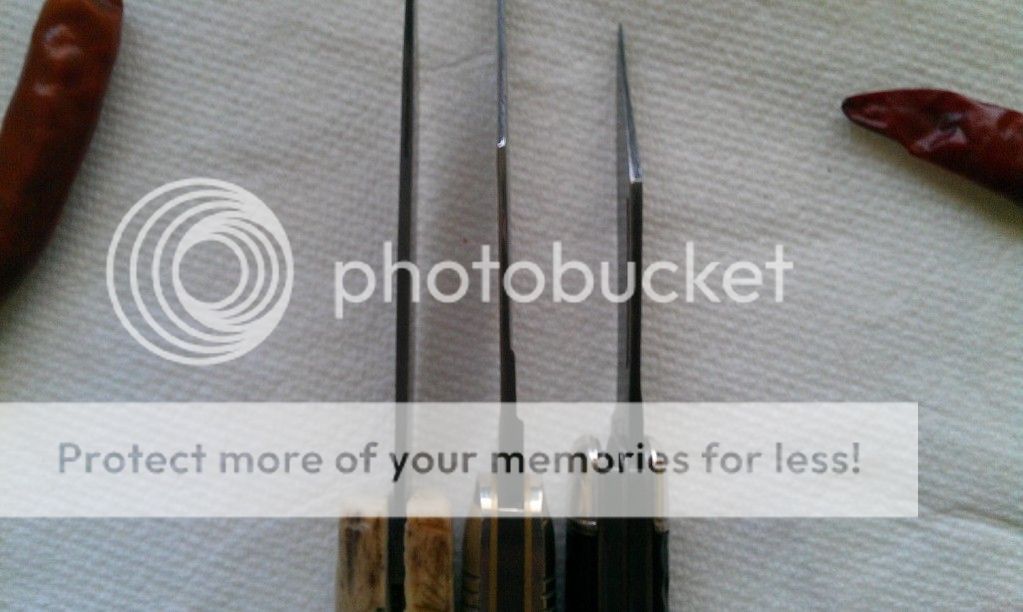
Here are the pics of my thinnest ground knives, Opinel #6, GEC Conductor and Hammer Brand Serpentine Jack/Peanut stand-in (please excuse the oiliness, they're all sitting waiting for their turn at the pocket)
IMAG0270.jpg

IMAG0271.jpg
 
Last edited:
My Queen Classic Whittler and GEC Northfield Clip White Owl have very impressive thin grinds. The Queen is discontinued and I've heard that the grinds on their standard line aren't as thin. I've noticed that the grinds on the Clip blade White Owls has a thinner grind at the tip than the Spear blade White Owls... and that the Northfield Clip has a thinner grind than the Tidioute Clip. The Opinels are great slicers. The polished stainless Opinels, like the Opinels with the bubinga wood or the ebony handles, are extremely thin... probably because of the extra polishing. They're very impressive slicers.

Here's a well shot of the White Owl. I'll see if I can take some scans from the other side of the blade.

0031545.jpg


I've been pretty impressed by the grind on this D2 classic Queen whittler and it got me wondering about the grinds on other Queen knives and knives from other makers. My GEC Calf Roper has a pretty nice grind. I also have a 1970s Case stockman with an impressive grind but I've misplaced it (hope it turns up soon!) so it's not shown in the photos.

Are all the Queen D2 blades ground this thin or is it just the whittler pattern or the classic series? I'm especially curious about the grinds on the amber bone whittler and stockman.

What production knives have the best grinds that you've seen? (aside from Case/Bose collaboration knives ;) )


q-whttler.jpg


grind-1.jpg

left to right: Case Mini Trapper, Queen Whittler

Here's a shot of the spine of the blade. Notice how narrow it gets toward the tip. By the way... I'm not sure why the blade would be crinked in a split back whittler but there's a slight curve in the Queen blade.

Spine:
img286.jpg

left to right: Queen Whittler, GEC Calf Roper

Edge:
img285.jpg

left to right: Queen Whittler, GEC Calf Roper

The Roper has a pretty nice edge though it's slightly uneven at the tip. I haven't tried evening it out on bench stones yet.

img284.jpg

left to right: Queen Whittler, GEC Calf Roper, Schrade 8OT, Case Mini Trapper

It would be best to compare whittlers to whittlers but these were the knives that I had readily available.
 
That's why I like so much the case knives between 60-70's impressive grinds and hand finishing really attending the detail
 
Any chance we could see a pic of that breast pocket skinner.
Being a trapper/fur hunter,,, any time I see the word "skinner" my curiosity is awakened.

PS,,,, I prefer older stuff too, but I live in the past, so it's to be expected. :o
 
Talking of thin blades and impressive slicers: I agree with the White Owl showing prowess in this area (Opinel too it goes without saying). Queen Cutlery's 66 Muskrat-single spring-is another candidate, so too the S&M Half Whittler with Turkish Clip/Cope, the Master on this knife is so thin you can flex it!
 
If you search A. G. Russell's sight for Vest Pocket Skinner, it will come up. He has two versions. I don't know that I will actually use it for skinning as to me it's a bit small, but it makes a great, classic pocket knife.

Also, when I say I like thin, I don't mean the thickness of the blade at the spine, but the thickness right at the edge, the point between the primary and secondary bevel. I also have an old Kissing Crane Whittler that is ground very thin. It just seems to me most knives, even smaller pocket knives aren't ground as thin as they could be right at the edge.

I re-beveled a Russell-Grohmann #1 to thin the edge to about .006"-.008". Turned it into a great knife from just an average cutting tool.

Q
 
Douk-Douk is another one. The spine is a good size but the grind is quite thin. They take a scary sharp edge.

douk-douks-3.jpg

douk-douks-1.jpg

douk-douks.jpg
 
When I want thin which is most of the time, I go with one of my Case knives; my 47 and canoe have wonderful thin blades!
 
Back
Top