Here is one more for the experts

Joined
Aug 12, 2021
Messages
3
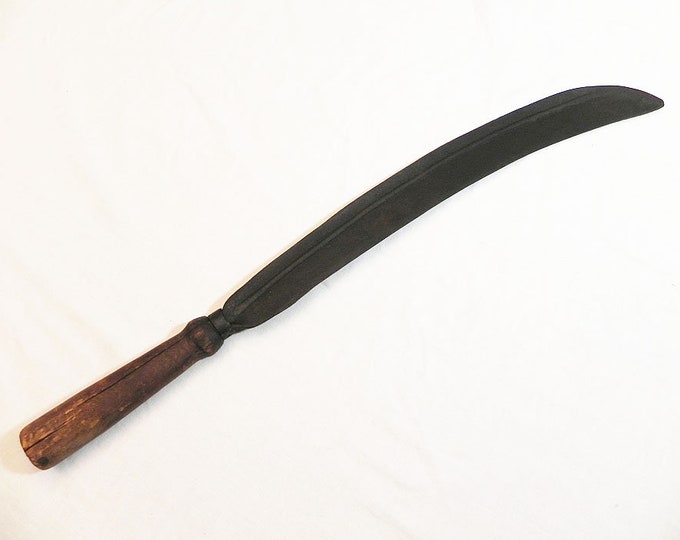
A few years ago while clearing out a detached garage that my wife's grandparents owned in the early 60's, I found this fixed blade knife laying on some old shutters that were up in the collar ties for who knows how long. The house was built in Barnegat Light, NJ in about 1828 or so. It has a long curved, single edge blade about 13" long, despite being in rough shape is almost sharp enough to shave with. The handle appears to be bone, sea mammal I think. It has intricate carvings with acorns. A little history on the area it is a fishing community back in the day. In the 60's boats began long lining for tuna and swordfish. Japanese brokers visited the docks and paid handsome prices for these fish which would be packed in ice laden wooden coffins and air shipped to Japan. Im thinking this blade may have been left behind by one of these buyers.....but wtf do I know? Any ideas?


I also agree. The length and thinness of the blade leads me to believe it is an extra-large fillet knife.
 
Last edited:
And look at the handle, probably designed that way to allow for a sawing motion when slicing through massive chunks of dense tunameat.
 
Looks like a cut down saber blade attached to a cane handle to me. Probably used on fish, but originated as other items.
 
Looks like a cut down saber blade attached to a cane handle to me. Probably used on fish, but originated as other items.
Agree with this. Else there would not be ridges on the blade.
 
It's not a Japanese Tuna Knife.
I agree the blade, handle, sheath probably came from something(s) else.
0Ys8mm.jpg
 
Handle might've came off a cane. The blade could be a reworked sword, corn, or hedge knife.

Antique corn knives -

il_680x540.1912753632_a363.jpg
.

s-l1600.jpg
.

Hay knives, corn knives, hedge, old scythes, etc..... have all been used to make similar over the years. The older ones sometimes have wide sword like fullers, t backs, etc....
 
Last edited:
Back
Top