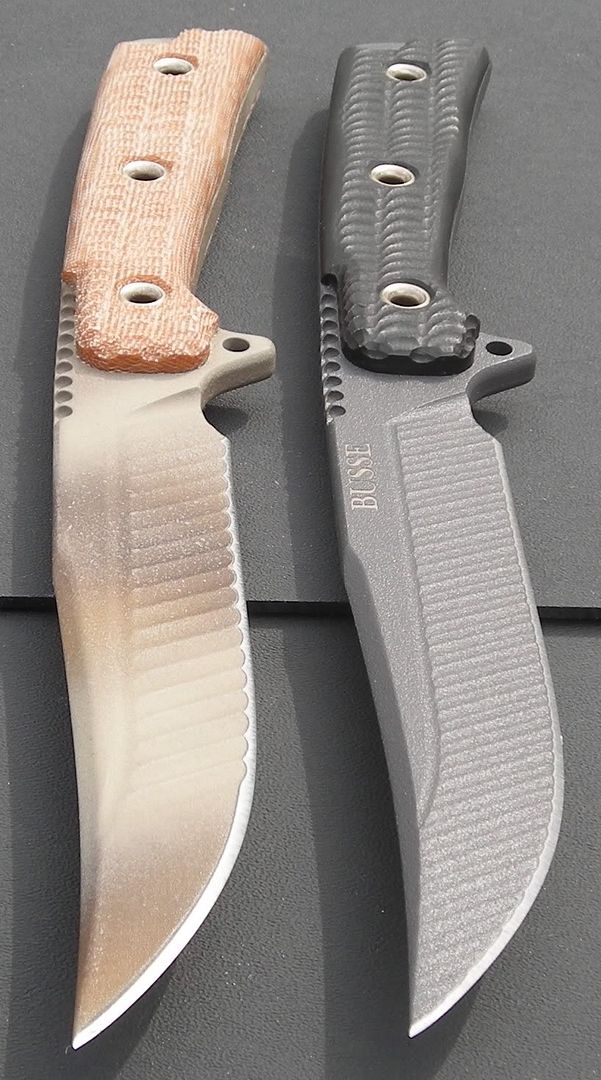
HG55: What are "vents" for on the blade?

The CBTs are to reinforce the metal so that it is stronger with a thinner blade. I think that's what you mean by vents.
 
I believe the Corrugated Bevel Technology was designed to decrease the surface area of the knife contacting the media that is being cut to reduce friction (and look cool).
 
Also reduces the weight while maintaining the strength of thicker stock:thumbup:

Picture044-2.jpg
 
I had a little different take on the corrugations along the HG55 edge. The Corrugated Bevel Technology grooves on blade flats of knives like the original CG FBM run parallel to the edge, which would seem to strengthen the knife’s resistance to lateral force.

The corrugations along the HG55 blade run perpendicular to the edge, which actually could result in a weakening of the edge if not done properly. Like serrations, these could invite stress fractures by concentrating lateral force on the shallow parts of the corrugations and inviting cracks to start. The scalloped ends of the corrugations on the HG55, the score line just above their upper limit, and the “saber” grind thickness above that line all would act to counter any such problem, I’m assuming.

To me, the advantage of the HG55 corrugations is that they seem like they would act as serrations by making material “work” against the edge, enhancing cutting efficiency. They remind me of a Henckels santoku chef’s knife design which is touted for this effect, allowing the blade to cut paper thin slices by the combined effect of making the material “work” more against the edge and by reducing the amount of surface area of the blade flat which contacts the media being cut (reducing friction as squishware mentions above).

From the product description for the Henckels:

“This version of the santoku … has … oval cut-outs along the blade. The benefit to this blade style is that cooks can cut paper-thin slices and individual slices won’t stick to the blade.”

So basically, you would be getting advantages of both a straight edge and a serrated edge on one blade.

Of course, I could also be full of it. :D

Here’s a product photo of the Henckels design:

attachment.php
 
Last edited:
Here's an odd question...what does the HG stand for? Ive only heard people say "Hog" but I dunno if thats right...I mean why abbreviate a 3 letter word. doesnt make much sense.
 
Here's an odd question...what does the HG stand for? Ive only heard people say "Hog" but I dunno if thats right...I mean why abbreviate a 3 letter word. doesnt make much sense.

Hydrolyzed Glutamate, it's a common preservative found in Beer.
 
IMO the corrugations do nothing for strength. What you are looking for to accomplish a higher strength/weight ratio is a fuller.
It should be pointed out that it is impossible to strengthen an object by removing material. You may be able to keep most of the strength while making it slightly lighter, but it will ultimately be a weaker structure in the end.
(It makes me angry when people say they've made something "stronger" by drilling holes in it.)
 
IMO the corrugations do nothing for strength. What you are looking for to accomplish a higher strength/weight ratio is a fuller.
It should be pointed out that it is impossible to strengthen an object by removing material. You may be able to keep most of the strength while making it slightly lighter, but it will ultimately be a weaker structure in the end.
(It makes me angry when people say they've made something "stronger" by drilling holes in it.)

Ah.. but maybe corrugations are actually adding material, to a blade thickness that would normally be at the trough of the ripples. :)
(sort of a half-full/half-empty argument).
 
Back
Top