hidden tang question

Joined
May 25, 2009
Messages
389
I am making a kitchen knife for my mom's fiance. She even paid for a bar of damascus for me to use (thanks to Dan Seaver). the bar is 14" long and I'd like to be able to make 2 knives from it. my question is how long does the tang on a hidden tang knife need to be in order to be strong enough for kitchen work? the knife I'm planning will be a general kitchen utility knife. my mom's fiance is a vegitarian so I'd assume all that will be cut with this knife will be veggis and such so it wont see any realy hard use. would 1" - 1.5" be too short?
Thanks guys
Jason
 
Jason are you forging or stock removal? You have 2 choices, if you forge you can draw out 2" of the billet into as much hidden tang as you wish. The other alternative (it applies to stock removal as well as forging) is to make a stub tang then pin and weld/braze some all thread or steel to give you enough tang to work with.
 
I have seen no kitchen knives with that short of a tang. The ones I'm thinking of were partial tangs, 2-3 rivets, and I'm thinking 2.5" to 3" at least. Maybe, you can get away with that little, buy why try? Why not make one chef and a pairing knife?
I've had some really cheap knives with more than 1.5" of tang, and I would want more out of a quality knife. I'm not against hidden tangs, if done correctly they can be great.
Could you do a rat tail on each knife, and offset each of the blades when you draw them on the steel. Do it so the tangs overlap, does this make sense? Maybe you could get the knives you want, and the length.
 
Thanks for the info guys. I don't forge yet but hope to one day.
I was thinking about adding some extra tang with all thread or something but I have no way of attaching it. My only tools are a drill press and my grinder.
 
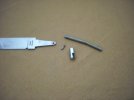
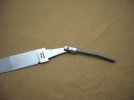
A drill press and grinder are all you to make an extra long tang. Flatten one end of the all thread, grind a slot big enough for the blade tang to go in at least .5" then drill a hole through both. Pein a pin through and voila, extra long tang with thread. Once in the handle the pin won't come out.
 
A drill press and grinder are all you to make an extra long tang. Flatten one end of the all thread, grind a slot big enough for the blade tang to go in at least .5" then drill a hole through both. Pein a pin through and voila, extra long tang with thread. Once in the handle the pin won't come out.

Thats sounds pretty easy so I might not be understanding what you are saying. Do you have a pic of what you are talking about?
 
I do this to many damascus billets.

Take the bar, say it is 1.5X14X1/8". Cut two 5" pieces of 3/16X1.5" mild steel. It can be A36 from the hardware store (plain mild steel), 1070, whatever. I would avoid high carbon steel. Bevel the ends and weld ( or have a friend weld them) the mild pieces on each end. temper the whole thing at 450F for two hours after the weld. File/grind the tang pieces flush with the damascus. Now you have a 26" bar with mild ends. Cut it at a diagonal in the center to make two blade blanks. You can either make a full tang or cut to a stick tang. In either case, place the weld 1" into the handle. It works perfect every time.
 
Here's how I do it. In case you dont know, the little threaded collar is called a rod connector. When preparing it drill the hole first and drill it big enough for an easy slip fit for the pin. If you slot first it may collapse from drilling pressure. Then put it in a vise and slot with a hacksaw and clean it up with a file. Be sure tang is an easy slip fit also. Assemble and pein the pin like you would a guard/bolster. There are other ways but this is easiest for me. Hope this helps.
 

Attachments

  • Stub tang pics 001.jpg
    Stub tang pics 001.jpg
    30.4 KB · Views: 61
  • Stub tang pics 003.jpg
    Stub tang pics 003.jpg
    61.2 KB · Views: 67
I have seen this hinge pin method before and always wondered how strong it is. Any thoughts on comparable strength?
 
Think also of balance, not just of strength. The weight of the tang help to balance the blade.

I cut my blades with 4" tangs laying them out so the tangs overlap, being at the top and bottom edges of the sheet along it's length and right in the middle. The tips of the knives are at each end.

If you can weld you can go less maybe the 1.5 to two you suggest and add length with offcuts or mild.
 
Maybe someone can come up with the shear strength of a 1/8" 416 SS pin. It would be interesting to know. As far as balance there is about as much weight there as there would be with a solid tang. The ones I make like this always balance at or very near the guard.
 
very roughly, 180 lb, .... calculate as 60% minimum tensile strength divided by 3, gives safety margin 1.2, assumes tensile strength of annealed 416 as 75000 psi

...I think... that was the first time I tried calculating it
 
I think the issue with shear strength would be irrelevant since you aren't pulling on the blade. As long as the handle and any guard is tight to the tang, maybe secured with a little epoxy, there should be no worry about the pin itself shearing unless you clamp the blade and pull back on the handle. If the tang is not tight, then constant movement may cause wear at the pin eventually but it should take a while no matter type of steel.
 
I think that the pin is loaded in shear whenever lateral loads are applied to the handle. The tang is the only tensile element in a structure like this, so it gets stretched while one side of the handle gets compressed. Sounds like a 1/8 pin is adequate for normal knife use. Looks like a lot of work to do nicely though, now I want to try it! Thanks for that and the other ideas here.

I've welded to a stub tang and also made handles out of solid aluminum to make up for short tangs. Strong handle materials allow more margin for strength (but 90% of my blades are full tang)
 
I'd like to thank you all for such a wealth of info.
I think I'll go with either Stacy or Darrin's method. the bar I have is a bit over 1" wide by 3/16" thick by 14" long so not much room for laying out my 2 knives in order to cut out with the tangs over lapped. plus I have no way of cutting them out anyway.
 
I do this to many damascus billets.

Take the bar, say it is 1.5X14X1/8". Cut two 5" pieces of 3/16X1.5" mild steel. It can be A36 from the hardware store (plain mild steel), 1070, whatever. I would avoid high carbon steel. Bevel the ends and weld ( or have a friend weld them) the mild pieces on each end. temper the whole thing at 450F for two hours after the weld. File/grind the tang pieces flush with the damascus. Now you have a 26" bar with mild ends. Cut it at a diagonal in the center to make two blade blanks.
You can either make a full tang or cut to a stick tang. In either case, place the weld 1" into the handle. It works perfect every time.
I went ahead and had some mild steel welded onto the bar and now have everything ground outand ready for heat treat. Going to send to Rob! at knifemaker.ca just wondering about the welded area during HT I'm Assuming that since it was recommended from such a reliable source that it will be fine. Should I let Rob know that it's welded together or will it not make any difference?
 
Back
Top