Hidden Tangs and Pins; a Question

redsquid2

Rockabilly Interim Pardon Viscount
Knifemaker / Craftsman / Service Provider
Joined
Aug 31, 2011
Messages
3,121
Looking at hidden-tang knives, I notice some have a pin through the handle, and some have the tang running out the back, either peened or tightened on with a nut. Is it really necessary to have this reinforcement? What about just making sure you have lots of epoxy in the hole, and cutting some notches in the tang?

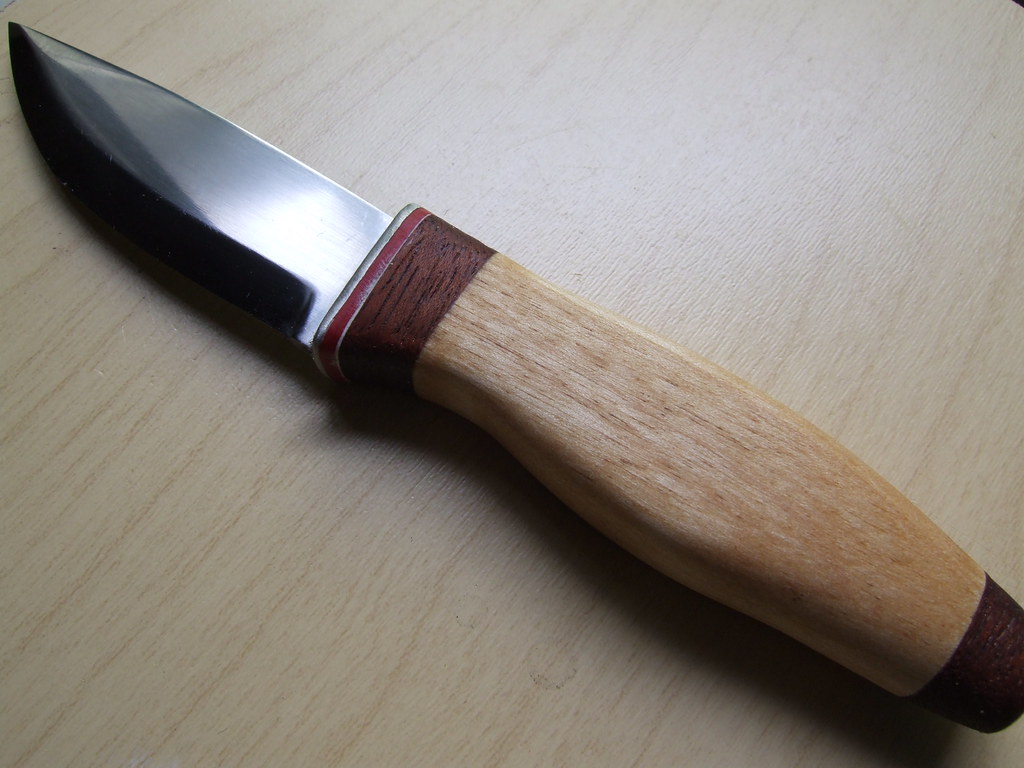
That was what I did with the knife pictured below. I mated my handle mated with a 2 3/4" blade. I figured it would be strong enough, since it will only be used for cutting rope, and slicing cheese and sausage. That's assuming I got enough epoxy down in there. I don't think drilling through the handle is a good idea, since the knife is completely assembled.


Thanks,

squiddy
 
Forgot to post the picture, then went out of town for a long weekend.

6182784139_f51811608b_b.jpg


Thanks for the tip regarding Randall. I am not familiar with them, but will google.
 
Being of a "belt and suspenders" sort of mentality, I tend to either use a pin or a threaded tang/buttcap arrangement. There are some good makers that do things with epoxy and a notched tang only, and I'm sure it's plenty strong if done well. If the handle is on well enough that it has to be ground off or otherwise obliterated to be removed, I'd say it's good enough. If you really want to know, you can always destruction test some pieces.

Pretty little knife you made there.
 
The knife will probably be plenty strong and will last forever for its intended purpose. I'd still recommend pinning the handle or installing a threaded buttcap to make it last 100 years. This is the challenge of knife making . . . You have to put the pinning hole in the blade tang before heat treatment (assuming that it is an air hardening steel), but how do you get the drilled hole in the handle to line up exactly? It makes you think and plan every step.

Mike L.
 
Being of a "belt and suspenders" sort of mentality, I tend to either use a pin or a threaded tang/buttcap arrangement. There are some good makers that do things with epoxy and a notched tang only, and I'm sure it's plenty strong if done well. If the handle is on well enough that it has to be ground off or otherwise obliterated to be removed, I'd say it's good enough. If you really want to know, you can always destruction test some pieces.

Pretty little knife you made there.

Thanks, Salem.

One old knife I guess I already did a destruction test on. Popped the pin out first. Dropped it in boiling water, pulled on it wi vice grips, whacked it on the counter top, boiled it again, but it still took a lot of time and effort. I guess that's my destruction test. :D
 
Many, many scandi's made without peened tang or pinned. Modern glues are plenty strong enough to cope with normal use. If you've ever had to redo a scandi handle because of something that happened in the final stages, you'll know just how strong a glue bond can be. I usually drill a couple of smallish holes in the tang to allow glue to run through the hole, set and then act as a pin.
 
I work this way: during the building of the handle, i fix the tang wedging matches (or toothpick...etc) between the tang and the inside tunnel of the will be handle (taking care of simmetry as much as i can); then i drill the pin Hole in one side of the handle until i dent the tang.......now I remove the tang from the handle piece and, before the heat treatments, drill the hole in the tang; little bigger than the one in the handle, and a bit flared (countered??? i'm from italy sorry for my english). Doing so it's more likely to find the hole in the tang (and pass it through without problems) and drill through the other side of the handle when doing final assemblage. I put also bicomponent glue.
 
I do my hidden tang handles both ways. I like using the pins as a means of keeping things TIGHT and secure while the epoxy sets. I find that if I don't pin the handle I constantly fuss with it while the epoxy sets up to insure it doesn't fall out of alignment or expand (or move in any other unattractive ways).
 
I noticed the same, with the handle trying to swim until it sets (and I prefer long time cure epoxy) :)
I do my hidden tang handles both ways. I like using the pins as a means of keeping things TIGHT and secure while the epoxy sets. I find that if I don't pin the handle I constantly fuss with it while the epoxy sets up to insure it doesn't fall out of alignment or expand (or move in any other unattractive ways).
 
Back
Top