
"High Carbon Steel Myth" -- true?

Joined
Sep 1, 2013
Messages
842
I came across this awhile ago, and was wondering what you might think of this article? Is this information correct?

Here's an excerpt;
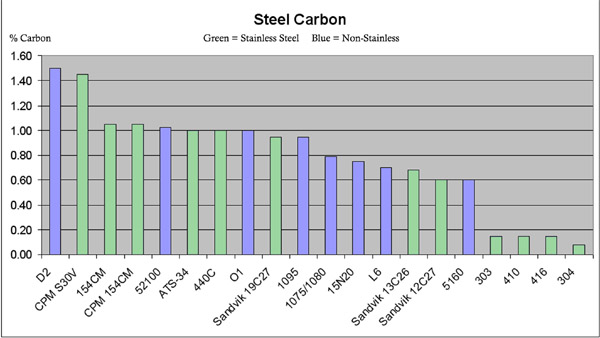
I prefer modern stainless steel alloys for most of my my knives. I will make a knife with pretty much whatever steel a customer prefers, but my personal choices are almost always stainless. One common misconception that I frequently hear is that people think stainless steels contain less carbon that the traditional "carbon" steels like O1, 52100, 1095, or 5160. The fact is that the most popular stainless blade steels are high carbon steels and actually contain MORE carbon than those traditional "carbon" steels.

CarbonSteelChart.jpg


http://www.cartercrafts.com/carbon_myth.htm
 
My understanding (which could be way off) is that stainless steel tends to have more carbon because the added chromium tends to vacuum it all up by forming chromium carbides.
 
Making good quality steel was a black art for hundreds of years! Carbon in the mix is part of the equation for strength and hardness. From what I understand, stainless (by virtue of being an alloy) has a molecular structure/orientation that is not as ideal for creating sharp edges as is conventional carbon steel.
But somebody on here with a metallurgy background will chime in.
 
Labels like "carbon steel" and "stainless steel" are used to classify the performance, and behavior of the steel based on its content. But there is no fine line of distinction. All steels have carbon. All steels can rust.

Someone correct me if I'm wrong, but when you're talking just wear resistance, carbon is the element that matters. Additives used to reduce corrosion detract from its cutting performance and produce a coarser grain structure. That also makes them more difficult to resharpen and they wont take a keen edge easily.

However, modern day metallurgists are able to get very high performance and high corrosion resistance out of very exotic blends of elemental additives. These blends often wont combine uniformly in a molten state so the blend is fused together from a premixed powdered state.
 
Labels like "carbon steel" and "stainless steel" are used to classify the performance, and behavior of the steel based on its content. But there is no fine line of distinction. All steels have carbon. All steels can rust.

Rust is a specific type of corrosion. H-1 is chemically unable to rust because it lacks the compounds to form this specific type of corrosion, it can corrode though.
 
300six, I'm here . For a start metallurgy is only a black art for those who insist on talking about molecules .Metals have metallic bonds therefore have crystals , not molecules ! We have a huge number of stainless steels out there , just pick the one you want.
Jill , normally we see rust as iron oxide .Steels 'rust ' depending on the various alloying elements and the HT. H-1 depends on nitrogen instead of carbon which is why you get corrosion resistance.
 
Back
Top