
- Joined
- May 18, 2009
- Messages
- 1,831
Are grinds like this still ground at a 12.5 degree angle on each side or is it more steep?
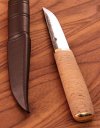

The BladeForums.com 2024 Traditional Knife is available! Price is $250 ea (shipped within CONUS).
Order here: https://www.bladeforums.com/help/2024-traditional/
I'm pretty good at math so I'll try to find a formula or something to go by.
 ), then solve for either the angle or the height up from the edge.
Trigonometry. Tangent (angle) = opposite / adjacent. Opposite side would be 1/2 of the blade thickness (unless you're doing a scandi chisel grind,
I believe I have some reading to do. I'm pretty good at math so I'll try to find a formula or something to go by.
Thanks for the link to the book. I'm downloading a copy now.

All flat grinds that are not reground with a secondary edge can be, for the sake of argument, considered scandi grinds.
When makers start considering the blades they make in terms of angles with specific degrees involved; they are on their way to turning out better blades.

Here it is your calculator, if you have a high grind you could make a consistent secondary microbevel by taping -or shimming as you find easier- the spine (for scandi as for straight razor you must hone flat on the stone). So chech for height of the bevel and thickness of the spine.... better than a protractor
http://www.google.it/url?sa=t&rct=j...sg=AFQjCNH-pihEDb07cfR5oO8m-y6FHIu1Bg&cad=rja
Bye bye
