Himalayan Imports Khukuris

Joined
Aug 20, 2001
Messages
172
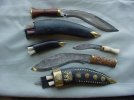
All (3) were bought new from Uncle Bill in 1995, and I am only asking what I paid for them (or something close to it, if possible), shipped anywhere domestic via UPS. All are new and mint with sheaths.

One is a standard British Military Issue w/wood handle.....$100.00

Here's how Bill Martino described the others when I bought them:

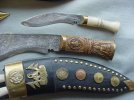
"Small Dhankuta - This khukuri is handled with VERY RARE horn of Nepal's beautiful little spotted deer. Because the horn is so rare, the blade is actually forged to fit the horn. The blade is fully engraved......$325.00

"The COLLECTOR MODEL" - The ultimate artform khukuri, whose blade has been engraved by one of the world-renown Newari engravers of the Kathmandu valley." Blade is fully engraved, horn handle is carved, and the sheath is adorned with coins of Nepal and other brass trim.......$275.00
 

Attachments

  • Khukris - closeup.jpg
    Khukris - closeup.jpg
    42.2 KB · Views: 251
  • Khukris - group.jpg
    Khukris - group.jpg
    37.1 KB · Views: 334
That is a good looking BAS, I haven't seen one with a wood handle before.

Chris
 
Mikey, could you post length and weight, or length anyway? Not of the BAS, the other two. I am assuming the little one is a bilton style about 9" OAL and 6 oz., and the big one is about 15" and 20 oz.

I am guessing that just comparing to the BAS and my own similar knives. (?)

I have seen BAS's with wooden handles, but never one with the old Shop 1 scrolled buttcap. It also does not have the current inlaid sword of shiva or the (new?) style double frog, but it is a real beauty. Std. bolster and no cho creep and well taken care of. Sweet!

Thanks for any info.

Norm
 
Chris and Norm,
The big guy is 15+ inches long and weighs 1#6oz+. The small one is 8-1/2" long and weighs 4.2 ounces.
Any advice about pricing will be appreciated.

Thanks for looking.

Mikey - Littleton, CO
 
Too bad you guys dont live in the third world. the prices your paying for are exorbitant and unheard of here in my country. When I saw a Kukri I liked I borrowed it and had it hand forged for the equivalent of US20 dollars. the blade was stock removed from railway tracks the handle made from carabao(water buffalo ) horn it was tempered and well balanced. While I agree the kukri shown was better looking the funtionality of the hand forged blades made by the smiths in my country are world class very functional with sheaths made from carabao leather. If ever you guys are in this part of the world give me a holler and ill show you what a blacksmith shop in the Phillipines looks like.
 
angelitobarcelon - HI kukris are made in Nepal, in a blacksmith shop with very, very few power tools. :D We're willing to pay real money for HI khuks because they're indestructible and because the kamis (blacksmiths) live in such a poor area. Our dollars give these kamis an income they could probably never hope for by selling knives to their fellows, who are just as poor as they are.

When I consider that I can pay for an HI khuk and get a one-of-a-kind near-indestructible knife AND put a roof over a man's head, food in his mouth, and medicine in his cupboard, all for the same price that I could buy a factory-production knife... well... the choice is simple!
 
angelitobarcelon said:
While I agree the kukri shown was better looking the funtionality of the hand forged blades made by the smiths in my country are world class very functional with sheaths made from carabao leather. If ever you guys are in this part of the world give me a holler and ill show you what a blacksmith shop in the Phillipines looks like.

That sounds like fun. And good to know knives are made the same way there too. If you don't mind, what other kind of blades are local to your area? Got any pictures? Post on the HI forum please. We'd love to have you there.

Andy
 
People who have followed the market on these tell me that the prices now are a lot lower than I paid several years ago. OUCH! Not withstanding the fact that the fancy ones are not that easy to find now, I do have to sell them. I'll post lower prices soon, but if you have an offer before then, don't be shy. You won't hurt my feelings.

Mikey
 
Anybody interested in them at GREATLY REDUCED PRICES!?
$150.00 for the little one with the exotic deer horn handle.
$200.00 for the big fancy one.

Mikey
 
Somebody buy these nice Khukuris please! I should never have looked at that pic - those Khukuris are beautiful!

whitie
 
Whitie,
Thanks for the kind words. It's nice to know the knives are appreciated even if I do have to take a big "hit" to sell them.

Mikey
 
aproy1101 - sorry I was so late to answer I was overseas on a very long business trip. Blades in my country would vary depending on where you get them. In the capital the blades sold to tourists are basically very shiny chrome plated trash, very ornate but non functional. My advice is to stay away from this.

If you go to the provinces the blade quality becomes significantly better since the buyers are not souvenir hunting tourists. buyers are basically agricultural farmers and landowners who demand a blade be both cheap, rugged and functional. Blacksmiths normaly use toolsteel taken from bearings, suspension bars of trucks, jeeps and buses as well as railroad tracks. For cutlery they would use old bandsaw blades they buy from the mill.

Tools used are crude grinding stones some of them not motorized. Instead of a forge it is common practice to use a hole in the ground and then proceed to use coconut husks to heat the metal overnight. Forget about Rockwell C scale testing they dont even have powerdrills. The procedures are passed on from aprentice to master blacksmith ( ussualy father and son ). Finding records on how they actualy make the blades is nearly impossible.

Quality to the end user is very good despite the crude methodology. The blade making practices have for the most part have not changed for generations. The designs have been tested over the centuries and works very efficiently for each designs intended use. The japanese during world war two for example found out the hard way that a barong can lop off a head or appendage with one blow. The number of designs available is too many to elaborate there would literaly be hundreds of variants the most common would be the barong, kampilan, kris,and tabak. Native axes similar to the north american tomahawk was also used by the head hunting tribes in the past.

If you are sensitive about rust stay away from handmades they do not use stainless steel because its difficult to sharpen and the raw material is more expensive than the final cost of the knife. In the jungle rust is not a concern we use a special leaf commonly available to take rust off and besides we dont use the rustly blades for food preparation that comes in direct contact with food so its not a major issue.

Best Regards

angelito barcelon
 
on_the_edge said:
Just FYI, the original post is @ 10 months old.


Yes, but he got it anyways. It was meant to be I guess. The knife musta waited for the right buyer.
 
One thing that might be pointed out is that these are delivered to U:S: client prices .

The other price does not take into account the various costs inherent with Mr. brown shorts delivering the boxed magic we all slaver over .
 
Back
Top