
-
The BladeForums.com 2024 Traditional Knife is available! Price is $250 ea (shipped within CONUS).
Order here: https://www.bladeforums.com/help/2024-traditional/
You are using an out of date browser. It may not display this or other websites correctly.
You should upgrade or use an alternative browser.
You should upgrade or use an alternative browser.
Hit me with your feedback
- Thread starter mpcoppin
- Start date


Stacy E. Apelt - Bladesmith
ilmarinen - MODERATOR
Moderator
Knifemaker / Craftsman / Service Provider
- Joined
- Aug 20, 2004
- Messages
- 38,428
Overall, from what I can see in the photo, it looks like a serviceable knife.
That style is called yanagi-ba. It is a sashimi knife ( not a sushi knife). Yanagi-ba is normally single bevel, but can be made in a Western double bevel grind and would be called a gyuto.
Your handle looks a bit too round and fat in the middle. The blade should have less drop from the spine and more edge rise at the tip.
Handle should be Wa- octagonal
D - oval with a ridge on the use hand side
Oval - oval around a 3:2 ratio.
Here is a classic yanagi-ba:
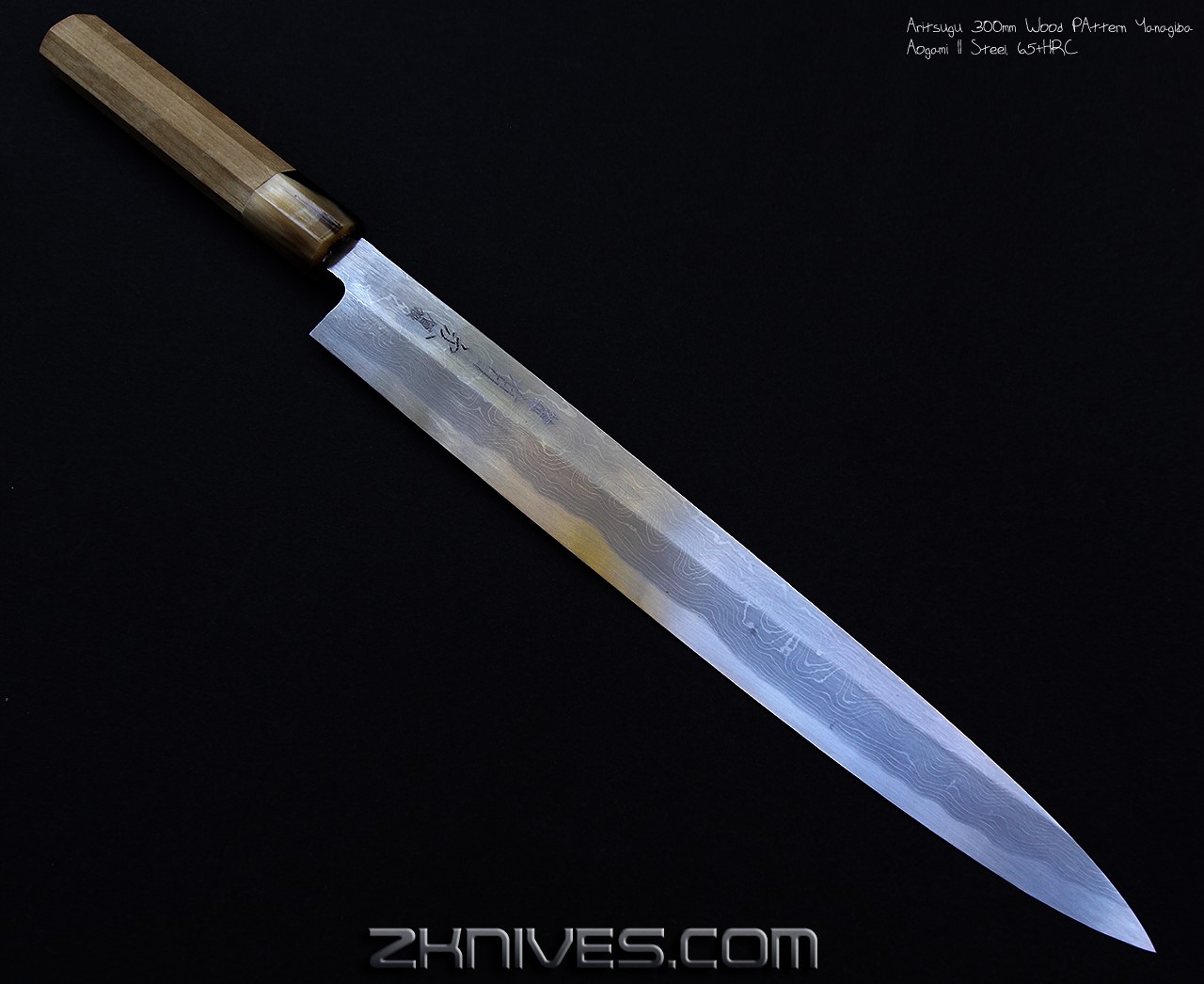
That style is called yanagi-ba. It is a sashimi knife ( not a sushi knife). Yanagi-ba is normally single bevel, but can be made in a Western double bevel grind and would be called a gyuto.
Your handle looks a bit too round and fat in the middle. The blade should have less drop from the spine and more edge rise at the tip.
Handle should be Wa- octagonal
D - oval with a ridge on the use hand side
Oval - oval around a 3:2 ratio.
Here is a classic yanagi-ba:
Your handle looks a bit too round and fat in the middle.
I saw that. I wanted to take it down more but I was afraid I’d start to get into problems of exposing the dowel I used in the middle. Lesson learned.
I know. Get this... The spine bowed on me in the quench. It was straight as an arrow side to side and the blade was clean but the tip took a nose dive and I didn’t want to wreck the whole thing trying to correct it. If you’ve got to have something go wonky in the quench, I’ll take that over a twist or a bacon edge but it was weird.The blade should have less drop from the spine and more edge rise at the tip.
tell us a bit about the blade AND handle.
I started with a piece of 1” x 8” x 3/8” 1084 that was leftover from another disaster. I had to draw it out to about 1.5 x 13 x 1/10. The rest was done on the grinder. The blade ended up about 9.5”.
Heat treat w/ my propane forge and canola oil. Temper in the kitchen oven.
The handle is canarywood & redheart. It’s kind of a square with the corners rounded off. I like a flat top and bottom edge on the handle to index.
The tang is about 3/8” sandwiched between two sides of a 3/8” dowel that I cut a slot into. Then I drill a 3/8” hole down the middle of my handle pieces and glue it all up.
Stacy E. Apelt - Bladesmith
ilmarinen - MODERATOR
Moderator
Knifemaker / Craftsman / Service Provider
- Joined
- Aug 20, 2004
- Messages
- 38,428
Just grind the edge rise up a bit as it approaches the tip. That will change things a good bit.
Don't be afraid to make post-HT corrections.
Saturday I went over to Steve's with Zephen (Steve's step-son/my grandson) and we all forged/ground for eight straight hours. Steve quenched a simple EDC with full tang. It warped. He pulled it out of the oil quickly clamped it in the vise, and grabbed the tang to try and straighten it - PING! - right through the middle rivet hole of the handle. He said a few words, tossed it in the slack tub, and grabbed a new piece of steel. I fished it out when he wasn't looking and reground it to a stick tang. A few other changes corrected some other things at the ricasso and tip that needed to be moved a bit. We welded about an extra inch to the tang and put a sambar stag handle on it. Steve came up with a really cool idea for the butt, added a water buffalo bolster, and steel guard. It is 100% nicer than it would have been before ... and he was going to trash it.
Later on, I was working on a fancy mokume san-mai chefs blade. I accidentally overheated the tip a bit when forging the bevels, and squirted liquid metal from the mokume layer on one side at the tip. When I hardened it, the tip peeled back on that side about an inch. It looked like a ruined knife from some very expensive steel to steve and Zeph. I went to the grinder and ground off the tip, angled the spine down, adjusted the edge curve, and make a bunka-bocho shape. It ended up a much nicer knife when the sides were finished.
Point is, a messed up knife after HT isn't a ruined knife, it is just a knife shaped object that needs a bit of adjusting.
Don't be afraid to make post-HT corrections.
Saturday I went over to Steve's with Zephen (Steve's step-son/my grandson) and we all forged/ground for eight straight hours. Steve quenched a simple EDC with full tang. It warped. He pulled it out of the oil quickly clamped it in the vise, and grabbed the tang to try and straighten it - PING! - right through the middle rivet hole of the handle. He said a few words, tossed it in the slack tub, and grabbed a new piece of steel. I fished it out when he wasn't looking and reground it to a stick tang. A few other changes corrected some other things at the ricasso and tip that needed to be moved a bit. We welded about an extra inch to the tang and put a sambar stag handle on it. Steve came up with a really cool idea for the butt, added a water buffalo bolster, and steel guard. It is 100% nicer than it would have been before ... and he was going to trash it.
Later on, I was working on a fancy mokume san-mai chefs blade. I accidentally overheated the tip a bit when forging the bevels, and squirted liquid metal from the mokume layer on one side at the tip. When I hardened it, the tip peeled back on that side about an inch. It looked like a ruined knife from some very expensive steel to steve and Zeph. I went to the grinder and ground off the tip, angled the spine down, adjusted the edge curve, and make a bunka-bocho shape. It ended up a much nicer knife when the sides were finished.
Point is, a messed up knife after HT isn't a ruined knife, it is just a knife shaped object that needs a bit of adjusting.