Ho do you clean up your flats on a full tang?

Joined
Sep 16, 2002
Messages
1,577
How do you clean up your flats on your full tang knives? Specifically, starting from mill finish of the raw material through flat and ready to mount scales.

I have always done this completely by hand on a flat plate with sandpaper because I have had very limited success making and keeping things acceptably flat on the belt grinder, however I am certain there is a much more efficient method of doing this. Flat platen? Contact wheel? Holding the blade horizontally, or vertically? Grit(s) of belts?

Thanks in advance for sharing your methods!

PS I would guess a disc grinder is probably the best method short of a surface grinder, but I don't have one and won't any time soon.
 
I use a ceramic platen on my belt grinder. It's very easy to round over the edges, so I leave a little extra steel all the way around until I have both sides nice and flat. I hold the blade vertically with a welding magnet. Then I take the profile down to the desired shape, leaving clean square edges all around. Don't be shy with the layout dye or magic marker to help check for low/wavy/weird spots. As for belts I go through the same progression as I do when working on bevels; 50, 120/150, 220 if I have them, 400. Kind of like hand-sanding, I change the angle slightly between grits to see when the previous scratches are gone.

I'm interested in getting or building a good 9" disk grinder but it's not in the budget for a while.
 
We use the large flat plane on our 4X36 sander or the flat platen on the 2X72, then clean up on a granite stone with sandpaper, just to ensure its true before glue up.
 
Ceramic Platen. One advantage of tapering a full tang knife is it is much easier to clean the flats up.
 
Thanks for the info, guys! A disc grinder is not in my future any time soon, but even when I used a friends once I still had trouble keeping things flat.

James, I like your idea of leaving a little extra around the profile. I should have also asked when you do the cleanup...I have always done it as a last step just before HT (bevels ground, profiling complete, tang holes drilled and hollowed, etc.) Perhaps doing this (at least the initial work) first thing right after cutting out the profile would make more sense. I have tried the magnet before, but that was even more unsuccessful for me than holding on with my hands.

Diamond J, how far do you take it on the platen before you switch to the granite/sandpaper?

Tom, I've done a tapered tang before, but I had even more trouble with it than non-tapered tangs.

Keeping things flat, whether by hand or on the platen, has been a long time struggle for me. I sure wish I could figure out what I'm doing wrong!
 
Paul, I generally drill, cut the basic profile, taper/flatten the tang blending it into the ricasso area, then start working on the bevels and clean everything up.
 
Paul, if you can adjust your platen to be a little "proud" of the contact wheels you can sight down the blade and make gentle passes.

Edited to add:

Dykem or marking the tang with a lot of magic marker will help guide your grinding.
 
9 inch disc grinder. Take the flats to 400 grit before I grind bevels. After heattreat back to 220 then all the way to 1000.Buff
 
Hi Will,

I adjusted my platen that way for doing tapered tangs, so I'm set there. I'll try the Dykem...that's one of those things I always forget about, although the scale probably serves a similar function while it's still there.

Since you suggest 'gentle passes', does that mean you are holding the blade perpendicular to the platen?

Sorry for the million questions, guys, but the ability to get things flat on the grinder has eluded me for a looong time and I really want to figure out the right way to do it!
 
Paul,
Yeah, I actually hold the tip in one hand and have a welding magnet on the tang in the other hand. Plunge is perpendicular to the platen... ummm grinding from ricasso to butt.... dunno any other way to describe it :D
 
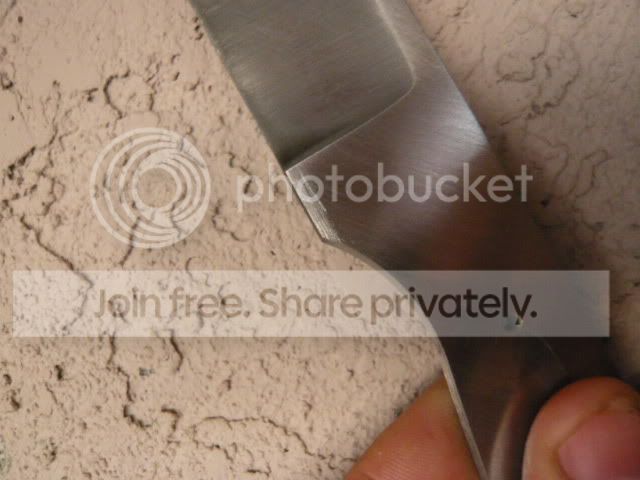
OK, so I gave it a try again and got about the same results that I have before. I held the tip in one hand, and I tried with and without a magnet for the other hand, blank parallel with platen as if tapering the tang. One particular area I've had trouble with in the past is the bottom of the ricasso, between edge and handle. You can see in this pic that I get a low spot there. Since I've seen that before, I biased my pressure towards the opposite side, but it still happened. (This photo was taken after quite a bit of hand sanding post-grinding trying to make it flat again, so it was even worse when it came off the grinder.)

P1020890.jpg


Can anyone tell what I might be doing wrong here??
 
I'm guessing you're applying pressure to that area and it's getting more belt love than the rest of the tang. That or you're applying and removing the tang from the grinder in roughly the same spot. Remember that when you're holding the tip of the blade it's angled, so your blade is probably approaching or leaving the grinder at an angle until you get it on or off the belt.

Easiest way I tapered tangs is to hollow grind the tang, leaving very little material to be flat ground. Flat grinding, as you know, stresses the equipment and belts.
 
I agree with Will , it looks like your approach is off and that section is hitting the platen 1st . Start from the top of the platen and butt of tang , then slide on down keeping even contact .
 
That must explain it guys, because I was focusing pressure towards the other side somewhat.

Thanks for the tip of starting at the top of the platen and sliding down, Jack...sounds like that would help!
 
Easiest way I tapered tangs is to hollow grind the tang, leaving very little material to be flat ground. Flat grinding, as you know, stresses the equipment and belts.

This right here was a huge but obvious breakthrough for me recently. I've had constant trouble keeping tangs flat. I don't do tapered tangs so I just started hollow grinding out the centers a bit or at the LEAST, drilling my lightening holes first. Usually a combination now. It makes a huge difference, particularly because it speeds up any hand powered sanding to finish things. I've also stared being more lazy. Tangs that are being covered do NOT need a pretty finish, in fact it's counter productive in terms of bonding the scales with the adhesive. I don't harden my tangs so I don't do any special cleanup on them ahead of heat treat, just whatever's needed along the way. So they're drilled out, hollowed, whatever, but left fairly rough internally. After heat treat I cleanup with coarse sand paper by hand for the hollowed area, some dremel use with a wire or soft sanding wheel for tough to get spots... A drill or buffer with a wire wheel would work too, but most of my knives are small enough it's not an issue. Then I check flat, quick touch up on the 8" disk sander built into my 4x36 and I'm done. The key is that all I had to flatten was the perimeter, the rest is not touching anything anyway. Much faster, much fewer chances to make an error... I make my errors coming into or out of contact with the abrasive, so the fewer times I need to do that the easier it is to get it right.

I tend to have issues in the same spot you showed, just try to keep it flat when starting and stopping, and use the magnet more than the tip, the tip is just to keep it stable, sometimes on smaller knives I'm JUST using the magnet.

My quality has improved a lot over the past month, and the time and struggling involved has decreased. I haven't been posting much here but it's the stuff I learned here that's finally soaking in and translating into better practices and steadiness. I should have some pics of a few recent pieces available soon. I've got two ready to sell as soon as sheaths come in and two more in process for a customer. So plenty of pics soon.
 
Last edited:
Buy a surface grinder!!!!!! ;) :) :D

No seriously. ;)

The easiest way to do it on a full thickness tang AND get it dead nuts flat is to hollow grind as much of the tang as you can, just leaving the perimeter of the tang at full thickness. THEN go to your surface plate. Don't hold it with your fingers.... make a block with some rare earth magnets embedded in it to hold the blade to the block, and also put a pin in the block so that it catches on one of the pin holes in the tang. Then you can apply very even pressure on the surface plate.

You can do this with a tapered tang too... it's just a little trickier to hold it at the correct angle (but still easier than trying to get it flat with a moving belt on a platen- IMHO) :)

Or buy a surface grinder. ;) :)
 
At the risk of sounding like either a smartass or a dumbass, have you thought about drawfiling?
 
Paul,
I made a 9" disc sander,and set it up with a pulley so it runs very slow.This way i can use fine paper and hold it with bare hands. If you want I will send you a picture.
Rick
 
At the risk of sounding like either a smartass or a dumbass, have you thought about drawfiling?

That's not an either type of "ass" question, but draw filing adds even more opportunities for being out of square than hand sanding on a granite plate. The file ends act as levers..... I quit using a grinder so I do a loooottttt of drawfiling at least until my hammering and sen work improve ;)

A good trick to use with a 9" disk that's horizontal is to use a foot pedal controller. The first guy I apprenticed with used one like that to do his flattening work.
 
Back
Top