
-
The BladeForums.com 2024 Traditional Knife is available! Price is $250 ea (shipped within CONUS).
Order here: https://www.bladeforums.com/help/2024-traditional/
You are using an out of date browser. It may not display this or other websites correctly.
You should upgrade or use an alternative browser.
You should upgrade or use an alternative browser.
Hollow Ground?
- Thread starter newknife
- Start date

- Joined
- Mar 18, 2008
- Messages
- 9,491
Hollow ground is a grind not so much a blade shape. Nothing wrong with it. Some guys like more steel behind the edge as it makes it stronger. Typically hollow ground knives have a thin edge and are great cutters/slicers. Alot of hunting knives are hollow ground. Some makers like Bob Dozier do amazing things with hollow grinds. Use what ever works for you.
Yep, I think it boils down to use. Convex and scandi/flat grind have a bit more steel behind the working edge and therefore tend to make more stout blades, however, in my opinion, all knives are a compromise. The thinner the edge the better slicer/cutter, but more fragile. All depends what you are wanting the blade to do.
Just my .02
Doc
Just my .02
Doc

All the HG ground knives I've used were fine, I have to say for wood work that scandi's are the #$%^.
Put it to you this way.
Hunting knife: Hollow Ground
Bushcraft: Scandi
All rounder: convex, full flat
Some like full flats and convex's for woods work, and they work fine, just a preference for me to use scandi's. Though my convexed RC6 is a mean slicer.:thumbup:
Put it to you this way.
Hunting knife: Hollow Ground
Bushcraft: Scandi
All rounder: convex, full flat
Some like full flats and convex's for woods work, and they work fine, just a preference for me to use scandi's. Though my convexed RC6 is a mean slicer.:thumbup:

- Joined
- Mar 1, 2009
- Messages
- 1,142
Just my opinion, but there's only two good reason for hollow ground blades - cheaper to produce ( I assume, since it's the grind of choice on cheap knives) and weight savings. It's my least favorite grind. The only reason I own any knives with a hollow grind is because I liked everything else about the knife enough to look past the grind. But again, that's just my opinion, ymmv...
..."hollow ground" blades. Why is that?
For the dramatic grind lines, well thats what Bob Loveless says.
Like others have stated, edge geometry is always about balancing strength and cutting ability,
all grind types can be made thinner or thicker, as can the cutting edge itself.
When evaluating a knife I always start by looking at the tasks the knife was designed to do,
a thin bladed slicers will never make a good heavy duty bushcraft tool,
just like a big camp knife will never excel at detail work.
Hollow ground masters like Bob Dozier can make thick hollow ground blades (like his Wilderness model) as well as his more well known ultra-thin skinners/slicers.
Like wise, the Convex Maestro Mike Stewart makes thick workhorse blades designed for serious chopping as well as very fine slicing tools with zero degree convex edges.
All things in knife making are about balancing the factors to create a knife to fulfill certain tasks.
Like I always say, buy a knife from a respected maker that was designed for the tasks you have in mind and you will be happy.
Big Mike
- Joined
- Sep 22, 2003
- Messages
- 13,182
Just my opinion, but there's only two good reason for hollow ground blades - cheaper to produce ( I assume, since it's the grind of choice on cheap knives) and weight savings. It's my least favorite grind. The only reason I own any knives with a hollow grind is because I liked everything else about the knife enough to look past the grind. But again, that's just my opinion, ymmv...
That's me.

- Joined
- Jan 28, 2006
- Messages
- 7,035
I don't care for hollow grind because they cut great -- right up until you hit the transition line from concave to the flat side of the blade. Great for cutting things that aren't very thick, but beyond that. . .

- Joined
- May 17, 2006
- Messages
- 450
For the dramatic grind lines, well thats what Bob Loveless says.
Like others have stated, edge geometry is always about balancing strength and cutting ability,
all grind types can be made thinner or thicker, as can the cutting edge itself.
When evaluating a knife I always start by looking at the tasks the knife was designed to do,
a thin bladed slicers will never make a good heavy duty bushcraft tool,
just like a big camp knife will never excel at detail work.
Hollow ground masters like Bob Dozier can make thick hollow ground blades (like his Wilderness model) as well as his more well known ultra-thin skinners/slicers.
Like wise, the Convex Maestro Mike Stewart makes thick workhorse blades designed for serious chopping as well as very fine slicing tools with zero degree convex edges.
All things in knife making are about balancing the factors to create a knife to fulfill certain tasks.
Like I always say, buy a knife from a respected maker that was designed for the tasks you have in mind and you will be happy.
Big Mike
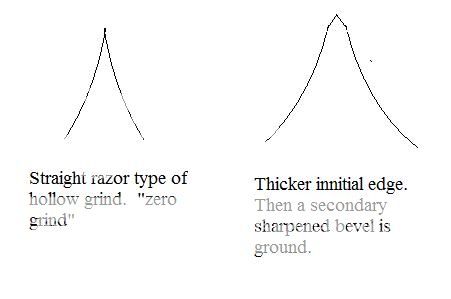
This was very well said. A hollow grind doesn't necessarily need to be "thin" relative to the blade thickness. If you look at some knives that have an unsharpened swedge, they are often hollow ground swedges without a secondary sharpened bevel. For example, a 1/4" thick blade can be hollow ground and left with 1/8" edge thickness before the secondary sharp bevel is ground. It offers a good marriage of weight savings from the hollows and the strength of a scandi secondary bevel.
You can also hollow grind all the way to a "zero" edge leaving the edge at almost an immeasurable thickness before the secondary bevel. Straight razors have this kind of hollow grind. They slice and cut much more efficiently but battoning with a straight razor would most likely result in edge deformity because it is so thin at the edge.
- Joined
- May 17, 2006
- Messages
- 450
Here's what I mean by two different types of edge thicknesses with hollows:

- Joined
- Mar 31, 2006
- Messages
- 823
when spliting wood, after the knife is batoned fully into the wood,I ask because the SOG bowie looks nice. The edge didn't seem to have a problem being pounded into wood. But isn't that where the problem would be with this type of grind?
it is the spine being the thickest part of the knife that does the splitting not the edge. the split usually extend an inch or two past the edge. cutting cross the grain is a diffrent story.
P.S. I keep hearing in WSS&S how weak hollow ground blade's are. IN 40+ Years of knife use i've never broken or seen one broken in use. seen some tips snapped off while people were screwing around but they weren't all hollow ground either. Sorry Rant off

Decent general description/diagram of different types of grinds here-
http://en.wikipedia.org/wiki/Grind
http://en.wikipedia.org/wiki/Grind