
How careful are you to keep the joints clean when cutting w/ your traditional knife?

Joined
Oct 9, 1998
Messages
490
I've been making a lot of fresh smoothies for my kids to drink with my GEC #33 Conductor, and that involves cutting a lot of apples, pears, kiwi, etc.

I try my best when cutting to keep the fruit juices on the blade only, but sometimes it gets into the joint. Because of the carbon steel I can't help myself from immediately rinsing the joint in water, blowing it out, and reoiling with mineral oil.

I'm sure many folks are less concerned than I am, so tell me- how detrimental is it to the joint to let juice or whatever fluids from what you are cutting sit for a day or even longer (gasp!) before cleaning it out?
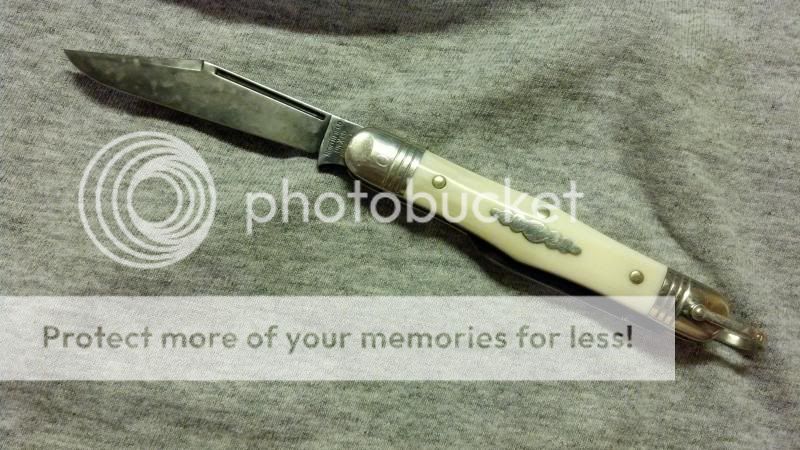
 
I don't worry about it and they do just fine. I oil mine once or twice a week (just one small drop on each pivot) and that's about it. I rarely give them a bath in any kind of water other than just the blade. The blade often gets rinsed with hot water or warm water and dried off.

These old traditionals with 1095 will do just fine. They have done just fine for a hundred years or so.
 
What you're doing is plenty. Oil the joint once a week as said above. One tiny drop in the pivot :)
 
Like stated above. My knife is full of mud and cow manure now and it will work itself out. I usually oil once a month with wd-40 or 3 in 1 oil.
 
I also take a rather minimalist approach, seems OK :o
 
Try a toothbrush with a little dish soap, then mineral oil and the toothbrush to for a deep wash. Or a dry toothbrush to get the lint & gunk out.

Thanks,
 
Wipe it off, a drop or two of some kind of oil once a week, and it'll do just fine. Kind of oil don't matter much. I've used 3-in-1, gun oil, and even a drop or two off a dip stick. All worked.
 
I do my best to keep fruit juices from getting in the joint. It seems like most people here aren't as worried as I am about it, but they might be more used to carbon steel than me.

I've only had carbon steel slip joints for a little over a year.
 
Like stated above. My knife is full of mud and cow manure now and it will work itself out. I usually oil once a month with wd-40 or 3 in 1 oil.

Man, that sounds like the worst smoothie imaginable! :eek: :barf: :p
 
Appears I'm in the middle here - no manure in my knives, but I do oil them when they look dry. As for apple juice, blood from meat, etc., from cutting food, I use the paper napkin and wipe it off when done. OH
 
When enough juice from fruits gets in the pivot, the opening/closing gets sticky, loosing the springy action, and that is when i put the knife in warm to hot soapy water, open and close it a few times, rinse under running warm water, dry it, oil the joints, and back in pocket in goes.
 
When I do processing like the one you told above (cutting a lot of fruits, vegetables etc) I just use some handwarm water when I finished the cutting. When I carry the knife and walk along the oil can - I put a drop of oil inside the joints. Honestly - I don´t care that much, as long as there is still an oil film the pivot and joints get oiled and protected.

Just a drop of oil here and then... that´s it for me.
 
If I get sticky fruit juices up into the joint and liners, I'll usually rinse off with warm soapy water if it's available and dry it out well (paper towel and blowing out the joints), and then try to remember to oil it later. But I usually use a stainless steel knife when I'm going to cut fruit unless I am intentionally trying to get a patina started on a carbon blade. Less maintenance.
 
When enough juice from fruits gets in the pivot, the opening/closing gets sticky, loosing the springy action, and that is when i put the knife in warm to hot soapy water, open and close it a few times, rinse under running warm water, dry it, oil the joints, and back in pocket in goes.

This is my experience as well. I'm less worried about juices, etc causing corrosion; but they definitely can make the pivot pretty sticky. First noticed this on a 'carbone' Opinel that I'd sliced some grapes with. It's sort of a double-whammy, in that the sticky mess in the pivot tends to collect a lot of other junk as well (pocket lint, dust, etc.) which just exacerbates the stickiness. This also happens with stainless folders as well (saw it this morning, in my 'Bucklite' 424, which frequently gets used for apple-cutting chores).

I'm in the habit of wiping down my blades with a little Windex after using them for foods or other wet/messy cutting jobs. Sometimes though, a little juice still gets into the pivots before I can wipe it off. As mentioned above, that's when the knife gets a hot & soapy bath. In some sense, I think using a folder for such jobs is actually better for them, because they tend to get cleaned up more thoroughly, and more often, than they otherwise might be. ;)


David
 
The juice from most fruit will get sticky and gooey when it dries. That is the only reason I would wash it out. But a quick hot/warm water rinse and some compressed air to dry it like you say should be fine.

Then a drop of oil....
 
Try and use something food safe. Some of the recommended oils are not good to consume, which is not an issue if you're cutting rope instead of fruit.
 
How careful are you to keep the joints clean when cutting w/ your traditional knife?

Not very. But, then I don't use my pocket knife for food, because I use it for cutting everything else. So there is seldom any worry about getting gunky up into the pivots and springs.

The most food prep I do is to peel apples when I'm at work. However, the tiny pocket knives I carry at work lead a sheltered existence and are not the ones I carry anywhere else.
 
There is nothing wrong with taking care of your knife, but to me, soaking the thing in water repetitively would potentially be more detrimental than a little kiwi juice. Oiling the pivot should work those things out no issues, and never underestimate the power of a towel, pant leg, shirt, etc etc. Dont get me wrong, if the joint gets sticky you have to work it out, but I still would try oil first. Some folks are purty anal about cleaning their knives (taking apart and what not) but in my time as a knife enthusiast I have never taken a single knife apart just to clean it and only put one solidly rusted up slip joint into water and dish soap. YMMV
 
There is nothing wrong with taking care of your knife, but to me, soaking the thing in water repetitively would potentially be more detrimental than a little kiwi juice. Oiling the pivot should work those things out no issues, and never underestimate the power of a towel, pant leg, shirt, etc etc. Dont get me wrong, if the joint gets sticky you have to work it out, but I still would try oil first. Some folks are purty anal about cleaning their knives (taking apart and what not) but in my time as a knife enthusiast I have never taken a single knife apart just to clean it and only put one solidly rusted up slip joint into water and dish soap. YMMV

  • Use HOT (~120° F) water + dish detergent (Dawn/Ivory/Palmolive/etc)
  • Exercise the pivots in the soapy water
  • Rinse also in HOT water, again exercising the joints. Hot water warms up the internals, which therefore will dry much quicker.
  • Dry all that can be reached by hand, then use WD-40 or isopropyl alcohol to flush out residual moisture from the joints and seams.
  • Lube as needed, if desired.

This is the procedure I use for all my slipjoints (both stainless and not), and it's worked like a charm. No harm will be done to most knives this way, especially if done only occasionally (once or twice a month, or less, as needed). The last part about flushing out the joints and seams with WD-40 or alcohol, after the bath, makes all the difference in getting the moisture out of it. And the hot water rinse really helps in evaporating off water quickly. The only knives I haven't done this to are those with unstabilized wood handles (no issues with synthetics, bone or stag). Even then, if washed/treated like a typical wood-handled kitchen knife, most of those would likely be OK. More so, if the wood handles have been oiled a little bit, on a regular basis.

'Soaking' in water for an extended period of time isn't necessary; the above steps shouldn't take more than maybe 15-30 minutes, and most of that will be in drying and/or flushing moisture out afterwards. The 'wet' steps immersed in soapy water shouldn't take more than a total of 5-10 minutes. What makes the difference is minimizing the wet time; so long as the knife doesn't sit 'wet' and unattended for an extended time, there's very little risk.


David
 
Back
Top