I would say that repeatability is a major factor, too. You need to make knives that look like what people want, and make future knives that look the same.
This is not knocking your knife you showed, but using it as an example:
The edge is sort of all over the place. The heel is way too curved up and the tip seems to com down to the edge and stop abruptly. (get rid of heel and make edge more evenly curved)
The spine suddenly drops down at a curve to meet the edge at the blade's midline. (tip too high)
The handle is lovely wood, but varies from a normal kitchen knife in shape. ( not the biggest issue, but one to look at for future knives)
Thanks all (great comments) -
but I would like to emphasize again that I do not ask this question as to how I can start selling knives - I was just curious how people started down that path - though the more comments that come out the more I think this thread might be useful to some future aspiring maker/seller

I could not agree more wholeheartedly with Stacy that, were one to want to sell, then repetability would be crucial. From the way I see it - you would need to develop a "style" that people recognize and learn to want. Variations on that are possible/likely (a great example of this is Horsewright's collection of knives - a set type of basic design, but many (beautiful) variations on that theme). Though an equally important factor is
time. Working from a basic refined pattern would allow you to relatively quickly punch out knives by working from a template. One-off's (one type of knife at a time like I am currently doing) would take WAY too much time to generate each knife (and like Stacy says - would just confuse or not interest the potential customers). As I am
not selling, this is entertaining to me, both as a way to develop different skills and to explore making different styles.
Stacy - LOL - between you and me (and the rest of the forum
) I really do
not like the profile of that santoku at all. That effort began with a discussion when my son and this roommate set up their apartment, and he pulled out this Kyocera santoku and was talking about how sharp it was (and what all the benefits of ceramic knives were).
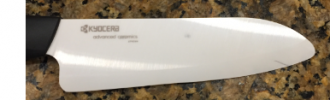
When that knife developed a chip in the edge, I offered to make a "replica" of that knife out of a modern steel so he could get a feel for what can be done with those modern steels. so the profile, including the handle, tip, and blade profile are direct traces of that ceramic knife (and came pretty close to the original in the end, though I had to play some games with the handle because the original was insert molded). The apparent uneven-ness of the curvature of the edge, and the vertical location of the tip are mostly artifacts of the photography. The curvature at the heel IS a mistake: while striving to get that plunge line evened up I thinned the metal in that location too much - hence the curvature there. Like I said in my earlier post - I do (and did) see it ... but curiously my son and roommate see nothing at all wrong with the knife...
(aside, that roommate has just recently taken a materials course that included some metallurgy. Funny enough, even though this whole thing started with his singing the praises of ceramic, and my trying to say - "not so fast, consider what current steels can do" ... when I dropped the knife off with them, he was asking questions like "what steel is it made of", How was it heat treated", "What hardness was it annealed to", etc. go figure.
)
Again folks, please remember that I did not start this thread to ask how I could sell or change what I am doing to be able to sell. It was simply driven by curiosity about how others have come to that point....



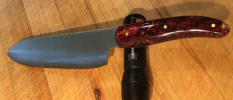


 Now the whole street has knives from me . Many of my friends get something like hunting knives from me .After some years I started getting calls ... Hello ,I'm relative to your neighbor Miki ....can you make same knives as his to me ??? Hello ,I'm friend to your neighbor ......I want same knife if you can make one ?


