Perhaps this is not the proper forum, but since it's a question regarding my GEC Premium Trapper I thought I'd start here.
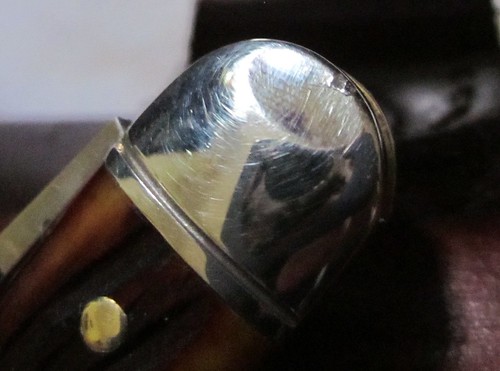
A little over a week ago I purchased my first GEC knife--a lovely #48 Tidioute Dogleg Jack in amber jigged bone. I really like it and have been carrying it every day since. The knife is lovely and well made and I'm sure I'll be adding many more GEC knives in the future. However, there is a very minor detail that makes me a little fussy. (Full disclosure, prior to reading these forums, I doubt I would have ever even noticed this issue.) Where the bolster meets the bone on one corner, the bolster sticks ever so slightly above the bone. It's nearly impossible to see, but running your finger over it, you can feel where the bolster corner sticks above the scale. There's no way I'm sending it back because it's such a minor issue, but I'd like to fix it.
I'd just like to sand it down so it's even. I really like the knife so I don't want my efforts to fix this to damage it. I assume I can just grab a few grades of sand paper and delicately sand the offending corner, but I'm not certain. I don't want the bolster or the bone to look all sanded up when finished.
So, what's the best way to fix this? What grit should I plan on starting and ending with? All advice will be appreciated.
Thanks.
A little over a week ago I purchased my first GEC knife--a lovely #48 Tidioute Dogleg Jack in amber jigged bone. I really like it and have been carrying it every day since. The knife is lovely and well made and I'm sure I'll be adding many more GEC knives in the future. However, there is a very minor detail that makes me a little fussy. (Full disclosure, prior to reading these forums, I doubt I would have ever even noticed this issue.) Where the bolster meets the bone on one corner, the bolster sticks ever so slightly above the bone. It's nearly impossible to see, but running your finger over it, you can feel where the bolster corner sticks above the scale. There's no way I'm sending it back because it's such a minor issue, but I'd like to fix it.
I'd just like to sand it down so it's even. I really like the knife so I don't want my efforts to fix this to damage it. I assume I can just grab a few grades of sand paper and delicately sand the offending corner, but I'm not certain. I don't want the bolster or the bone to look all sanded up when finished.
So, what's the best way to fix this? What grit should I plan on starting and ending with? All advice will be appreciated.
Thanks.