How to finish a (curved) soldered guard?

Joined
Aug 16, 2013
Messages
131
I have searched and can't find topics on the cleaning up of a soldered guard.

Usually I finish the blade and guard before soldering. The ricasso is satin finished in the same direction as the satin finish of the blade.
The guard is mage of copper. The back of the blade and the ricasso have been tempered back to blue to increase the toughness of the blade and be able to file the tang shoulders.
There is seldom clean up necessary.

With this one, the solder was flowing. I had put a stainless steel pin in my flux.
I used the pin to spread the solder without letting the flux drip off.
The solder flowed as wide on the guard as the amount of flux allowed it to flow, foo far...
Won't make that same mistake again.

Now my first question.
How can I clean up the curved guard and ricasso of the knife?
For the moment I have no idea and can't find any answers to finish the solder joint without messing up the rest of the finish.
How do you clean it up, which techniques and tools do you use?


My second question.
How do you finish the solder joint on a knife with a flat guard.
I can sand the guard next the ricasso and the guard at the front and back of the blade. But the scratches always overlap.
How to get a uniform finish on the guard?


xGIwv1fundefined.jpg
xGIwv1f.jpg


8S1Q33m.jpg

8S1Q33mundefined.jpg
 
Last edited:
Do you have any thicker brass round or square stock? File a piece that’s around 6” or so down to an edge and scrape along the solder. The brass should be a tad harder than the solder but not as hard as the steel as to scratch it.
 
Do you have any thicker brass round or square stock? File a piece that’s around 6” or so down to an edge and scrape along the solder. The brass should be a tad harder than the solder but not as hard as the steel as to scratch it.

I forgot to mention in my initial post and will edit it.
The guard is copper. The back of the blade and ricasso have been tempered back to blue to increase the toughness of the blade and be able to file the tang shoulders.
I'm afraid I'll scratch the copper guard with a brass chisel.
 
I think it's a little late for JB weld. The guard is soldered on.
When soldering joints like this, you can use a soft lead pencil to mark where you don't want solder to flow.
 
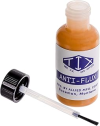
Yes, a lead pencil or anti-flux. Anti-flux is a mixture of yellow ochre and water. TIX makes a good anti-flux. Runs about $10 a bottle, which will last many years.
1773742084410.png
 
I wonder…could you warm the solder back up and gently run a piece of copper that’s been filed to a point along the seam to clean it up? Not to the point the solder is liquid but where it’s cloudy right before it looks glassy
 
OK, I'll tell you what you don't want to hear.

Unsolder the guard, sand everything clean and solder free, apply anti-flux on the face side, and resolder with much less solder. It only takes a tiny bit to fill the gap it the metal is clean and the joint reasonably tight.

BTW, TIX is one of the easiest solders to use on guards. It is in thin sticks. Sometimes I pound one flat to make it even thinner so I apply less solder.
 
Use a copper chisel.

I hadn't thought of this. Excellent idea. No risk of scratching the copper guard that way.

I think it's a little late for JB weld. The guard is soldered on.
When soldering joints like this, you can use a soft lead pencil to mark where you don't want solder to flow.

Yes, a lead pencil or anti-flux. Anti-flux is a mixture of yellow ochre and water. TIX makes a good anti-flux. Runs about $10 a bottle, which will last many years.
View attachment 3134985

Excellent tip. I had no idea a pencil would work or antiflux existed. This will prevent similar problems with future knives.
 
OK, I'll tell you what you don't want to hear.

Unsolder the guard, sand everything clean and solder free, apply anti-flux on the face side, and resolder with much less solder. It only takes a tiny bit to fill the gap it the metal is clean and the joint reasonably tight.

BTW, TIX is one of the easiest solders to use on guards. It is in thin sticks. Sometimes I pound one flat to make it even thinner so I apply less solder.

Sadly the knife has been completely assembled and peened.
I used a minimum amount of solder.
I live in Belgium. The solder I use is Griffon Resist-2.
It is a tin-silver solder that is used for soldering water pipe, that comes in a set with the correct flux to go with it.
I hammer the solder flat and cut of small pieces with scissors.
The amount of solder is not the problem. But it seems that the extra flux I used when the solder was flowing, diluted the solder and flowed over the guard.

All instruction about soldered guards I find are straight guards that are polished on a polishing wheel after soldering.
I don't think it's possible to use a polishing wheel on a curved guard, so I'm looking for a different solution.
 
I've used gel super glue as an antiflux (never heard that term before). It burns off during soldering and the residue is easy to pick off with brass or copper chisel. I've even gotten most of it off with a wooden toothpick.
 
Back
Top