How to perform a high temper

Joined
Apr 27, 2009
Messages
991
I am making some test blades in M2. They receaved 5 minutes at 2200 degrees followed by a plate quench and into LN within 10 minutes. I forgot about them so they got about 46 hours of LN. I'm going to try one blade with a high temper. It's in the oven now for 2.5 hours at 1000 degrees. According to the AKS info it gets LN after this as well. I'm a little fuzzy about what comes next. Do I keep at the 1k tempers or do I drop back to 400?

The other blades i am starting the first temper at 400 degrees. Does that sound reasonably? Is there any other tempers i want to try? I still have more M2 are there any heat schedules that I should try?
 
You would stick with 1000f tempers. But the whole idea of LN2 is primarily RA conversion, of which the high heat tempers accomplish, and also "eta" carbide precipitation, to which I understand are negated by the high heat tempers (which form their own carbides, larger carbides) The ideal would be to quench, LN2 soak, temper 400f, LN2 soak again if desired, 400f temper, 400f temper.

Or quench, 1000f temper, 1000f temper, 1000f temper.
 
B
You would stick with 1000f tempers. But the whole idea of LN2 is primarily RA conversion, of which the high heat tempers accomplish, and also "eta" carbide precipitation, to which I understand are negated by the high heat tempers (which form their own carbides, larger carbides) The ideal would be to quench, LN2 soak, temper 400f, LN2 soak again if desired, 400f temper, 400f temper.

Or quench, 1000f temper, 1000f temper, 1000f temper.
I'm trying to do the test to find out what one is better for M2. I have heard rumors that the RA is pretty bad with M2.
I'm going to assume that if the test blade is chippy then I will move to a 1100 temper and so on?
 
Ra is extremely bad with M2 so yeah I would experiment with a Sub-Zero quench. A relatively fast quench will help too.

A typical M2 heat treat is about 20% ra after three 1000 degree tempers

you may find your peak secondary hardening at 950, or 975, or 1000, or 1025, dialing in the secondary hardening can be tricky

if it's too chippy a higher tempering temperature might help that, but a better option might have been to use a lower austenitizing temperature
 
Ra is extremely bad with M2 so yeah I would experiment with a Sub-Zero quench. A relatively fast quench will help too.

A typical M2 heat treat is about 20% ra after three 1000 degree tempers

you may find your peak secondary hardening at 950, or 975, or 1000, or 1025, dialing in the secondary hardening can be tricky

if it's too chippy a higher tempering temperature might help that, but a better option might have been to use a lower austenitizing temperature
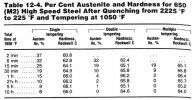
A typical 1050°F double or triple temper largely eliminates all of the retained austenite:
M2 tempering.jpg
 
A typical 1050°F double or triple temper largely eliminates all of the retained austenite:
View attachment 1032647
So far I'm at 2200 and plate quench, cryo, 1000 temper, cryo. I will just finish up the next 2 2.5 hour tempers.
Per your cart this should put me close to 66Rc. If its chippy at that hardness what do I adjust.
I also have the low temper options. Is there a way to predict if there will be a RA issue with those?
 
A typical 1050°F double or triple temper largely eliminates all of the retained austenite:
View attachment 1032647

I wouldn't be so sure about that. This might be old information here, how old is this literature?

I'm working right now but when I get chance I'll dig out some specific information for this thread, but I'm pretty sure that M2 is typically 20% RA in the finished fully heat treated tool. The application of x ray crystallography has changed some of the perceptions about RA but isn't widely available in some of the older texts.
 
I wouldn't be so sure about that. This might be old information here, how old is this literature?

I'm working right now but when I get chance I'll dig out some specific information for this thread, but I'm pretty sure that M2 is typically 20% RA in the finished fully heat treated tool. The application of x ray crystallography has changed some of the perceptions about RA but isn't widely available in some of the older texts.
I look forward to the reference. X-Ray diffraction is the oldest and most common measurement method for retained austenite, including with old literature.
 
If I have no RA what would be the disadvantage to high temper?

Loss of eta carbides (lack of clarity on benefits/costs), precipitation of secondary carbides, which in other steels such as 3v, cru-wear, or V4e results in mushy edges, even though wear resistance is increased. You also get less stain resistance with high temper.

The primary benefit of low temper is fine edge stability (and overall toughness), and better stain resistance is the secondary benefit. You give up some wear resistance to get this.
 
If I have no RA what would be the disadvantage to high temper?

The little bump in wear resistance due to the additional secondary carbide does not widely translate into better edge retention in steels in secondary hardening. In many steels the advantage to avoiding secondary hardening is enhanced edge retention due to improved edge stability. In many steels (M2 may or may not be one of them) if you can address RA and avoid the edge stability problems caused by it you'll avoid some of the mushy crumbly edge seen in the high temper.
 
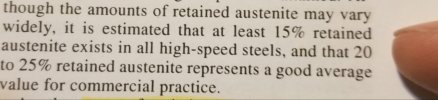
I spent over an hour digging though my books and didn't find the specific reference I was looking for. It's possible it's not even in my literature and I've seen it on line but I recall reading that an industry standard heat treat for M2 (does not include cryo, does include three ~1000 tempers) leaves about 20% retained austenite in the finished tool (endmill or drill etc)

This note, from current literature, comes pretty close to that:

20181207_091820.jpg


I have noticed that references created in this century frequently give higher retained austenite estimates than older 20th century texts on the same alloys and the reason for the discrepancy being improvements in the techniques (x ray crystallography) used to measure it. For example I could probably find a reference for D2 showing perhaps 5% in a particular scenario in an old book but perhaps twice that for a similar scenario in a more current book.

So we have a fellow (the OP) ask about heat treating M2 and using LN. I point out that M2 is particularly bad about stabilized retained austenite. The alloy is one of the worst, in that regard, that a knife maker is likely to come across. So I point this out and suggest he experiment with a sub zero quench and a relatively fast quench. These are common sense measures a person can take to reduce this problem and would be low hanging fruit for anyone using M2 in a knife.

You present an excellent table specific to M2 that contradicts the need for this. Given what I've seen in reference to discussions about RA in texts from different time periods I was (and am) a little skeptical about this, but I differ to your greater knowledge about the subject matter.
 
Perhaps the commercially produced steel uses few tempering cycles or short tempers; don't know. X-ray diffraction was discovered in 1912, and major studies on steel with XRD started in the early 1920's. The fundamental capabilities of the equipment haven't changed substantially in many decades. There's no reason to distrust something just because it didn't come out after 2000.
 
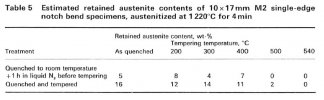
Here is a 2001 paper on M2 showing ~15% RA after a double 1h temper at 540°C (1000°F), and ~7% with double 1h temper at 570°C (1050°F): http://mit.imt.si/Revija/izvodi/mit015/leskovsek.pdf

Hey I'm out in the shop on my phone I can't really see this very well, could you give me a brief synopsis, does this newer information contradict the older tables, I'm just curious?
 
Hey I'm out in the shop on my phone I can't really see this very well, could you give me a brief synopsis, does this newer information contradict the older tables, I'm just curious?
The closest 1:1 comparison would be with the double 1h temper at 1050°F. The old table shows 4% and this paper shows 7%. Pretty close I would say.
 
I spent over an hour digging though my books and didn't find the specific reference I was looking for. It's possible it's not even in my literature and I've seen it on line but I recall reading that an industry standard heat treat for M2 (does not include cryo, does include three ~1000 tempers) leaves about 20% retained austenite in the finished tool (endmill or drill etc)

This note, from current literature, comes pretty close to that:

View attachment 1033241


I have noticed that references created in this century frequently give higher retained austenite estimates than older 20th century texts on the same alloys and the reason for the discrepancy being improvements in the techniques (x ray crystallography) used to measure it. For example I could probably find a reference for D2 showing perhaps 5% in a particular scenario in an old book but perhaps twice that for a similar scenario in a more current book.

So we have a fellow (the OP) ask about heat treating M2 and using LN. I point out that M2 is particularly bad about stabilized retained austenite. The alloy is one of the worst, in that regard, that a knife maker is likely to come across. So I point this out and suggest he experiment with a sub zero quench and a relatively fast quench. These are common sense measures a person can take to reduce this problem and would be low hanging fruit for anyone using M2 in a knife.

You present an excellent table specific to M2 that contradicts the need for this. Given what I've seen in reference to discussions about RA in texts from different time periods I was (and am) a little skeptical about this, but I differ to your greater knowledge about the subject matter.
Lol. I fat fingered the post botton.
I have made 5 blades so far. The first I got something transposed in my brain and did 1975 with 400 degree temper and cryo though I didn't get it into cryo right away so it's not a reliable tester. This last batch of 4 I pulled one out to try high temper. The others are all 2200 and straight into cryo. As I keep working on this besides doing a lower austenizing temp is there anything else I can try like a prequench?
If anyone is interested in this steel I can make some coupons with my next round of testing.
 
Last edited:
We are talking about tempering here but I think you should experiment with lower aus temps. For knives you will gain some toughness and lower retained austenite with lower austenitizing.

Try 2100-2150f


Hoss
 
Back
Top