How tough is the average traditional folder ?

Joined
Nov 25, 2006
Messages
7,039
Good day gentlemen. I am finding traditional folders to be increasingly attractive. I realize that these are light to medium use knives for day to day tasks. But I was wondering how the average, no specific make or model, traditional folder would stand up to side loads etc. for feather stick making. Is this going a bit too far ? B.T.W. I really enjoy your traditional folder picture threads. :thumbup:
 
I think you'll find that the average slip joint is way tougher than you may think. People as far back as the 1800's used them for everything from farming, working cowboys out in the middle of nowhere, sailors on square rigged vessels making the China trade run, trappers, and many more sorts of working men, under less than ideal conditions. Many of the traditional knives are named for the trade that gave birth to them. Trappers, sodbusters, stockmen, harness jacks, electrician knives, to name just a few. Something as mundane as a feather stick is not even trying hard. In fact, with the thin flat ground blade, a small traditional pocket knife may well be easier to use than a modern.

Carl.
 
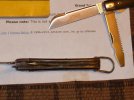
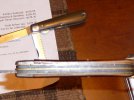
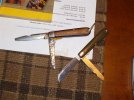
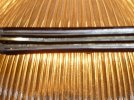
Some models don't seem to hold up as well to serious strong arm use over time as others but others endure it even if they do show it as is plainly displayed here in my second oldest folder a Boker Electricians from, well, 44 or more years ago I figure but that could just be some wishful thinking on my part, its probably longer! :eek: I've had it a while and its been worked from when I was a kid to becoming a cranky old man. I remember sticking this in trees throwing it as a boy! Its how the blade got just a bit shorter but it still cuts up a storm and works even if it has been replaced. Hopefully this here new one I have from GEC now will survive long enough to carry me the rest a the way through this life now. Took me a while to learn it was the electricians I was actually beatin up an using but every one I had had serious use so I finally just put one in my pocket for good.
 

Attachments

  • P1000632.jpg
    P1000632.jpg
    59.4 KB · Views: 87
  • P1000635.jpg
    P1000635.jpg
    61.3 KB · Views: 88
  • P1000637 (Large).jpg
    P1000637 (Large).jpg
    71.5 KB · Views: 110
  • P1000634 (Large).jpg
    P1000634 (Large).jpg
    89.4 KB · Views: 81
I think you'll find that the average slip joint is way tougher than you may think. People as far back as the 1800's used them for everything from farming, working cowboys out in the middle of nowhere, sailors on square rigged vessels making the China trade run, trappers, and many more sorts of working men, under less than ideal conditions. Many of the traditional knives are named for the trade that gave birth to them. Trappers, sodbusters, stockmen, harness jacks, electrician knives, to name just a few. Something as mundane as a feather stick is not even trying hard. In fact, with the thin flat ground blade, a small traditional pocket knife may well be easier to use than a modern.

Carl.

i wonder if they did any spine whacking back then. :p
 
I've used this Ulster scout very hard for over 50 years now, and I only had to squeeze the main's pivot in the vice just a little bit about 7-8 years back to snug it up a little. The scratches on the spear main give some indication of how this knife gets abused, but it's still hangin' in there.

HardWorker_zps04053d83.jpg~original
 
I'd think it's more about technique than blade choice. Any knife can make a featherstick. You could even use the lid of a soup can.

Personally I'd think a Opinel would be a good choice. It's a thin, sharp blade, that can be locked open (in some of the larger sizes) allowing for the use of both hands. Plus they are rather inexpensive, so if it does break, it's not such a loss.

But if you are a hamfisted type person, you might be better off with an axe
 
They aren't pry bars if you keep that in mind you are golden. I really appreciate slipies for their compactness. I also split wood with a hatchet and a hammer and not a knife and a log or better yet a pneumatic log splitter if I could ever afford one or had a need. The tough knives are cool but all in all their needs are largely manufactured for recreational wilderness fun which is totally OK by me. For me I prefer the thin blades of traditional and a nice spyderco or benchmade here and there and that's enough for my needs. Different strokes for different folks! I'm on the hunt for a Ti framelock and a tiny fixed blade even though I don't need them lol.
 
I will tell you that Sodbusters, Large Stockman, full sized Trapper, Moose and TL-29 patterns are some of the burliest folders out there. Then add the Buck 110 and other classic American Lockbacks and there is a whole other stable of tough built folders. Heck even the Opinel #6 and up feel really sturdy when locked. Many modern folders are overbuilt and do not cut and slice with any finesse compared to Trads.
 
Thank you all, I appreciate the input. I really see little reason not to go this route now. It will be more or less coming full circle as these were what I carried as a youngster. But back then, every farmer had one in his pocket. :) I will simply use a more robust tool for a heavier application.
 
I have found mine to be extremely tough. The worst that I have seen is a pin come loose which you can easily fix. Even though loosing pins may seem 'weak' I don't look at it that way. They are as tough as the materials they are made from :)
 
Good day gentlemen. I am finding traditional folders to be increasingly attractive. I realize that these are light to medium use knives for day to day tasks. But I was wondering how the average, no specific make or model, traditional folder would stand up to side loads etc. for feather stick making. Is this going a bit too far ? B.T.W. I really enjoy your traditional folder picture threads. :thumbup:

If your knife is sharpened for wood working and you know how to use it there will be no side load.

If you hold the knife by the handle and hack away at the stick prying and levering the blade around the pivot will likely come loose on a typical nickel silver bolster pinned pivot traditional.
 
I will get whipped like a wog crossing the line for saying this, so here goes nothing. I've abused a few of my working knives and they've held up well. I know the day will come when something breaks and I'll swear. For some reason I enjoy pushing the limits.
Respectfully, Chance.
 
I think this depends on your technique for feather sticking and making shavings.

If you work slowly and deliberately, you'll avoid most side loads. But if you're making shavings quickly and forcefully using one of several recognized strong techniques that assume a fixed blade and if you then hit a knot, I could see tweaking a plain, peened pivot slip joint. Heck, I've done it on a few occasions roughing out some work.

Usually you can correct minor wobble by pressing in a padded vice.

But if feather sticking is something you do a lot of, strongly suggest a $15 experiment with an Opinel for two reasons.

Opinel by Pinnah, on Flickr

One, the Opinel's rivet isn't filed flush so it much tougher in terms of resisting blade play of any kind. Much, much tougher than any slip joint or lockback I've owned by a long shot

Second, the thin convex blade excels and making feather sticks and curly shavings. Honestly the best blade I've found for this.

Third (who's counting?) the round handle doesn't produce hot spots under heavy use.

Fourth (I'm on a roll), you can baton with it within reason.

I'm in the process of learning my new Emberlit wood stove. For me, learning a new stove means making tea on it several times a week for a month, regardless of the weather. Today's weather was a long night of soaking rain so the midday tea required a lot of shavings and splitting several two-finger sized sticks down to a size that would fit into the stoves feeder hole.

I used my Opinel 9 and have been just to convince myself that it's all I really need to prepare kindling for the miserly stove.

The trick for batoning with the Opinel is to leave the ring undone so it pivots freely.

Oh, the tea was PG Tips, which has rellaced King Cole as my go to tea. Quite nice.

Last note, if I were to go with a slip joint for this, I would look at a large sodbuster which a really burly joint. I would avoid anything with a hollow grind too.

 
Last edited:
Solid advice from someone who knows what he's talking about. Sometimes rare in these parts.
 
One nice things about slipjoints, at least in my opinion, is that they sorta dictate to you how hard you can use them safely. Something like a Case mini trapper or medium stockman, for example - you're not going to be hacking away at thick sticks to chop them up, you're not going to pry stuff, etc. Making feather sticks should be just fine, but just remember that if you get jammed, the blade can close on you if you yank it out. Constant awareness will make you handle knives in a safer manner.

You may want to think about getting a small fixed blade though. There's many custom makers here that make traditionally styled, small fixed blades that are far more suited to some tasks than thick "sharpened prybar" modern fixed blades.
 
I will second Pinnah's advice on Opinel knives. So far, I haven't found a better blade at wood processing.
A small fixed blade ain't a bad idea either. :)

Fausto
:cool:
 
IMGP7548.JPG


they are not just pretty,they are capable cutting tools,personal skill dictates how much you can do,as mentioned above,you just feel it ;)
 
Something as mundane as a feather stick is not even trying hard. In fact, with the thin flat ground blade, a small traditional pocket knife may well be easier to use than a modern.

Carl.

Agreed. I've said it before, but I really don't believe there is such a thing as "hard use" with a knife. There's just use and abuse. And carving a feather stick is pretty standard use; just a knife blade carving wood.

-- Mark
 
Back
Top