
-
The BladeForums.com 2024 Traditional Knife is available! Price is $250 ea (shipped within CONUS).
Order here: https://www.bladeforums.com/help/2024-traditional/
You are using an out of date browser. It may not display this or other websites correctly.
You should upgrade or use an alternative browser.
You should upgrade or use an alternative browser.
Hybrid aluminium honeycomb
- Thread starter Andybrock
- Start date
Well, when you finish the handle, do you wish the aluminum to be exposed so it's bright 'n shiny? OR, do you prefer the aluminum to be below the surface of the resin? If exposed, get aluminum same thickness as the scales, fill with resin and go from there. "IF" you wish the aluminum to be shadowed below the surface of resin, then get aluminum about half the thickness of final scale, mold it up with resin and go from there.
You're the artist, do as YOU prefer. If you're anything like me, you'll wish to try it both ways to determine which you like best.
You're the artist, do as YOU prefer. If you're anything like me, you'll wish to try it both ways to determine which you like best.

kuraki
Fimbulvetr Knifeworks
- Joined
- Jun 17, 2016
- Messages
- 4,679
I personally prefer not to use the same thickness as the scale will be, in order to keep a continuous layer of resin on the tang side of the scale. Otherwise you're relying on each cell to individually adhere to the honeycomb, which may be fine if you're gluing liners on, but still worries me at the edges where the honeycomb cells are broken out from handle contouring.
As for cell size, I've generally used 1/4".
As for cell size, I've generally used 1/4".
Last edited by a moderator:
- Joined
- Sep 21, 2013
- Messages
- 1,574
So Kuraki when you make your own you leave some around the edges do you leave a .5 inch around the edge of the honeycomb? I guess you could get the knife to the point it needs scales and them make them to order.
Thanks!
Thanks!
kuraki
Fimbulvetr Knifeworks
- Joined
- Jun 17, 2016
- Messages
- 4,679
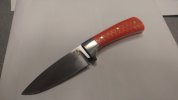
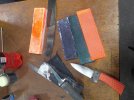
Oh, I don't leave any extra around the edges. Only on 1 face. So when I use .25" tall honey comb, I pour .375 or more of resin over it in the mold. That way I have enough resin stock to mill flat without breaking through to the honey comb on the tang side.
- Joined
- Sep 21, 2013
- Messages
- 1,574
Oh ok I see. Each cell is connected to the whole by a resin layer facing the tang.
I've had an 18x18 block of honeycomb for over a year now. Can I ask a few more questions?
1. What resin do you use?
2. Do you use vacuum/ pressure pot? Would a heat gun/plumbers torch do for bubbles?
3. Easiest way to cut that stuff? Bandsaw?
And thanks!
ps. That orange blade turned out nice but that bolster looks really good. No pins, nice flow to it.
I've had an 18x18 block of honeycomb for over a year now. Can I ask a few more questions?
1. What resin do you use?
2. Do you use vacuum/ pressure pot? Would a heat gun/plumbers torch do for bubbles?
3. Easiest way to cut that stuff? Bandsaw?
And thanks!
ps. That orange blade turned out nice but that bolster looks really good. No pins, nice flow to it.
kuraki
Fimbulvetr Knifeworks
- Joined
- Jun 17, 2016
- Messages
- 4,679
Alumilite
Pressure pot, I would say no on heat as it's going to increase the reaction of the resin and in the best case, only speed up hardening, worst case severely weaken the resin.
Bandsaw once cast. I cut the honeycomb with a utility knife before casting. Zips right through it. Hold it down flat and you'll only damage/collapse the very edges, which you'll grind away after casting anyhow.
Pressure pot, I would say no on heat as it's going to increase the reaction of the resin and in the best case, only speed up hardening, worst case severely weaken the resin.
Bandsaw once cast. I cut the honeycomb with a utility knife before casting. Zips right through it. Hold it down flat and you'll only damage/collapse the very edges, which you'll grind away after casting anyhow.
- Joined
- Sep 21, 2013
- Messages
- 1,574
Ok thank you very much.
- Joined
- Sep 4, 2018
- Messages
- 163
 kuraki
- Have you ever (accidentally or on purpose) ground the hardened resin down to the embedded material, then applied another layer/coat to seal in the material? I had a vision of pouring a tinted/coloured layer as deep as your honeycomb material, polishing the honeycomb, then sealing with a clear layer? Kind of getting the best of both worlds...?
kuraki
- Have you ever (accidentally or on purpose) ground the hardened resin down to the embedded material, then applied another layer/coat to seal in the material? I had a vision of pouring a tinted/coloured layer as deep as your honeycomb material, polishing the honeycomb, then sealing with a clear layer? Kind of getting the best of both worlds...?
Last edited:
K
KillerGriller
. Be sure to use epoxy resin - polyester resin will be too weak and brittle. Fill the honeycomb, pass a torch over it to remove bubbles, let kick and cure. grind excess off and buff. Seal with clear layer. Should work fine.
Tim
Tim
kuraki
Fimbulvetr Knifeworks
- Joined
- Jun 17, 2016
- Messages
- 4,679
I don't think I understand exactly what advantage you're trying to achieve, unless it's encasing the scale in an attempt to decrease the chance of a cell failing. And in that case, no, I haven't tried that because I don't know that it's possible to create a strong enough layer on already contoured scales that achieves anything.