I could use some tips or help on silver brazing.

Joined
Jul 10, 2002
Messages
77
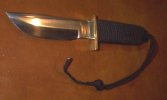
I completed my second forged blade out of O-1. It is what I would call a "Hunter-Survival" knife. It has a paracord wrapped handle like some tactical knives feature, but with a general purpose blade with a little more belly to it. The blade is 5" and 10" overall.

Everything with very well until I tried to silver braze the gaurd on. I used silver braze that melt at about 1100 degrees. Followed instructions, used an oxy-acetylene torch with 00 tip. I wrapped the blade with a cold wet diaper as a heat sink. What a nightmare. How do you do this/what kind of proceedure do you follow? It took several hours of cleaning up and left an unattractive mess at the base of the gaurd.

Here is a pix of the knife, althought you cant see the mess.

I would really appreciate any pointers you could share with me.

Thanks Joe.
 

Attachments

  • image002.jpg
    image002.jpg
    23.9 KB · Views: 165
I use a solder that flows at about 350 degrees,The solder is basicaly filling any voids between blade and guard,so useing the silver brase is overkill.Most of the knife supply houses handle this type solder.Hope this helps...
 
It's a common misconception that the purpose of solder is to hold the guard on. A little extra bonding strength is a plus, but if someone is using solder to literally hold the guard on, then the fit is not as good as it should be. The real purpose of solder is to seal the joint from moisture and contaminants.

The high temp silver solder is overkill as stated above. TIX low temp solder is a very good choice. You can get it from Uncle Al the Knifemaker's Pal (Al Lawrence) at Riverside Machine.

k1_tm75.gif

TIX Solder at Riverside Machine

Melts at 275 degrees for all solderable metals. "Hardest soft solder on earth." Melts at 275 degrees 'F' Bond strength is 4,000 psi. For steel, gold, silver, stainless steel, ainico, pewter, most alloys. Works beautifully for attaching precious metal inlays. Works best with TIX flux.

Or, it you want to get away from the headaches of cleaning and burnishing the solder joint altogether, check out the Solderless Guards tutorial on my website. For this method you do have to have a darn good fit. This is not for filling in gaps, which would look like crap. But when you can get good fits to begin with, this is really good way to seal the joint.
 
Try a silver bearing soldier without lead. They melt about 450 degrees.For clean up I took a 1/8 rod of nickel silver fashioned the tip into a slanted engraver type point put it in my vibrating marking tool.
You'd be surprized how fast you can clean up a joint.
Take Care
TJ Smith
 
I have a 19000 btu kerosene heater that takes the chill off my shop. For curing epoxy I take a 10 inch piece of galvinized stove pipe. Don't put it together, leave a 3-4 inch wide opening. Put a heat lamp at the top or even a good spot light that will give your epoxy enough heat to set up. You might want to put the tubes in for a while first so you can get it to squeze out.
Take Care
TJ Smith
 
I Agree 100% with Terry The Fit Should be Very Close Before You Try to Seal / Attach a Guard Be it By Silver Sloder or Other Method's Try the Light Test !!:D :D
 
Maybe no one uses silver brazing? Over Kill ? Know How?
what if you wanted to braze on a tang or braze a joint on a furel
what if you want a strong joint?
Theres more things than sealling a joint on a guard
Any one know how to silver braze??
 
Maybe no one uses silver brazing? Over Kill ? Know How?
what if you wanted to braze on a tang or braze a joint on a furel
what if you want a strong joint?
Theres more things than sealling a joint on a guard
Any one know how to silver braze??

Ron,
I take it from your post you were looking for some help, hit this post and are a little disappointed.

I'm no expert so I'll just say that the post was about filling joints so the post reflected that and that brazing silver to steel is basically really hot glue. :D Like welding, you don't get penetration and therefore true bonding of the materials unless you are brazing similar materials.

To answer your question if any on knows how to silver braze...there are some really smart metal smiths and even some metallurgists on the form that can give you some tricks of the trade if you post a thread. I have found that, for me anyway, I have just had to mess up a lot of stuff practicing to learn how to weld.

I hope I've not misunderstood your post and I hope this helps.

chiger
 
I think there's some confusion concerning terms here.

I solder, braze, weld ... you name it.

Just to be clear, when I talk of soldering in this context, I'm not talking about using a soldering iron, but a torch--the way jewelers solder. This might look like brazing, but it's really classic hard-soldering technique.

There is good advice offered above. I don't think there's any reason to use 1100 F solder for this application, and braze is usually thicker and wont penetrate and flow into your joint like hard soldering. Hard soldering produces a very, very strong joint.

I like a low temp silver-bearing solder from Brownell's (around 550F or so), but that's pure personal preference. I have used IT solder (which is over 1000F) and think it's a waste. The 550F stuff is plenty strong if you're going for some added mechanical strength, and pretty bright like silver solder.

I assemble the knife in a vice with the point up. If the fit is what is should be, it should be a stable-enough assembly so there isn't any other clamping. I just clamp it in so that the vice jaws are closing on the FAR edges of the guard-- as far away from the area to be soldered soldered as possible--the blade and joint area are suspended in the air.
If it's a strange-shaped guard/blade and there might be instability, I'll peen a section of the tang so that the guard presses on with some resistance and stays in place. Worst-case, I'll tack it from underneath with TIG.

You want a decently hot-neutral flame. If I'm doing 550F solder or softer I'll use MAPP gas. You want to do this operation fast and not heat the part more than necessary. If your flame is too hot, you'll cook your flux off and have problems.
I'll dip the end of a welding rod into the liquid flux and touch it to the joint. It will wick in pretty fast and clean without getting all over the guard. The solder follows the flux and doesn't like to stick where there's no flux.

With solder in hand, heat the guard from UNDERNEATH. NEVER-NEVER FROM THE TOP. Rather, with the flame under the guard, Repeatedly touch the solder to the joint from the TOP. The joint will heat up fast and the solder will--all of a sudden-- wick in just like the flux did. It'll take about one second to zip all the way around and all the way through between guard and tang.
Remove the flame IMMEDIATELY. If you overheat the solder it will tend to flow through the joint and give you a concave appearance and voids. Done correctly, there shouldn't be any need (except under unusual circumstances) to use heat shield since the process is very fast so you aren't heating the heck out of your workpiece.
I usually clean up the joint line on top of the guard, if necessary, by cutting the excess off with a big, flat graver. It should be very minimal.

I think this process is basically what the others are referring to when they speak of soldering. Again, a good silver solder joint is tremendously strong. This would be the typical process for guards, fittings, etc.

 
Yes , terminology.Braze is high temperature , solder is low temperature .Either way the metal is heated to the melting point of the solder or braze ,then you apply the solder/braze and capillary action fills the joint.For a knife ,as stated , heat from below. For braze you will effect the HT of the blade at the guard area even if the blade is kept cool. The trick is to fit the guard carefully .For the strongest joint and gap for capillary action the gap is .003" .For a stainless steel solder make sure the flux is designed for that .A solder of about 95Sn, 5Ag works well ,stays shiney and melts at about 450 F.
 
The best I've found for gaurds, and I haven't tried all that many, is silver bearing solder sold at car quest. Melts around 450 deg. Comes in a kit with low temp solder and liquid flux. I've gotten to the point where now most of my blades I JB weld the gaurds on alla Terry Primos methoud. The solder is for moister seal more than anything. The gaurd has blade shoulders in front and handle behind it, if done rite it'll be a slight press fit and it ain't going anywhere.

I have used hard solder to add tange extensions, comes in handy as your not limited to a few thread on a flatened tange for a pommel cap, you can split a bolt and have any size thread you want with in practicle limits.

BTW, good looking knife, may want to round the square corners off the gaurd, but other wise good job.
 
Maybe no one uses silver brazing? Over Kill ? Know How?
what if you wanted to braze on a tang or braze a joint on a furel
what if you want a strong joint?
Theres more things than sealling a joint on a guard
Any one know how to silver braze??

try the search function, there are many tutorials for what you are looking for.hard soldering or brazing is a wasted effort on a guard,Bruce Evans has a nice tutorial on hard soldering a nickle silver sheath. tangs are usually wire welded due to heat treating temperatures.it's better to do a little homework before trying something new or asking advice first.
 
Back
Top