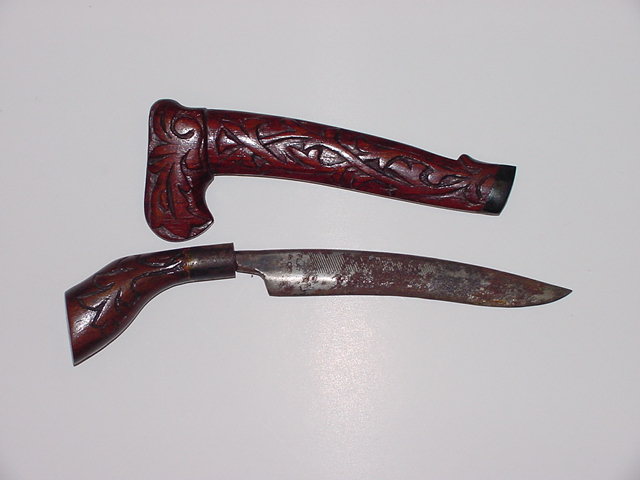
I need help IDing this knife from India or Burma.

Joined
Jul 13, 2012
Messages
3
Hi everyone,

This strange knife dates from the late 1930s or early 1940s. My great uncle acquired it in India or Burma during the Second World War. He was killed during Operation Thursday, the second Chindit expedition into Burma. The knife in question, along with a few more conventional blades, came back with his effects. I have been scouring the internet for information, but the knife itself holds precious little information about its provenance. I've taken a picture and posted it here using imgur. The only identifying marks on the knife are a pair of half-ellipse squiggles on the tang. And speaking of the tang, it isn't drilled. I can only surmise that it was never intended to have a permanent handle; I suspect that anyone using it could wind the tang with cord or something similar to achieve the same effect. The knife is not quite 11.5" long. The blade is a little over 7" long. If you have any information about what this is, where it came from, or what it was meant for, I'd be most appreciative. Thanks!
 
You'll need to include a picture...several pictures. Go to Bernard Levine's section of this forum and read the photograph instructions...or use a scanner...instructions for all are there. You may also want to ask the Moderators to move this post over to Bernard Levine's section. Folks over there know a lot and with good photographic information, should be able to help. But...no photos, no help I', afraid.

We look forward to seeing these pieces of history.
 
Here it is:

N35lL.jpg
 
Thanks for posting that picture. Looking back, I should have made the link more prominent. Hopefully someone can shed some light on this. It's been puzzling me for weeks.
 
It may be a one-off piece made by a local smith or kami somewhere.

In blade shape it reminds me of a bunch of Asian weapons.

Rencong (Tumbuk Lada)
Rencong-a-traditional-weapon-from-Aceh-500x247.jpg

tumbuk-lada.jpg


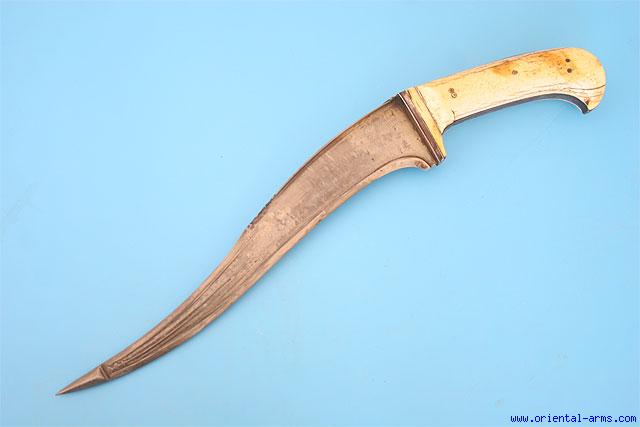
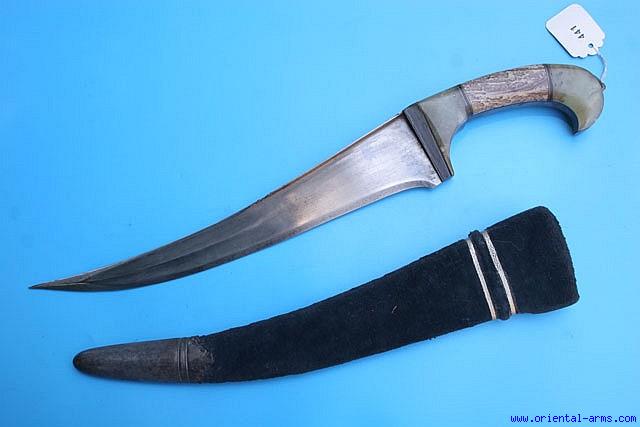
It looks most like a variant of the Indian Pesh Kabz.

ph-0.jpg

ph-0.jpg


That would be my guess. Note the full tang design and recurves, very similar!
 
Not a Pesh kabz. Those have reinforced tips and were designed to pierce chainmail.

Looks like a version of what is sometimes called a Khyber Bowie. Pretty common & generic blade shape with many names for knives used anywhere from Russian Caucasus, Balkans, Turkey through India, Pakistan and Afhanistan.

That plain grip is strange though. Perhaps it was once wrapped with wood, leather and bound with wire.
 
CWL:
That plain grip is strange though. Perhaps it was once wrapped with wood, leather and bound with wire.

Very strange indeed. My guess was cord of some description, but I suppose you could use anything. My guess is that the knife was never used: my great-uncle presumably bought it as a souvenir. He fought with a Gurkha unit (77th Indian Infantry Brigade) and was well-equipped with knives: he had at least two kukris — one ceremonial, the other field-ready — and a trench spike. The knife in question came back with his effects in a box of other similar, though easily identifiable, Indian and Asian knives.

Goosey:
It may be a one-off piece made by a local smith or kami somewhere […] In blade shape it reminds me of a bunch of Asian weapons

Here I agree with you. It's unfortunate that I haven't been able to find a similar knife anywhere. It's a fascinating piece, and the sentimental value is enormous, but I'd really like to know more. The more I think about it, the more I'm convinced that it's a one-off, or at least one of a small series, made by some local smith in Karachi or Lahore — the two cities where my great-uncle spent the most time.

I have one last resort, which is to try some contacts in the art world. Perhaps someone who specializes in Indian or far eastern art will be able to provide a definitive answer. Thanks for the help though, I really appreciate your expertise, and I'm farther ahead now than I have been since this came into my possession. If you think of anything else, don't hesitate to post.
 
Like I said, it is a basic blade profile commonly used from Russia-thru Balkans, Turkey, India, Pakistan and Afghanistan.

Sure it is a "one off" since some smith probably hand-made it, but the design has been commonly used by many nations and cultures for 1-2000 years.
 
Back
Top