
Identifying Handle Material

5K Qs

Gold Member
Joined
Jul 20, 2014
Messages
16,186
In particular, can you suggest any visual (or other) tests for distinguishing bone covers from synthetic ones? I like to buy used knives, but currently don't always know what I'm getting. I'd like to be able to take a "trust, but verify" approach to a seller's claims.

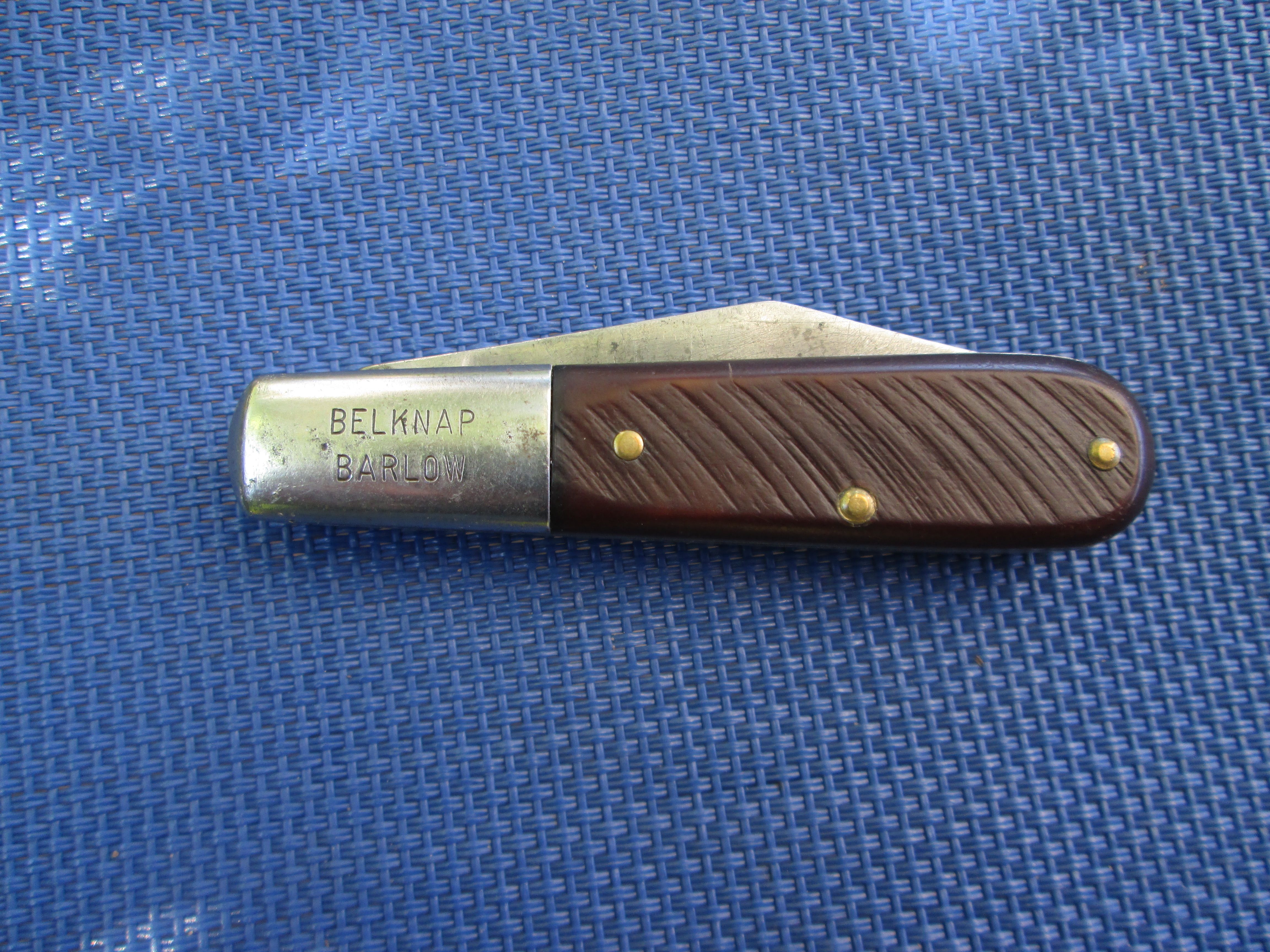
To my untrained eye, the "synthetic brown jigged bone" covers on a couple of Chinese Bucks I bought looks the same as the "amber jigged bone" on a new Rough Rider, or the jigged delrin on a Case peanut. Here's a photo of an old Belknap Barlow that I'm guessing is sawcut delrin, but is there a way I can train myself to tell for sure?

Thanks for any suggestions!
g9WbJX1.jpg


- GT
 
When comparing Delrin (or similar synthetics) to bone, my 'go to' method is just to take a close look under magnification, with BRIGHT light. Bone will always show pores & grain at some depth (some synthetics show simulated 'grain', but it's only on the surface). In particular, look at the end-grain on barehead-style knives; you should easily be able to see the 'holes' (pores) in it, and they can also be seen in the inside edges of jigging. Highly polished bone often becomes somewhat glassy/translucent, and you can more easily see the grain and other natural features within, under the surface. Dyed bone will almost always show some blotchiness or irregularity in the color, because natural bone doesn't ordinarily absorb dye uniformly. With really dark bone that looks uniformly dark by naked eye under average lighting, this can still usually be seen under very BRIGHT light, which will reveal more of the irregularities in the color.

Delrin or other similar sythetics always look like smooth & featureless plastic, even at magnification. No real pores or grain at all. With brown delrin specifically, I've always noticed a 'chocolate milk' or 'coffee & cream' opacity to it (this is what I see in your photo of the barlow; also not seeing any pores or grain in the smooth, un-jigged portions at the perimeter of the scales). With some experience, this can be recognized even in photos of most of them, if you're not able to look at them in-hand.


David
 
Last edited:
Back in July 2010 Charlie made this suggestion to test various cover materials.

waynorth said:

O.K, here's the test for plastic that I use.
I get a razor sharp knife, and I lay the knife to be tested on the table, shield or front side up.
I grab/pinch the butt of the test knife between my thumb and forefinger. I rest the sharp knife on the handle material like I am preparing to cut the test knife in half. Without pressing down, just using the weight of the sharp knife, holding gently, scrape to the right (toward the bolster) like you are trying to remove a little paint.
If the blade "skates" or slips, it's bone (or antler)!! If it drags or catches, it's plastic. Sometimes the blade will "bite" cow or buffalo horn, depending on density, but magnified, horn looks like compressed hair - fibrous.
Never tried it on tortoise.

Thanks for the info Charlie. I've used that method/s more than a few times.
 
Glad it works for you, Ed. The only way to do it over the internet, is to spend several years looking at thousands of knives, then verifying what you see!
It can get expensive - or not! There is nothing that replaces mindful experience.
 
Thanks for the helpful suggestions, guys :thumbup::thumbup:

David, I used a not-very-impressive magnifier to look at some of my knives that I purchased new and presumably know what material is used for the handles, and I think I could see pores (or lack thereof) where you'd expect them. (I hope it's not just the power of suggestion:))

Ed & Charlie, I tried the "scrape the knife" test on a few knives, and I think I could feel the catching or skating as predicted. Very cool!

(FWIW, regarding my Belknap barlow, I was doing some Google-assisted research and have concluded that 5722 was a delrin model and 5721 was a bone model. Can anyone familiar with Belknap's numbering schemes for their knife patterns confirm that?)

- GT
 
Thanks for the helpful suggestions, guys :thumbup::thumbup:

David, I used a not-very-impressive magnifier to look at some of my knives that I purchased new and presumably know what material is used for the handles, and I think I could see pores (or lack thereof) where you'd expect them. (I hope it's not just the power of suggestion:))

(...)

- GT

The light used with magnification is really what makes a big difference. The brighter it is, the more obvious the differences (& flaws) will be. Also makes a big difference in examining new edges on blades when sharpening; imperfections just can't hide under really bright light, which often is hard to look at. :eek:

The 'scrape test' mentioned by Ed & Charlie sort of works with a strong thumbnail as well. Usually, with Delrin and other synthetics, pressing into the material with a thumbnail will leave a mark/indent. Doing so on a bone handle, the nail will just 'skate' or slip across it, leaving no mark; it feels more 'glassy' under a thumbnail, sometimes reminding me of polished stone.


David
 
Glad it works for you, Ed. The only way to do it over the internet, is to spend several years looking at thousands of knives, then verifying what you see!
It can get expensive - or not! There is nothing that replaces mindful experience.

I agree experience is the best friend for this, never trust an unknown seller (they will lie), and knowing manufacturing history works in your favor. Picking bone from a poor photo is a good way to secure a good knife at Derlin prices.

Delrin in general has a softer appearance, while nice bone is usually a bit glossier. I never have much trouble with Delrin, but some of the older jigged acrylic/cell/acetate handles are tougher to distinguish.

Looking on the side view of the knife (down on the springs or liners) usually gives a nice view for the blood canals you see in bone, or that two tone Delrin look.

That Belknap barlow in the OP isn't one of the tougher ones. It's a Schrade USA made knife from the late 50's or early 60's, similar to ones made for Ulster, Imperial and Craftsman. Its clearly molded and not saw cut. But having seen this pattern about 200 times on eBay and handling several like it helps more than just looking at it and trying to explain.
 
Thanks for your comments, thawk. I learn something new about knives every day I visit the forum, and I'm also reminded every day of how much there is to learn. I should have become interested in this stuff a long time ago, because I'm running out of time to find out all the stuff I'd like to know:D

- GT
 
Back
Top