
In need of some education

Joined
Jan 7, 2010
Messages
26
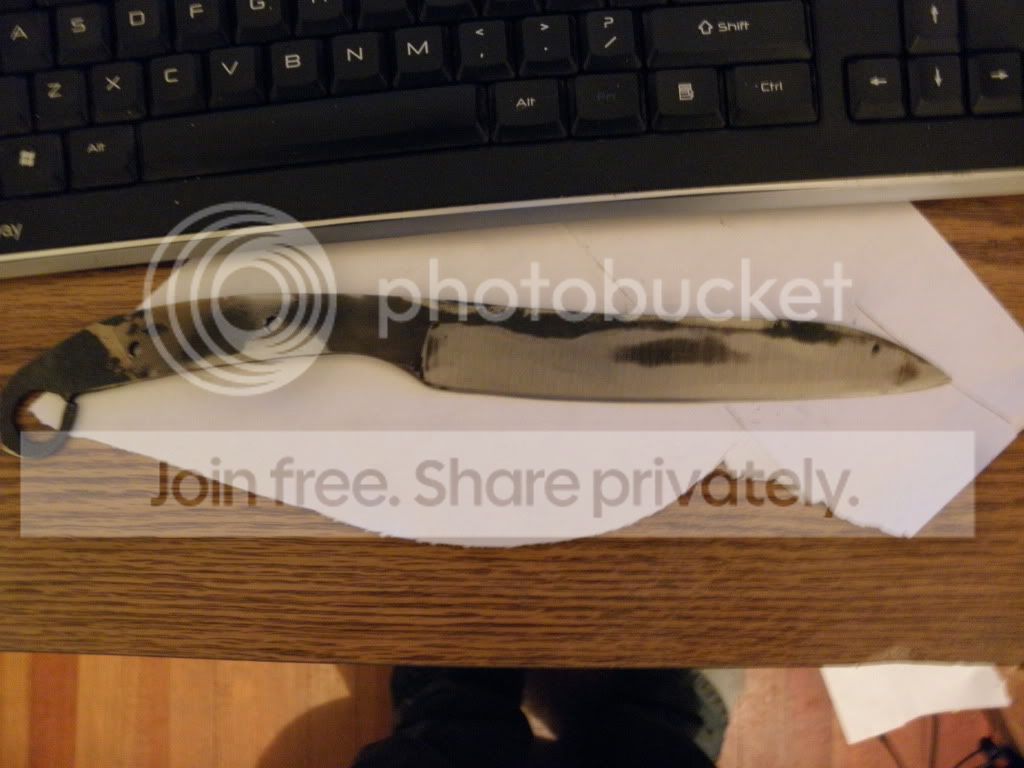
So i forged my 1st knife the other day form a nicholson file, did the ht by heating the spine from the ricasso forward with a torch until the edge was evenly colored and just past non magnetic, and quenched in mineral oil preheated to 135F. I did this 3 times. Then I tempered at 450F for 2 hrs, air cooled to 70F then froze to -10F and tempered again at 450F for 2hrs, and air cooled again. I know that this is not the recomended way to ht and temper 1095. I put a shaving edge on it with a medium grit stone, and cut a yellow pine 2x4 twice, and it still shaved, but then I decided to try and polish the edge with a fine stone and a machinists diamond rubber strop. Now i keep getting these little nicks towards the tip. I have looked at it with a 5x jewlers loup and am unable to see them, but when i drag my thumb-nail along the edge, i can feel them, there are 2 that i can feel. I have not put scales on it yet, and my grind lines leave much to be desired but its just a practice blade, and would like any ideas that may help me get better.
P2180091.jpg


P.S. I have a 4"x36" belt sander/grinder with a 10" disk on the side, a chainsaw sharpening file, an acetylene torch, a 2lb sledge hammer, an 8oz ball peen hammer, a 6" wilton bench vise, and a set of fractional cobalt bits. those compliment my homemade propane forge built with firebrick for a wood stove, and my toaster oven.
 
Last edited:
Not sure I have much to offer except my respect for working so well with what you have. :thumbup:

My best guess would be that it might be difficult to keep evenly distributed austenizing temperature with a torch. Polishing shouldn't weaken the edge unless the angle changed. It may make an inconsistency more obvious.

Rob!
 
So i forged my 1st knife the other day form a nicholson file, did the ht by heating the spine from the ricasso forward with a torch until the edge was evenly colored and just past non magnetic, and quenched in mineral oil preheated to 135F.

I did this 3 times.

Can you tell me why you did this 3 times?

Then I tempered at 450F for 2 hrs, air cooled to 70F then froze to -10F and tempered again at 450F for 2hrs, and air cooled again. I know that this is not the recomended way to ht and temper 1095. I put a shaving edge on it with a medium grit stone, and cut a yellow pine 2x4 twice, and it still shaved, but then I decided to try and polish the edge with a fine stone and a machinists diamond rubber strop. Now i keep getting these little nicks towards the tip. I have looked at it with a 5x jewlers loup and am unable to see them, but when i drag my thumb-nail along the edge, i can feel them, there are 2 that i can feel. I have not put scales on it yet, and my grind lines leave much to be desired but its just a practice blade, and would like any ideas that may help me get better.


P.S. I have a 4"x36" belt sander/grinder with a 10" disk on the side, a chainsaw sharpening file, an acetylene torch, a 2lb sledge hammer, an 8oz ball peen hammer, a 6" wilton bench vise, and a set of fractional cobalt bits. those compliment my homemade propane forge built with firebrick for a wood stove, and my toaster oven.

Can you tell me why you heated and quenched 3 times ?

and why you froze it ?
 
Last edited:
like i said, this is a practice blade, and I was practicing getting it to non magnetic and goin just a little higher. this blade will never be for sale, and as posted, I know that I did not preform a proper 1095 ht. just trying to figure out why it held up to the cutting test, then started chipping while polishing the edge
 
Sounds to me like you may have over heated the point area and caused some grain growth there. An easy thing to do with that type of set up.
 
Sounds to me like you may have over heated the point area and caused some grain growth there. An easy thing to do with that type of set up.

I agree,as much as you don't want to hear this,I would probably do a bunch of chopping of 2X4 and such to check for more chipping then break the blade to check grain structure.
Stan
 
thanks for the input guys, these are exactly the types of things i wanted to hear. well not exactly, but you know what i mean. i'm here to learn, and your advice is way better than finding out by makinga knife and having it break and hurt someone.
 
You treated 3x. Every time I read about triple quench, triple draw, the second quench is a sub-critical anneal. It's done to reduce the grain size. Is there something to be gained by triple quenching without a sub-critical annealing in the midst?
 
not as far as i have read, i just wanted the practice. i plan on breaking it to have the grain checked. does anyone know a good place to send it to have it checked?
 
Back
Top