INFI in smaller blades?.

These_Nutz

BANNED
Joined
May 2, 2008
Messages
378
Is infi worth the extra cost of other blades under 4 inches?.
Ive read on the forum a lot prefer rats 52100 for smaller blades and INFI on all the big choppers.
What are the advantages of INFI in smaller knives?.
And the draw backs?.
Also if you had the choice of steel on a small blade would it be INFI without any doubt?.
 
INFI is a way of life, yes RAT makes very nice gear and I love my RC-3 to death but I love my GW even more cause it is bomb proof and holds a stupid sharp edge longer.
 
Love the smaller blades!!

attachment.php
 
INFI all the way !

Nothing compares to its edge holding ability combined with ease of sharpening.
 
On smaller blades there can be some advantages to going with a harder, more wear resistant steel (s90V, zdp189, M2/M4). This is part of the reason why the BAD active dutys were bumped up a couple points in hardness compared to recent Busses. Still for all around use which may include occasional abuse, I still think infi has the best balance of properties. Compared to something like 52100 though infi has it beat hands down. Better wear resistance, similar hardness(for most makers), more corrosion resistance, and tougher.
 
Is infi worth the extra cost of other blades under 4 inches?.
Ive read on the forum a lot prefer rats 52100 for smaller blades and INFI on all the big choppers.
What are the advantages of INFI in smaller knives?.
And the draw backs?.
Also if you had the choice of steel on a small blade would it be INFI without any doubt?.


I for one don't recommend infi in small blades ..

You can use any other higher end steel, it will perform as good or better for EDCs...

INFI really shines when applied to larger blades.. This is just a fact... Don't believe me ?? Go ask Jerry, he is a honest guy... :)

On the other hand big or small blades INFI is the best for ease of sharpening..
 
I believe INFI really shines in big blades/choppers. It's a very nice steel for small blades, but the gap narrows slightly IMO. It's better than A2 and S30V IMO, but I like my Dozier D2 and Graham Bros 154CM blades a lot.
 
INFI as from the company in a small blade could be considered ok.. But thats just based on the grind which IMHO is better suited for choppers. Thin it down, (I put a mirrored convexed edge, down to aout a 10/20 deg angle) and the magic of INFI comes out. Easy to get to that point, I measured a Warden I had, and the edge was about 25 deg per side, I got it to where I wanted within 20 mins! That is amazing for a steel that has such toughness and edge holding. INFI really is the best "do all" steel. Tough as L6 for prying, edge holding comparable to the stainless supersteels, (154cm-s30v not the new jacks like zdp though.) And in my experience, about as stainless as ATS-34. Crazy good if you want a knife you can cut, pry and not worry about pitting on you overnight.
 
What I love about INFI in any size blade is that once it has a good edge all you need to do is strop the knife when it seems to be getting dull and the edge just jumps back onto that steel!:eek:

So while out camping/packing all I need is a piece of cardboard with some compound and I can keep the knife sharp for weeks.

I find that all my folders just p^ss me off now because by comparison they are too hard to sharpen.:grumpy:

So yes I like INFI in small blades.

.
 
On small blades the edge retention of powdered super steels from some of the Japanese mastersmiths is the ultimate for me. Cowry X from Hattori....R2 from Itou....OU31 from Matsuda....these are done in a damascus fashion with less brittle steels folded to protect the harder middle core steel. They are done to the highest Rockwell standard, Cowry X being Rc64, with convex edges and heat treatments done "masterfully".....very much similar to the Busse strengths regarding heat treatment....but the edge has to be seen as a life time edge. These are hard to sharpen so "stropping" the edge to stop it dulling is the best way to enjoy them. You would not want to re-profile this steel due to it's hardness. The edges though can deal with huge cutting tasks without dulling and do not need much maintenance.

Infi though can take just as sharp an edge and sharpens very easy allowing for how long it can retain it. The ease of sharpening is suprising allowing for it's edge retention ability. In my view though the Bussekin knives give their world class leading ability best in larger knives which make the most of the special properties of the steel.

Devin Thomas in the U.S. makes damascus super steels similar to the Japanese masters at similar high Rockwell hardness if you want to invest in "home" industries.

100_0194-1.jpg


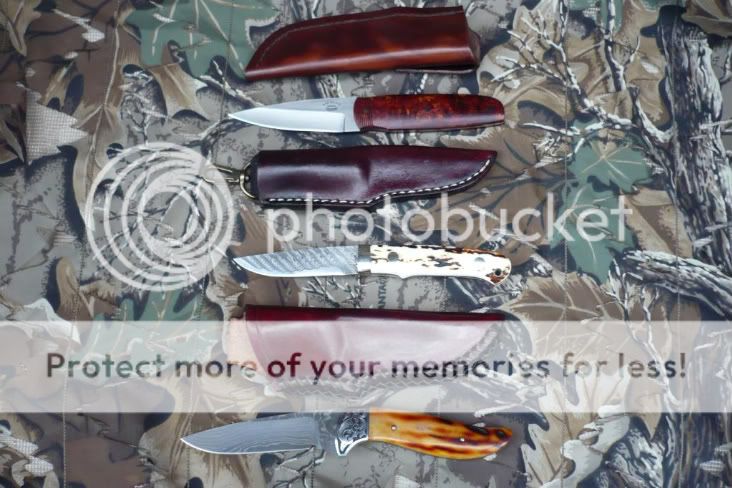
Here is a picture of some of my small blades. The middle knife is an Itou in R2 with a 3.5 inch blade. The bottom one is a Moulton with Devin Thomas damascus blade at 4 inches.

Here is a larger 5 inch R2 blade by Itou

100_0077-1.jpg


and a 5 inch blade by Hattori in Cowry X

100_0054-1.jpg


But once you go a bit bigger on a blade I think Infi starts to forge ahead because of the harder uses it can cope with without chipping and it still holds just as sharp an edge. Here is a Skinny Ash I stripped and Convexed the blade and the edge is as sharp as you can obtain.

100_0158-1.jpg
 
Infi on small blades? Yes. And yes again. I don't know how much better it is than any other steel on smaller blades, but it works great for me. To be honest, I'm not much of a steel snob. But with Busse, it's not just about the steel, they have some great small knife designs. A Cultie, a Warden or a BAD would be awesome in almost any high-grade steel. Infi is just the icing on the cake. And you get the amazing warranty.
 
Hogs---Would you like to see a Busse Kozuka?? :)
Like a Rat-Tail but better, with INFI!
 
For just staying sharp a long time, and for Salt water use, Stellite and Talonite in small knives is my first choice.

If you want to use it for a prybar, while staying sharp a long time, Then INFI works for me.

A good combination of hold an edge, stiffness and flex, but will still take a set before it breaks.

If you do not want to have to be careful, INFI rules.
 
I'm with Andre as far as Talonite and Stellite, but would add D2 as another alloy that works great in a smaller blade.
 
What I love about INFI in any size blade is that once it has a good edge all you need to do is strop the knife when it seems to be getting dull and the edge just jumps back onto that steel!:eek:

So while out camping/packing all I need is a piece of cardboard with some compound and I can keep the knife sharp for weeks.

I find that all my folders just p^ss me off now because by comparison they are too hard to sharpen.:grumpy:

So yes I like INFI in small blades.

.

Agree.

The thing about INFI is that it balances edge-taking, edge-holding, re-sharpening, corrosion resistance, impact resistance and flexural strength very well.

So, if you're talking about a small knife that can afford to be babied... to play by abridged rules, then you might want to look at different steels. But for an all-arounder, INFI is probably the best.

Like Tony is saying, INFI strops back up like tool steel, but it has corrosion resistance more on the order of pseudo-stainless.

INFI does not take an edge as well as O-1. Maybe does not hold it as long as D-2 or S30V… it’s easy to get it very sharp for a utility edge though, and to keep it there. In that sense, I actually see it as being more of an EDC steel than a big-blade steel.
 
Is infi worth the extra cost of other blades under 4 inches?.
Ive read on the forum a lot prefer rats 52100 for smaller blades and INFI on all the big choppers.
What are the advantages of INFI in smaller knives?.
And the draw backs?.
Also if you had the choice of steel on a small blade would it be INFI without any doubt?.

Advantages: I can cut through almost anything with little or no wear or damage to the blade beyond coating wear or scuffing the finish.

Disadvantages: Price. They have a mid- to high front-end cost, depending on your cost aversion to knives. But since it lasts a lifetime, that can be made manageable if you make a lot of money and can recover quickly, or simply limit yourself to the few that you actually use.

If I had my choice of steel on any blade, it would be INFI. It's close to perfection and anything that comes close to INFI doesn't really surpass it, so I just stick with INFI whenever blade design or carry systems aren't an issue.

The disadvantage to INFI in the past has been waiting around for a model you like to come out or become available at a price you can afford. Since that's not really an issue anymore (but might be again...?) I wouldn't count this as a real disadvantage.
 
INFI is great in smaller blades IMO. the edge holding is just impeccable. I love my Busse scotch dispensers and this is the perfect example of INFI being great in smaller EDC blades :)
 
Back
Top