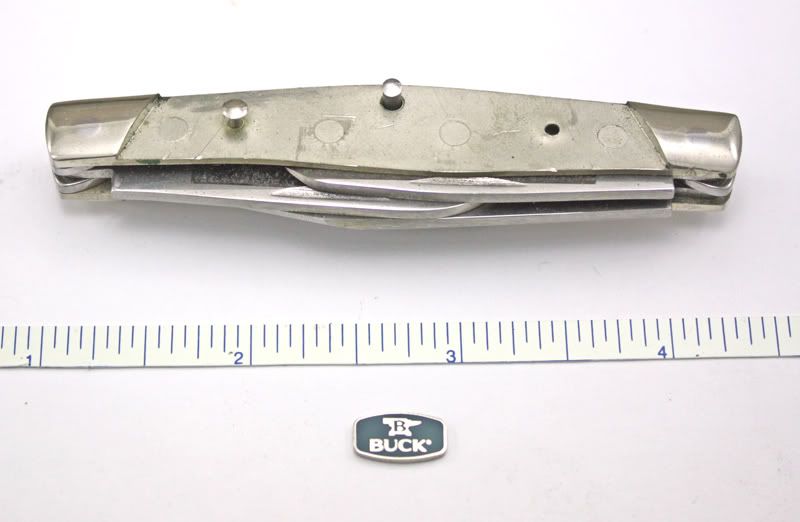
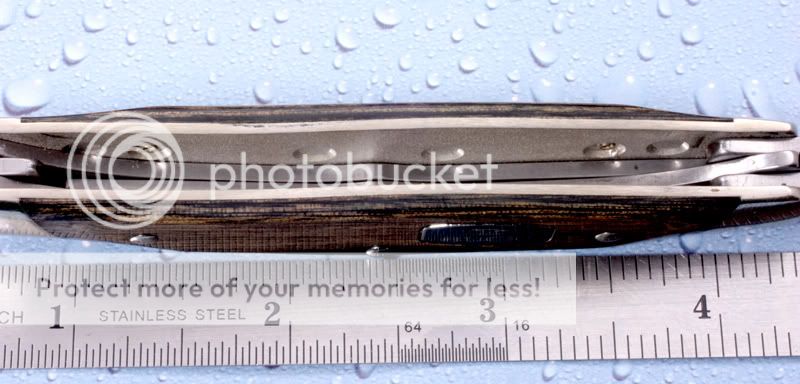
Innards? Pics requested?

Dornblaser

BANNED
Joined
Sep 5, 2010
Messages
456
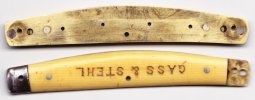
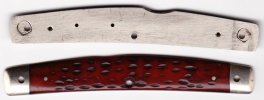
OK, I may be new but I am not shy about asking question and wanting to learn. I am wondering, and hoping, that someone has pics of shadow and bolster pattern knives taken about so that I/we can see the differences of the innards? Any other traditional innards pics would be appreciated as well. Yeah, I know, I am totally hooked into traditionals.

Thanks in advance.

- David
 
David, I don't think you're going to see any difference on the innards, both styles of knives have liners on the innards. The difference is outside the liners, shadows are pinned directly through the handle material, while bolstered knives are pinned through the bolsters.

Eric
 
There's not really much internal difference between bolstered and shadow traditionals - at least not in the old ones. Basically the shadow patterns won't have the bolsters attached to the liners by tommy pins -- the liners on the shadow may or may not have the holes in the liners where the tommy pin would go for bolsters (on a Case, they won't have the tommy pin holes).

I'll see what I can scare up.
 
There's not really much internal difference between bolstered and shadow traditionals - at least not in the old ones. Basically the shadow patterns won't have the bolsters attached to the liners by tommy pins -- the liners on the shadow may or may not have the holes in the liners where the tommy pin would go for bolsters (on a Case, they won't have the tommy pin holes).

I'll see what I can scare up.

Now you're going to have to explain to the folks what "tommy pins" are. :D
 
That would be a true statement. I don't know a "tommy pin" from "Adam's housecat".

Ed
 
OK, so what are tommy pins? And, are the bushings, etc., the same between the patterns?
 
Isn't a Tommy Pin much like a dowell pin that is attached to a bolster that slips into a corresponding hole in a handle/scale? Think I read about it sometime ago. Getting older so my memory is a bit fuzzy.
 
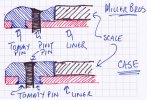
Tommy pins are how bolsters have been attached to liners for a long time - going back to the early 1800s at least. The tommy pin is an integral part of the bolster - as the bolster's general shape is being rough formed by a die, a short round "pin" is formed protruding from the back of the bolster. This is matched up to a corresponding hole in the liner and the two are then riveted together - no welding, no soldering - proving that many problems can be solved with a big enough hammer. Precisely how they place the hole for the tommy pin and how they place the pivot hole depends on the manufacturer. For many, the tommy pin hole and the pivot pin are always separate; for many Sheffield firms and a few old American ones, they made a tommy pin hole, riveted the bolster on, and then drilled the pivot pin hole thru both liner and bolster, never mind where it goes thru the tommy pin and liners - so long as the tommy pin diameter is somewhat larger than the pivot pin, this works fine; Case took this another step and made the tommy pin quite large, so that when they drill the pivot pin hole thru they go more or less thru the center of the tommy pin.

Here we see my sophisticated drafting skillz - showing a cross section of the bolster, tommy pin, pivot pin, liners, scale. Now with new improved diagram - 17% less confusing that before. Examples for Miller Bros and Case - images below.

attachment.php


This is a Miller Bros congress - a clapped out example of another I have - showing separate tommy pins and pivot pin holes -- along with some unusual construction. They used a generalized liner with preformed holes (at least positioning holes) - same for both liners - with unused holes for tommy pins for longer bolsters, a second set of unused holes for scale pins (for use with the longer bolsters), and unused shield pin holes. By placing one set of tommy pin holes close to the ends of the liner, they can also attach some styles of tip bolsters. Iron bolsters.

attachment.php


And this is a Case XX 64052 with the huge tommy pins. Nickel silver liners and bolsters. The older Case Tested XX knives used the same construction.

attachment.php


-- Dwight
 

Attachments

  • TradConstruction_millerbros_sm.jpg
    TradConstruction_millerbros_sm.jpg
    40.2 KB · Views: 288
  • TradConstruction_case_sm.jpg
    TradConstruction_case_sm.jpg
    36.5 KB · Views: 288
  • TradConstruction_sm.JPG
    TradConstruction_sm.JPG
    84.1 KB · Views: 275
Last edited:
... And, are the bushings, etc., the same between the patterns?

Bushings are a whole 'nother ballgame. Bushings are not a part of traditional slipjoint construction -- at least they weren't until Tony came along. They had sometimes been used in lockback construction for a while before then, I think. Basically, unless you're talking about the Case/Bose Collaboration knives (any regular production Case patterns with them?) or certain customs, traditional slipjoints - even modern ones - won't have bushings.

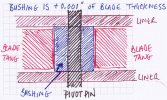
Continuing to showcase my amazing drawing skillz, here's how bushings are used in traditionals.

attachment.php


I've exaggerated the difference between the bushing length and the blade thickness. In Tony's method, the bushing is lapped to be 0.001" longer than the thickness of the blade tang -- so there's only 0.0005" (yes, five ten thousandths of an inch) between each side of the blade tang and the liners. Basically it allows the liners to bear on the ends of the bushing instead of the sides of the blade tang when you pin everything together, so you can be a bit more forceful in the pinning without screwing up the blade action -- the idea is to lock the bushing down and prevent it moving. Now the blade rotates on the larger bearing surface of the bushing.
 

Attachments

  • BushingConstruction_sm.jpg
    BushingConstruction_sm.jpg
    89.3 KB · Views: 46
Last edited:
Well, You wanted innards you got innards.

By some odd circumstance, I happen to have some Buck photos (tongue in cheek).

Schrade made Buck 301 bolsters 'innards'. Mid 60s
DSCF11212.jpg

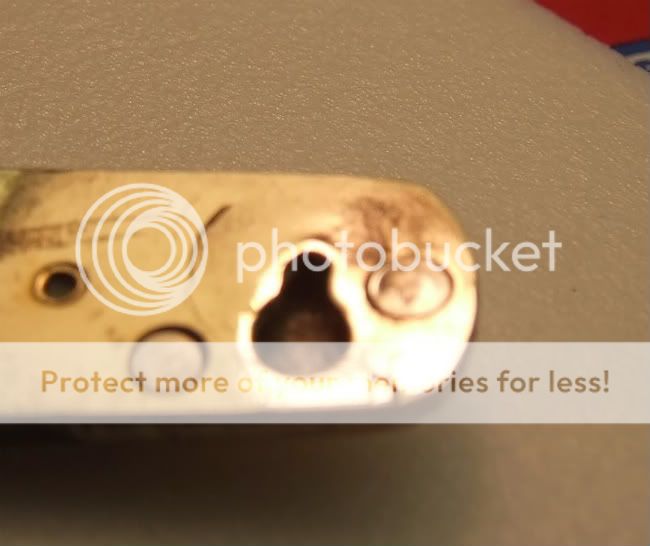
Keyhole slot hidden bolster pin went in. They hated these in the repair dept. as you have to completely take
the knife apart to change a blade....
DSCF11222.jpg

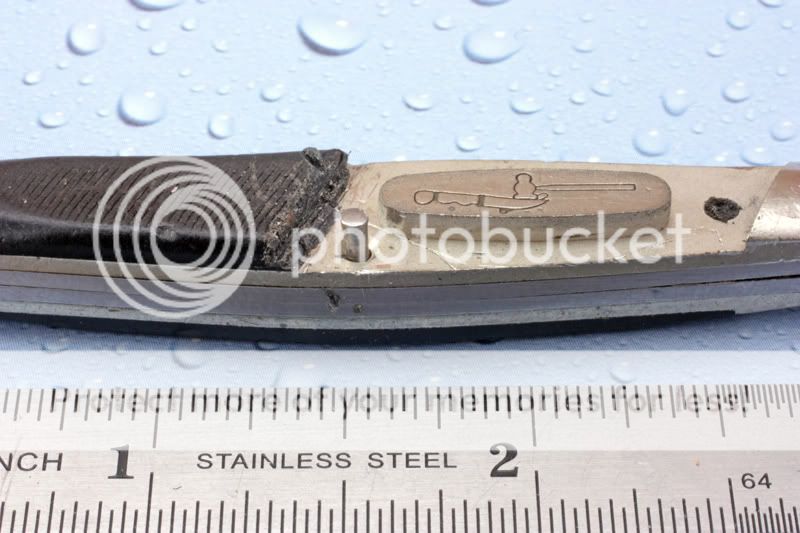
Camillus made Buck 303 bolster.
Camillus.jpg

Buck made 303 bolster.
Buck.jpg

This is the shield(pillar) of a modern Buck with Delrin/Valox scales.
Shieldcloseup.jpg

This is a photo of liner with no scale. The holes are NOT metal rivet holes, well the spring rivet is metal. The other holes are PLASTIC rivet holes.
Inside309noscalefront.jpg

Here you can see where the "head" of the plastic material from the scale is melted flat against the inside of the liner, a small shallow taper into the smaller thru hole makes the head.
InsideBack.jpg

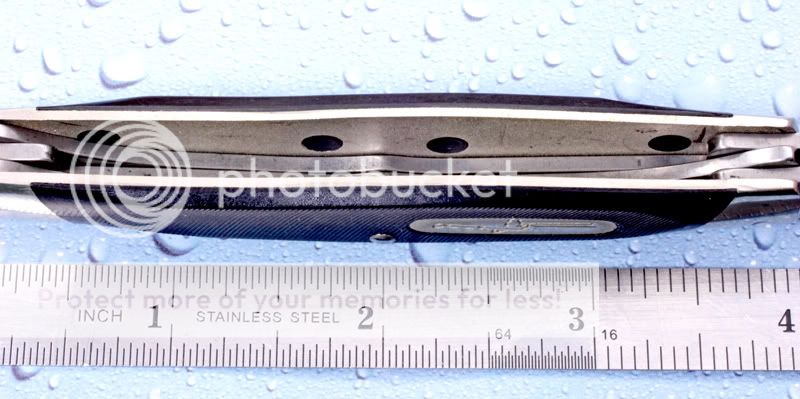
Here is Camillus made 307 large stockman, even those had the melted plastic scale rivet heads. Note brass liners.
307BladeWell.jpg

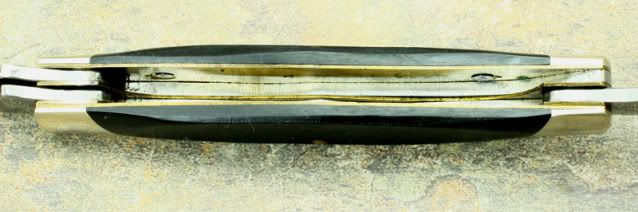
Here is a Dymondwood 303 which shows it is riveted on. The nickle/silver 'rivets' are hollow on the liner end and are rolled crimped inside the liner.
Burlstepone.jpg

Note the Valox and Dymondwood share the same liners before being machined to their own specifications.
Dymondwoodinsiderivets.jpg


I know, I know, more than you wanted to know. I am no expert, just showing the "innards" of Buck traditional slipjoint knives
that fell upon my disection table. Keep the discussion 'Traditional'.
300Bucks/ch

 
Last edited:
Sweet! Love these cutaway/groundaway photos. Around here, you should be very careful asking questions unless you REALLY want to know the answer.
 
This is all good, I have learned a lot. The pictures and drawings really are illustrative. Thanks.
 
Back
Top