Iron Oxide = ...Rust?

Joined
Sep 19, 2010
Messages
226
I have been reading that the abrasive component of red roughe or jewelers rouge is iron oxide. In my simple understanding, there are many forms of iron oxide, but they are all produced from iron+oxygen.

Based on this, I was wondering if it was in fact possible to take the actual rust off of old tools and scrap iron laying around, and use that rust to make a sort of paste, or left in powdered form, and used as a stropping compound.

The reason for this wondering is I am currently in Afghanistan and am looking for creative ways to make a field strop. I have travel sized/field style stones, but no strop compound. Call me an amateur but I have tried using cardboard, newspaper, notebook backings, printer paper, leather, denim, and wood as bare strops with no compound, and going from a fine (600) grit stone to these bare materials is not yielding the results I am striving for. Maybe I just lack the skill.

So if it is in fact possible, which by my simple method of thinking would tell me it is, I was hoping to be able to scrap/sand the rust off of the junk laying around here, work it into a belt or notebook backing, and have a working, albeit crude, compound.

Thanks for you time.
 
Not sure where you are in Afghanistan, but if there's a motorpool, I'd suggest some social engineering and trying to come up with some valve lapping compound. If you PM me with your location, I'll see if my schedule supports a transfer and I'll crack an inch or so off my green compound stick and give it to you.
 
I do appreciate the sentiment, you wouldn't believe how much support I'm getting over here. And no, I'm not anywhere near anybody that even knows the definition of the word abrasive or compound or lap hahaha. I have two full size sticks of green compound back home, one stick from woodcraft, the other stick is the more waxy stuff from sears. I would rather you keep whats yours as there is no need to put forth any effort on my behalf. Trust me, there is some rusty @$$ $#!t around here, so if this works, I would be set for the rest of the deployment until I return to my CrO. I just wanted to reach out for some insight on the matter, unsure if anybody had already tried it and failed/succeeded. Thank you for your support.
 
jeweler's rouge is not meant for polishing hardened steel, it can have very minor effect on a powered stropping system but by hand, it'll do nothing.
 
What does the local use to polish brass and silver? Those stuff might work. If there's local market, a common brand in my place is Autosol. It might work on cardboard.

Another option is ground off some ceramic and make paste from it, though I never try that, unsure if the particle will be small enough.
 
Handswaving me... I suspect FeO molecular bond is weak (air temperature) -> soft abrasive -> not effective strop. I would try, rocks mud (fine/super-fine mud or crushed/rub wet-rocks into mud) - Alumina (aluminum oxide + other hard abrasives) probably all around us.
 
I have been reading that the abrasive component of red roughe or jewelers rouge is iron oxide. In my simple understanding, there are many forms of iron oxide, but they are all produced from iron+oxygen.

Based on this, I was wondering if it was in fact possible to take the actual rust off of old tools and scrap iron laying around, and use that rust to make a sort of paste, or left in powdered form, and used as a stropping compound.

The reason for this wondering is I am currently in Afghanistan and am looking for creative ways to make a field strop. I have travel sized/field style stones, but no strop compound. Call me an amateur but I have tried using cardboard, newspaper, notebook backings, printer paper, leather, denim, and wood as bare strops with no compound, and going from a fine (600) grit stone to these bare materials is not yielding the results I am striving for. Maybe I just lack the skill.

So if it is in fact possible, which by my simple method of thinking would tell me it is, I was hoping to be able to scrap/sand the rust off of the junk laying around here, work it into a belt or notebook backing, and have a working, albeit crude, compound.

Thanks for you time.

A couple (or three) questions:

1. What steel are you sharpening?

2. What type of stone are you using? Is it natural, diamond, ceramic (AlOx), SiC?

3. What are the specific 'results you are striving for'?

Stropping becomes much, much simpler, in terms of materials needed and time invested, the more the edge is refined on the hones prior. You can minimize what materials/abrasives you need for stropping, by maximizing the work done on your hone. This can be as basic as gradually lightening pressure on the hone, after the bevel is set and the burr formed. Going very gentle after that, to remove the burr and gently refine the scratch pattern can make stropping much easier.
 
Last edited:
I am currently using a pocket combo diamond hone, the smith's coarse/fine with the rubber handle for storage. I have two other stones but their grits are coarser than the fine side of the diamond hone, so its the finest I'm working with. And I'm shooting for easily and smoothly shaving arm hair with no pressure needed. Like I said, perhaps I just lack the skill and need to continue practicing. And this project of collecting rust or other natural ingredients to make my own makeshift compound is more out of the need to kill time than the need to achieve my back-home-in-my-knife-cave sharpness. Thanks again to you all for your time.
 
I just remembered the sponge backed fingernail file buffers. They have Aluminum oxide in a very fine grits. I've used them down range when I was bored. Kind of like a mini sandpaper and mousepad arrangement.
 
If you can find yourself something ceramic then use that after your 600 grit diamond stone. You can use the bottom of a coffee cup or plate. Then once you have the knife just as sharp as you think you can possibly get it, then go ahead and strop very lightly maybe half a dozen times on newspaper. And That's that. When I say Lightly I mean Lightly. And Stropping more than a few strokes isn't necessarily going to give you a sharper edge.
Good Luck and have fun.
 
I'll throw this in. Make absolutely sure you're getting a burr along the full length of your edge, from the hone. I tend to believe, if a burr is formed, one should be able to strop on nothing more than plain leather, or cardboard, to really make the edge pop (shaving sharpness). Compound can refine it further, but it's not essential. Only exceptions might be if the burr is excessively heavy and stubborn to remove. In that case, some edge-leading strokes at an elevated angle, and very light pressure, should help to flip and/or break the burr off. Ceramic is very useful for this; the earlier suggestion of using the unglazed bottom of a coffee mug or similar piece could be useful for this.

More often than not, if stropping doesn't seem to be producing much improvement or sharpness, chances are, the edge isn't fully apexed (and the burr is therefore missing or incomplete). This is basically what I alluded to earlier, in making the most of the hones prior to stropping. Stropping is a very low-abrasion activity. So, if the edge isn't quite ready, it's very difficult for a strop to remove enough metal to make a dull edge sharp again.
 
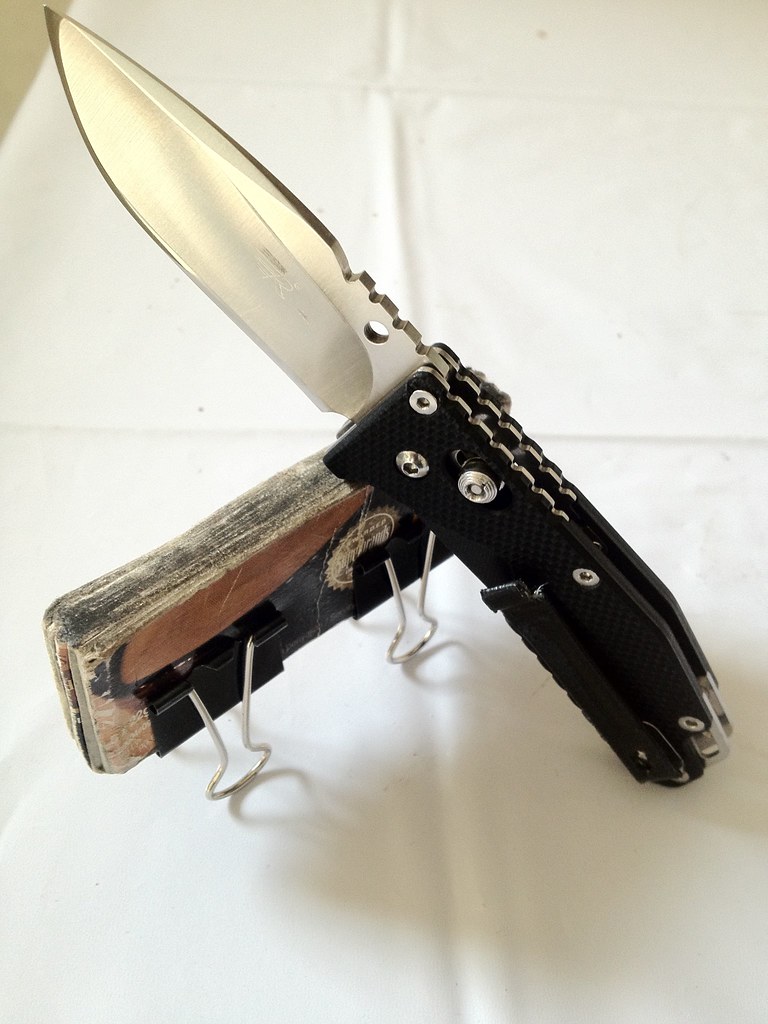
On second thought, handmade 'paper wheel'. I made one from instant coffee boxes, cut into rectangles, stacked them together and clamped it with paper clips (those black with handles). The exposed 'edge' of the cardboard makes good stropper, and stacked together, the thickness is enough to support the cardboards not to collapse under pressure from rubbing the edges.

Here is picture of it, hope it helps
6983964780_05920d6341_b.jpg

The black residue is resulting from using metal polish.
 
Last edited:
i managed to make my delica split hairs again by lapping it with metal polish on a smooth glass plate, no stropping. one guy on youtube used toothpaste on the rough side of a leather belt.
 
Back
Top