As far as a take-down holding up - as long as the guard fits the tang/shoulder area without any slop and the front of the handle is file-fitted to the tang, it would probably take action that is not suited to logical knife use to cause any problems.
You will also find NO slop in my pin fit from handle to guard/spacer.
I have beat repeatedly, knife after knife, time after time, on seasoned oak firewood and any other thing I can find around Andersen Forge, and have never experienced any type of failure.
As an aside to this, all of my JS submission knives were take-down, as well as the performance knife. And of course, before any normal thinking JS applicant would head off cross-country to do a performance test, he/she would perform the test over and over again at home with the performance knife.
Which I did.
I won't go into the entire test, but I didn't make a knife that would not just PASS the performance test, I made a knife that DEFIED the performance test.
My blade was so thick and heavy that I could not even insult it on the bend test. I needed a four foot cheater bar to accomplish the 90 degrees, and the knife assembly held up just fine.
I think the properly done take-down construction method is a little either misunderstood, or simply NOT understood.
It's more that just a couple pins and a threaded tang.
The tang runs completely THROUGH the handle creating an integral linear strength that can only happen with the threaded tang pulling everything forward INTO the guard shoulders..
I also quench and spherodize my tangs for really tight grain that makes the tangs themselves difficult to bend without locking the knife in a vise and bending with gloves on.
The only thing I've ever noticed as a result of chopping is that the threaded finial can work loose. So, a little teflon tape on the threads and she stays tight just fine.
Even the knives I make that are not take-down are still assembled with pins connecting the handle and guard and threaded tangs, which PULL everything forward into the guard shoulders. That assembly right there is the strongest hidden tang assembly I know of.
All that said - I don't know a knife that can't be compromised, and mine will hold up while performing any task that should be expected of a knife.
I do a LOT of Damascus, etching of hamons, hot-blued fittings, etc. I like the idea of being able to come back at a later date and tweak anything that needs to be done. The take-down assembly takes care of that.
You know, just use common sense in knife use - don't expect more than the knife is designed to do.
If you want a knife to perpetually abuse, and want no failure ever, just say so and I'd be happy to fill 'er up with epoxy.
It will still be assembled with pins to eliminate lateral twisting and a threaded tang and finial.



 .
.


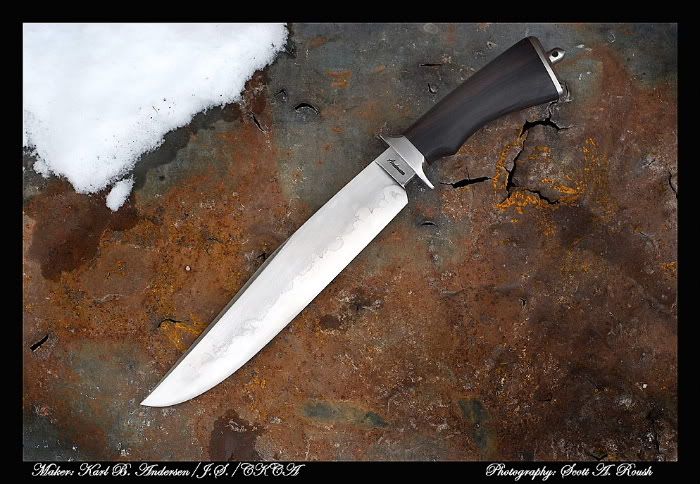
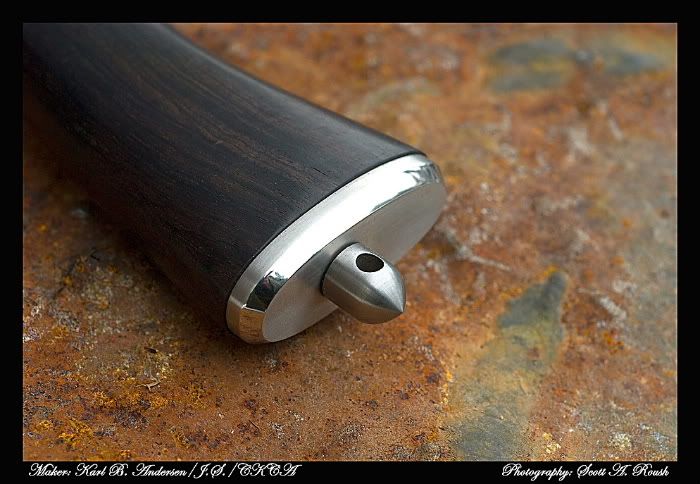


 ). Maybe without TOO shiny a blade as well. Stealthy choppa...
