
-
The BladeForums.com 2024 Traditional Knife is available! Price is $250 ea (shipped within CONUS).
Order here: https://www.bladeforums.com/help/2024-traditional/
You are using an out of date browser. It may not display this or other websites correctly.
You should upgrade or use an alternative browser.
You should upgrade or use an alternative browser.
Is the bevel messed up?
- Thread starter AdlerYeo
- Start date

Hickory n steel
Gold Member
- Joined
- Feb 11, 2016
- Messages
- 21,281
Is the bevel messed up as the tip looks a lot thicker than the back. How do I fix it?


The edge does look a little screwy, if you have a dremel and are careful you can fix it with one of those little sandpaper disks. You could also send it off to be reprofiled, I'm sure someone here on the bf's could do it for you.

- Joined
- Apr 3, 2011
- Messages
- 5,994
Yeah its just looks won't mess up function at all though... In fact it will probably help it 

stonesell
Gold Member
- Joined
- Feb 20, 2009
- Messages
- 1,491
Learning to sharpen is an ongoing process. Iv'e started to sharpen the tip area separately, to avoid a large bevel, and to keep the pointed profile. The other area near the ricasso, has also caused problems, since the knife is thicker there, and it's too easy to remove excess metal, creating an unwanted recurve. I have messed up a few expensive knives, but now I am much more careful to go slowly, and pay close attention. In your case, just use the knife until it needs to be resharpened, then try to make a smaller primary (cutting edge) bevel throughout. You can lower the shoulder a bit at 15 degrees, to make it easier to attain a small cutting edge bevel, about the thickness of a dime.
Towards the tip, the geometry often gets less favourable in thickness/height. That is why the tip's edge bevels often get broader. Some knives avoid this (especially if hollow ground to a thin edge all the way), but typically this is usually a good sign for a somewhat consistent sharpness towards the tip, not the opposite, especially if the blade has a fairly deep belly...
On blades with shallow bellies, the edge bevel width should be much more even, as there is less "excuse" for a wild disparity.
Towards the handle, there should be no difference in width if the knife edge has a proper "heel": If near the handle the edge is harder to sharpen the same, that is a problem with the overall design of the knife: I have found that knives with deep "heels" always sharpen better and more evenly all the way, but edge "heels" are often not present on fighting-oriented knives.
Gaston
On blades with shallow bellies, the edge bevel width should be much more even, as there is less "excuse" for a wild disparity.
Towards the handle, there should be no difference in width if the knife edge has a proper "heel": If near the handle the edge is harder to sharpen the same, that is a problem with the overall design of the knife: I have found that knives with deep "heels" always sharpen better and more evenly all the way, but edge "heels" are often not present on fighting-oriented knives.
Gaston
Last edited:
Nothing wrong with the sharpening, it is probably better than the original sharpening depending on your intended use. Looks like you sharpened it with a guided system and maintained the same angle all the way to the tip. I've sharpened with a guided system and achieved the same thing. So it will cut better because the angles are correct, but would be less strong for stabbing into tough materials.
This is kind of a pet peeve of mine- blades that come with varying angles towards the tip. It is hard to grind a blade with a lot of curve and keep good angles all the way out. When I look at a blade I like to think about how it is ground vs. how it should be ground to achieve good angles.
Look at how Spyderco grinds their Vallotton from the factory in order to achieve a reasonable edge all the way to the tip. They have to add a second bevel near the tip in order to be able to sharpen the edge all the way to the tip.
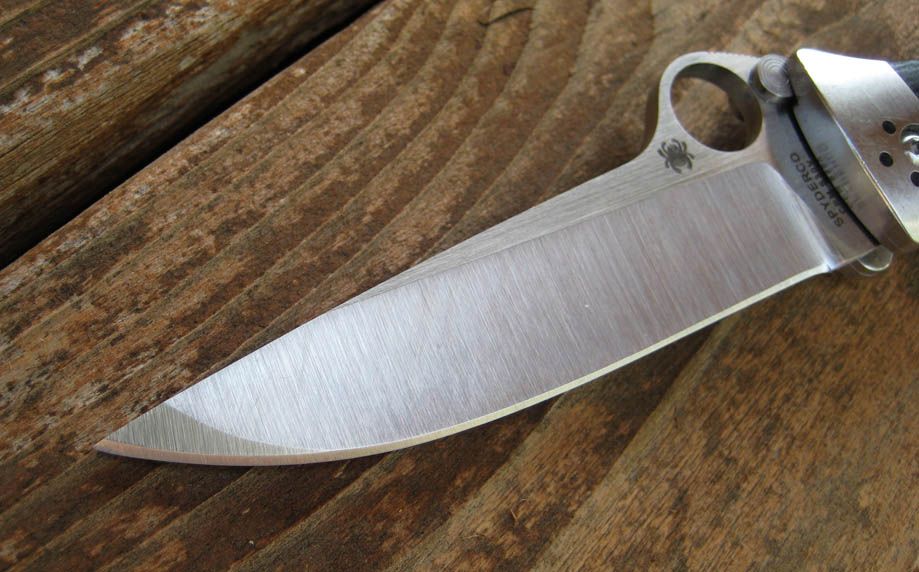
This is kind of a pet peeve of mine- blades that come with varying angles towards the tip. It is hard to grind a blade with a lot of curve and keep good angles all the way out. When I look at a blade I like to think about how it is ground vs. how it should be ground to achieve good angles.
Look at how Spyderco grinds their Vallotton from the factory in order to achieve a reasonable edge all the way to the tip. They have to add a second bevel near the tip in order to be able to sharpen the edge all the way to the tip.

- Joined
- Dec 27, 2004
- Messages
- 2,270
Could it be due to the recurve? How would the wider tip bevel help function?
The wider tip = a lower angle, which typically will cut better. It's not because of the recurve, as the edge goes toward the tip, it moves into thicker metal, so if it's the same angle as the rest of the blade, the bevel will get wider.
How are you sharpening this, and what knife is it?

- Joined
- Feb 2, 2005
- Messages
- 4,271
... How are you sharpening this, and what knife is it?
Looks like a Commander or mini-Commander. I have a mini-Com just like that. I'd just use it. Like Josh and cbwx34 said, it'll probably be a little sharper now all the way to the tip because of the lower angle.

- Joined
- Apr 12, 2009
- Messages
- 13,567
Yeah its just looks won't mess up function at all though... In fact it will probably help it
^This.
The wide bevel at the tip is likely just an indicator of how thick the steel is there, near the spine, assuming it looks essentially the same on each side (assuming it's not grossly unbalanced from side-to-side). Thicker steel near the cutting edge means wider bevels at a given angle. Narrowing the bevel's appearance can't be done without widening the apex angle at the tip, which won't help cutting or piercing performance at all. If the entire tip of the blade were thinned a lot, from the spine down, that could help (and Josh^ could help you with that
 ). But it's a lot of trouble for what is now mostly just a cosmetic issue.
David
- Joined
- Dec 27, 2004
- Messages
- 2,270
I usually use a diamond rod if that makes a difference
Hmmm, not really, since I'm guessing the wider bevel wasn't created with a diamond rod. You might look at getting a stone or something else to sharpen with... rods are typically used for maintaining an edge, and a diamond one can be pretty aggressive for the task. Can be used to sharpen, but there are better options.
one way to prevent this on a future knife would be to use a dmt or a stone of your preference and as you approach belly and tip raise the handle a bit...plan the outcome then mark it on the bevel with a sharpie. start at the heel and slowly and deliberately work your way to the tip. stop often to make sure you are hitting the marked areas and raise the handle at the belly and the tip...a slow and sweeping stroke.