Is wood enough to keep a linerless slipjoint together?

Joined
Aug 28, 2011
Messages
1,600
My urge to build a slipjoint is strong, and I'm wondering if one with wood scales and no liners would work.

I would have to find a type of wood that was strong enough, but I'm also worried about how moisture and drought may effect it.

Do you know about any slipjoints being held together with wood?
 
You might try your project using stabilized wood. It is phenolic resin impregnated and pretty well protected from water damage and warping. You can find it here on the forum from dealers. Or on that auction place. It isn't expensive and would be a good place to start I would think. Otherwise, you can buy a wrecked knife cheap with brass liners to use, or use sheet brass. Good luck!
 
It might, especially the stabilized wood Codger suggests, which resembles the resin more than the wood. But, I would thing it nearly absolutely necessary to use washers inlet into the wood at the pivots and center pin. Otherwise, I think the tangs are going to eat up the wood and the pins will get loose pretty quick.

Also, the birds eye rivets you see (cant recall the proper name) on shadow patterns to help give the pins some metal to "bear" on would be a great help as well.
 
I'm not sure, sounds like it should work though!

I'd also like to recommed Codger's suggestion as well, but be warned the task can be a bear to get them back together! I've only managed it successfully once with a Case sodbuster, then again I'm not very talented so that ould be why :p

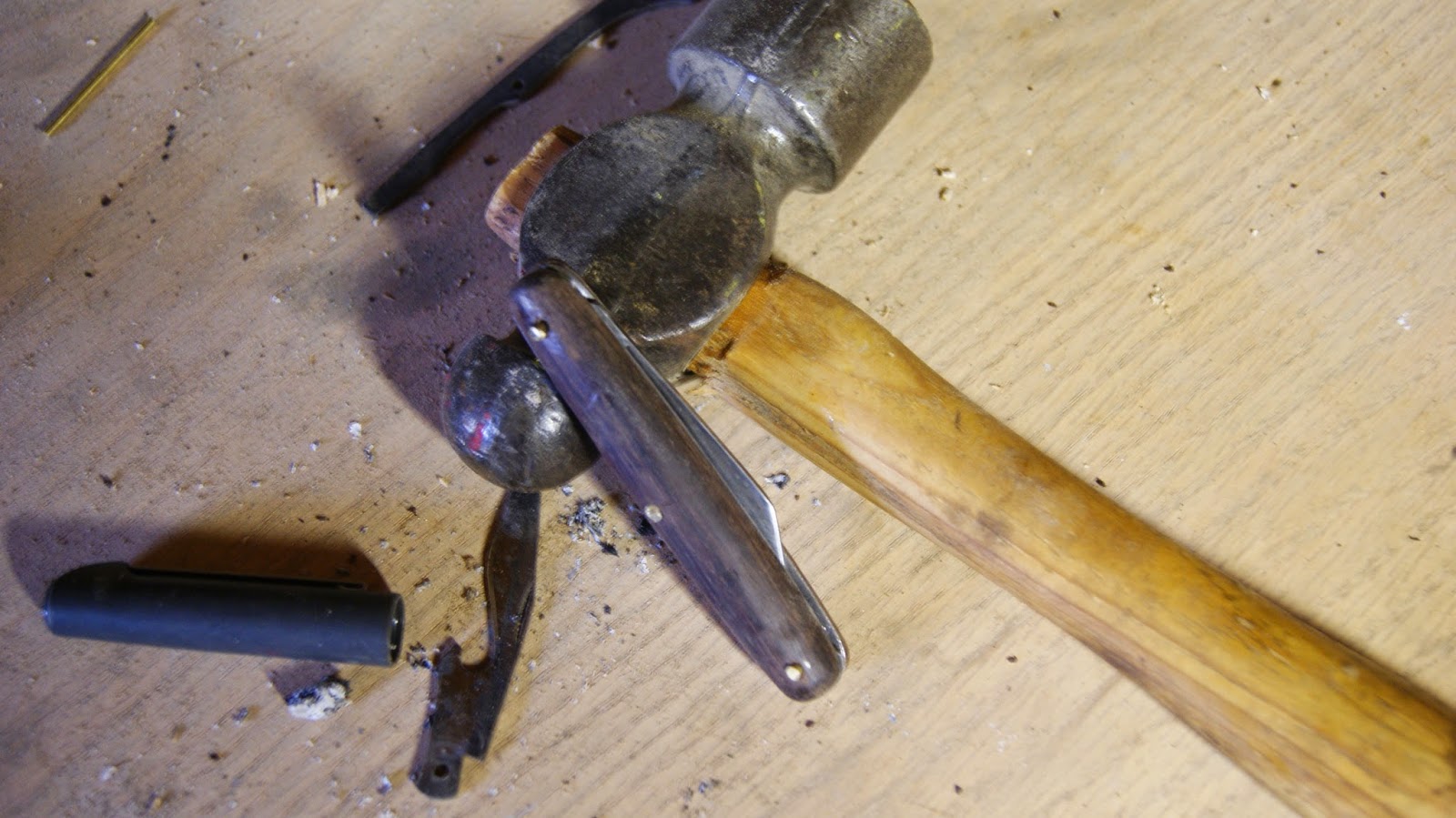
here's my lastest fail with a hammer brand that was all used up

DSC00780.JPG


I got it this far to find the blade and spring were not working together properly, it could fall out to a 45 degree angle when I turned it upside down :(

oh well, I learned this time form a post elsewhere that drilling holes into a hard surface to hold the pins while you work the whole thing together is a good help, and makes it less likely you'll cut yourselves putting the tension in the spring.

I'd recommend it as a good, fun and incredibly stressful way to spend your free time :D

Now I'll slink off, there are other successful and talented people around here who make this stuff look easy who can probably correct all that I just said :thumbup:
 
It might, especially the stabilized wood Codger suggests, which resembles the resin more than the wood. But, I would thing it nearly absolutely necessary to use washers inlet into the wood at the pivots and center pin. Otherwise, I think the tangs are going to eat up the wood and the pins will get loose pretty quick.

Also, the birds eye rivets you see (cant recall the proper name) on shadow patterns to help give the pins some metal to "bear" on would be a great help as well.

Is that the kind of pivot that is used on the GEC farm and field knives?

I hadn't even thought about stabilized wood, but maybe liners is the way to go.
 
I am with Codger. Maybe stabilised wood of a decent thickness may work. Rigidity is important. You should still try whatever you want. It is a great learn ing experience. Pm me if you have questions. I am new to this but I would be happy to help if I can.
nathan
 
Last edited:
I think it'll be a huge headache to go linerless with wood, especially on a slipjoint. As stated above the blade tang will likely dig into the wood, as will the spring end. There's a lot of force on a spring, and when it can't relieve the tension that's put on it vertically, it'll try other directions, like laterally. You've also got a huge amount of tension on the covers at the center pin, and most likely THAT'S where you'll see the covers fail by cracking. You're best bet on a linerless knife would be micarta or even better, G10. Stabilized woods, should you go that direction, are not necessarily stronger. Stabilization fills in voids and helps prevent shrinkage and to some degree splitting, but it doesn't lend a whole lot of extra strength as far as hardness goes. I'd stick with tried and true covers naturally high in resins like ebony or cocobola. Desert ironwood and hard pear are also good choices.

Eric
 
I would try true Lignum Vitae, it's been used as a bearing wood because of natural lubricity, is the most dense wood on earth so is as hard as you will find (won't float), and is actually quite attractive. I say give it a good try, high grit blade and wood finish, round off all mating surfaces in the blade tang, and go for it!

This guy has no liners, horn can work in a friction folder, I'm sure with enough foresight and planning (and lighter pull/spring strength) it's very doable!
603BD69C-9CAD-4A3E-A049-A57288573031-369-00000068952453A0.jpg
 
Back
Top