- Joined
- Oct 29, 2006
- Messages
- 2,912
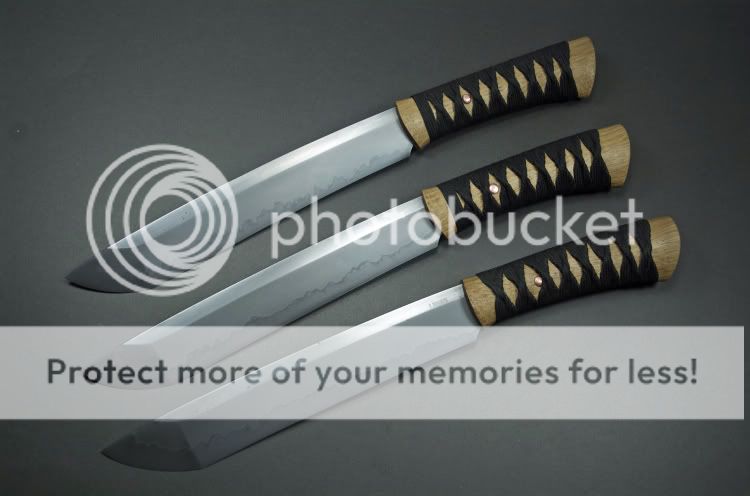
I just finished these three knives I'm calling Japanese Field Knives. They are inspired by the shinogi zukuri geometry of the samurai sword and some of the knives of Shosui Takeda.
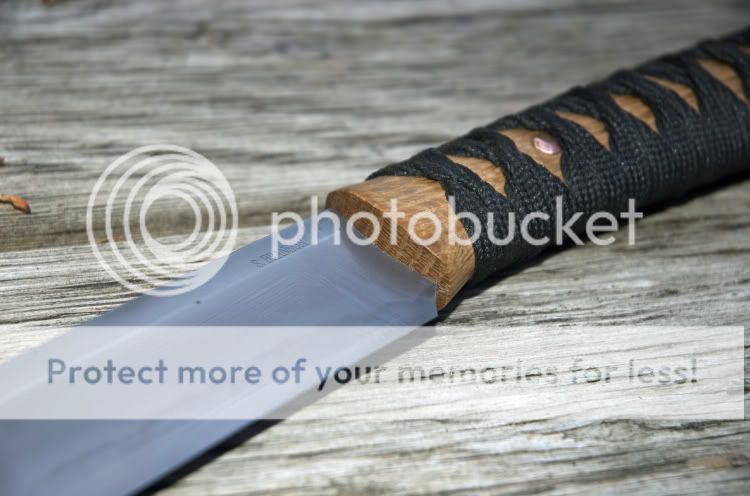
The blades are 10" of DHIII's W2 and the handles are 6" long in white oak with ito handle wrap and a peined copper pin.
I felt that with this design called for the longer handle. Small bits of forge scale are left on the upper bevel to capture the "utility" theme.
A few construction details... The handles were split rather than mortised so that I could keep the tangs quite thick, thicker than the blades. I hollowed out each side but as in a traditional tsuka, made one side deeper than the other so the force of impact would not follow directly on the seam. In this instance, with such thick tangs this is arguably unnecessary but a little extra insurance. Serving the same function of "extra insurance" is the copper pin. As the tangs are larger within the handle there is no possible way they could fly out. That fit of wood to steel took a lot of try fitting...
Further, the extra weight in the handle, combined with a distal taper gives these a well balanced feel, as one co-worker mentioned "they feel like a weapon as much as a tool".
The tips have a change in geometry and are counter polished for effect. The shinogi ridge line give these a nice "swoosh" sound as you swing them.
During heat treating this style of blade, I discovered that in water you get the curve upwards but in Parks 50 you get the curve downward. It must have to do with the taper towards the spine but anyway, in these I played that to the design and actually forged them straighter than they appear. The quench pushed them all downwards to give the profiles you see here. Neat stuff.
Here's some pics.
Thanks for looking!



The blades are 10" of DHIII's W2 and the handles are 6" long in white oak with ito handle wrap and a peined copper pin.
I felt that with this design called for the longer handle. Small bits of forge scale are left on the upper bevel to capture the "utility" theme.
A few construction details... The handles were split rather than mortised so that I could keep the tangs quite thick, thicker than the blades. I hollowed out each side but as in a traditional tsuka, made one side deeper than the other so the force of impact would not follow directly on the seam. In this instance, with such thick tangs this is arguably unnecessary but a little extra insurance. Serving the same function of "extra insurance" is the copper pin. As the tangs are larger within the handle there is no possible way they could fly out. That fit of wood to steel took a lot of try fitting...
Further, the extra weight in the handle, combined with a distal taper gives these a well balanced feel, as one co-worker mentioned "they feel like a weapon as much as a tool".
The tips have a change in geometry and are counter polished for effect. The shinogi ridge line give these a nice "swoosh" sound as you swing them.
During heat treating this style of blade, I discovered that in water you get the curve upwards but in Parks 50 you get the curve downward. It must have to do with the taper towards the spine but anyway, in these I played that to the design and actually forged them straighter than they appear. The quench pushed them all downwards to give the profiles you see here. Neat stuff.
Here's some pics.
Thanks for looking!