Japanese kitchen knife questions

Joined
Oct 31, 2004
Messages
1,442
So this question is not entirely unrelated to my last question.
I've been wanting to do a kitchen knife for some time, and the time is now. I decided to do a deba pattern (5" blade) for a couple of reasons: I like the shape, I thought it would be relatively easy, and therefore a good place to start, and they look pretty handy in the kitchen, even though I don't plan on butchering any poultry any time soon.
I've got the blade (actually two of them) cut out, holes drilled, and mostly profiled. As I plan to do a single bevel, I thought I'd heat treat the blade then grind it after. I'm using 1/8" 1084 (Aldo's) and quenching in canola oil. These are my questions:
1) should I harden the entire blade or just the edge?
2) How thin should I grind the edge before sharpening? If it makes a difference, I planned to do the primary bevel an inch wide (or a little wider).
3) What hardness should I shoot for? It is my understanding that japanese kitchen knives have harder edges (but softer spines) than european ones, but I don't know quite how hard I should go. This also relates to question 1.
4) I've never used a carbon steel kitchen knife before, so I don't know how concerned to be about rust. My tentative plan was to hand sand to 400-600 and finish with fine scotchbrite.
Thanks!
Chris

p.s. I'll post picture of the blade once I've got it profiled.
 
The Japanese kitchen knife freak in me wants to do more than answer your questions. However, I'll only say that I fear you have little idea of what a deba is, nor how it's used. I suggest you do a little research first and go from there. This isn't intended as anything more than what it says. Perhaps you just want the deba shape because you like it...which is perfectly fine. But, if you're after something true to original form, a little research could go a long way.

To answer your questions:

1. I really wouldn't matter. Traditional Japanese knives are made one of two ways...kasumi, or honyaki. Honyaki is a solid piece of steel, differentially tempered with a harder edge. Kasumi consists of a hagane, and a jigane. The hagane forms the cutting edge, and relatively all of the back (where the hollow is) and is made of the better material so to say.. The jigane is a softer layer on the front of the blade where the bevel is. Typically made of wrought iron or other material. So, traditionally, Japanese knives are made both ways...hardened through and through...or just at the edge.

2. This really depends on the use of the knife. A real deba is rather thick as it's intended use is heavy duty. However, a 5" deba is not a very common traditional knife. That would be like a 127mm deba....which I've never seen or heard of. I'm afraid to answer this one.

3. Your statement is not at all correct...see answer to #1 above. A typical white or blue steel deba is left softer than their yanagi style knife counterparts due to their heavy duty use....say real high 50's to low 60's...whereas the yanagi style knives are made a little harder....62 and up would be a good general guess.

4. I don't think a finish will affect rusting a lot. Don't let food particles or water sit on the knife for extended periods of time.
 
A one inch bevel on 1/8" materiel?

In my estimation, there should be about 1/2" inch single bevel on a little heavier blade. They are normally used for cutting through light bone, which still takes a fairly beefy edge.
 
I will follow up on Watercrawl's post. A small deba is 165mm edge length. General thickness of them are 4-5mm thick and are a single bevel knife. The back side of the knife has an urasuki, which is slightly(5 foot radius) hollow ground. You can do a double bevel deba but i might be inclined to say, use 3/16 stock. And most importantly, have fun!!!
 
Just for a point of reference, the 6 1/2" Tosagata Atsu Deba I have is double beveled and nearly 3/8" thick
at the handle. It has quite distinct distal taper.
 
Thanks for the input guys. I should have clarified a LOT more than I did, and I feel bad for asking such an unclear question. I'm not really trying to make a traditional deba, but more of a general purpose kitchen knife inspired by a deba that would be a little heavier than other general purpose knives. This is largely an experiment to try my hand at making a kitchen knife and to see how I like a pattern that will be very different from what I am used to. Since I do plan to use this (exactly how much and for what will depend on how I like it), I want to know what direction to go in for the geometry and hardness. The information people have given so far actually does help a lot, and I appreciate those who have answered.
Again, I feel like a jerk for leaving out such vital information from my question.

- Chris

p.s. from what I've read, 5" isn't so weird for certain types of debas: http://zknives.com/knives/kitchen/misc/type/Ai-Deba.shtml
 
I want to know what direction to go in for the geometry and hardness.

With 1/8" stock, if you want a slightly heavier duty blade, I would not do a full flat grind unless you have a very narrow knife....which a deba shape wouldn't seem to be. You, I believe, elude to this with the 1" bevel. Might not be a bad place to start.

As to hardness...I don't know 1084 all that well, but I would shoot for high 50's not knowing much else.

p.s. from what I've read, 5" isn't so weird for certain types of debas: http://zknives.com/knives/kitchen/misc/type/Ai-Deba.shtml

It's not common though and I would think a traditional deba that short would have very limited uses. Fileting guppies maybe. :)
 
I have done a few of these and they are a great multipurpose knife in the kitchen, prep of meats and vegs is made pretty easy.


1) should I harden the entire blade or just the edge? I dont think it matters, what ever you are comfortable with.

2) How thin should I grind the edge before sharpening? If it makes a difference, I planned to do the primary bevel an inch wide (or a little wider). I like a wide primary bevel, it gives you a very acute angle for a nice cutting edge, using aldos 1084 I dont think strength is going to be and issue with even hitting bone.


3) What hardness should I shoot for? It is my understanding that japanese kitchen knives have harder edges (but softer spines) than european ones, but I don't know quite how hard I should go. This also relates to question 1.

I would target 60Rc, might as well get good edge retention, as long as you use a cutting board there really is not much chance to damage the edge, I have chopped through beef bone with mine just to test the edge, no chipping or other issues . I think with 1084 in canola oil you probably will max out at 59 - 60 anyway. Using and electric kiln with aldos 1084 and canola oil I have had very little decarb so you can go pretty thin prior to HT, maybe 0.020 to be safe. Take the edge down to 0.010 with stones after ht, but flatten the back first with the stones.


4) I've never used a carbon steel kitchen knife before, so I don't know how concerned to be about rust. My tentative plan was to hand sand to 400-600 and finish with fine scotchbrite. I dont care what you do it will rust, that is what carbon steel does, You can always clean off the worst of it with a scotchbrite pad and bartenders friend or ajax powder. wipe dry after use and put a thin coat of oil on it to prevent rust. I saw one on the counter a couple of weeks ago and some drops of water got on the blade from somewhere, there were two small rust spots.

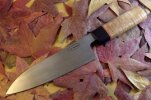
I make some kitchen knives up to 10" blade, but in my kitchen I grap a 6" all the time, I think its a comfortable size for all but cutting a big roast, Attached is a 1/8 with a full flat grind in stainless, buffalo horn and stabilize maple handle.


Thanks!
 

Attachments

  • HPIM5609.jpg
    HPIM5609.jpg
    66.9 KB · Views: 22
Last edited:
Keep an eye on the WIP sticky next week.

Sure i will!!! are You cooking something good in Your forge?
By the way the edge of my attempt to profane the japanese tradition (yanagiba) tend to be a straight line when grinding the bevel flat with the stones... one of the biggest challenge for me is to force a perfect plane into an upswept belly near the point of this kind of knives...i'll look for the WIP voraciously ;)
 
Back
Top