Japanese Whaling/Camp Knife - Well almost.. :(

Joined
Oct 29, 2006
Messages
2,912
This was inspired by a few sources. Firstly Don Fogg's Yakuza Bowie II.
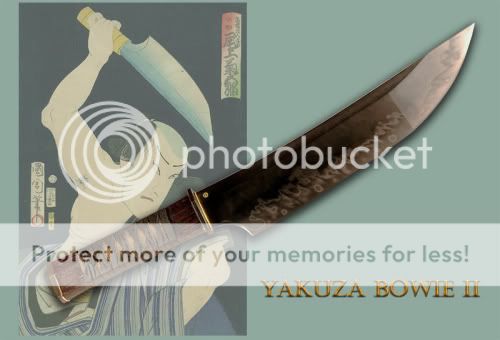
WhalingKnife8.jpg


And another version of this style of knife from another forum.
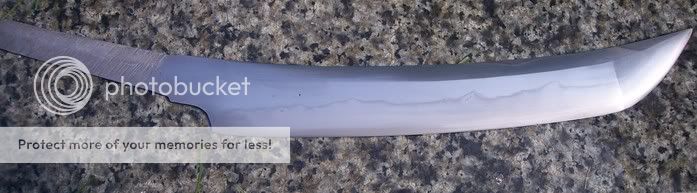
YakuzaShinogiside-02.jpg


Looking more closely at the woodblock print shows something I would like to make a little more closely but it does look like a very purpose driven design and I think where the drop to the edge is is probably a sharpened like a gut hook.

Picture3-2.png


For my intented purpose as a camp knife, it looked a little dangerous and not particularly useful so I altered the design quite a bit and also did not do the chisel grind like the originals... Hence the "Camp Knife" reference.

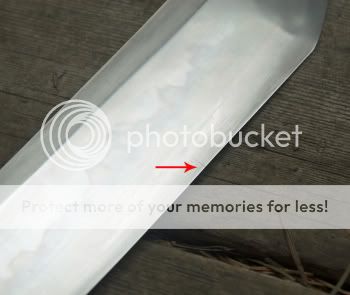
Anyway... The worst is yet to come.. I have been disappointed with Parks50 as a quenchant as one needs to forge to allow for the drop in the tip of the blade, the negative sori, and I have been having luck with water... well there is always a sacrifice and just when I thought I was safe, a quench that seemed to go perfectly.... tink!!:(:(:( I couldn't see it right away so I thought it may have been in the tongs (I told myself hopefully.:o)

But...

WhalingKnife6.jpg


WhalingKnife5.jpg


I didn't see it until I started to hand sand the blade... I had gone that far so I did a truncated polish job but did do some polish because it looked to have some great action in the hamon but I did forgo getting it super clean. I finished off the handle rather quickly too and did so to test the feel and durability of my wrap.

I'll use it around the yard and see if it still holds up. If not I will look at the grain.
Blade is 12" DHIII's W2 and the handle is 5 5/8" with wenge and cotton ito wrap.
The shinogi bevel is strongly tapered and there is a very pronounced mune. The blade is over 0.300" at the thickest part of the shinogi ji with a strong distal taper.

I figured I'd post it though as my first almost knife of 2012. I like the design and will do it again,, maybe with Parks 50 though. :o:o
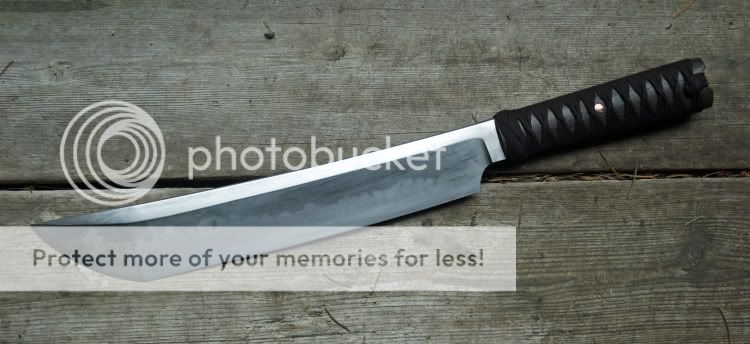


WhalingKnife2.jpg


WhalingKnife4.jpg


Happy New Year!
 
Last edited:
There we go, Stuart,

I know how it feels,

Great hamon, though, and the handle looks neat.

John
 
Looks like it would be an EXCELLENT camp knife Stuart. Too bad about the crack:( ..GREAT looking hamon though:D

Peter
 
Oops... forgot the hamon photo.

Yeah John, I saw your problems with the weld.. sorry about that...
 
Cool design and wicked hamon. Too bad about the "tink". Ouch.

Roger
 
so you're actually going to have a finished knife for me to ogle during our visit tomorrow? Can't wait!
 
That sucks .........the crack I mean :)

Great project and looking forward to round 2
 
That's too bad ... but it is indeed the risk when water quenching. I've heard the old 'tink' so many times. The frustrating thing for me is that when it happens on the larger blade.. it happens again with the small knives I try to salvage. Probably because of small hair line cracks. Oh well... the price you pay for the most active hamon.

Anyway... very cool looking blade. Should be fine for you around the house though.. I have a number of those.
 
Thanks.. In some ways I don't mind as long as it holds up. Now I have no choice but to keep it :p:)
 
That is awesome. I loved Don Fogg's the first time I saw it and I love this one as well. That sucks about the "tink" (or as I've seen it termed, "the dreaded ping"). I'd be curious to hear how it holds up in use with that crack.
 
Being differentially hardened I can't imagine the top of the blade falling off but I wonder if, when trying to pull it out of a log or something, it'll twist along the fault.

I hear the sound referred to "ping" but to my ears it's most certainly a dreaded "tink".. :p
 
I'm sorry about the "tink"! This is an incredible design and besides the "tink" it looks amazing. The hamon, profile and handle are all outstanding. I really admire your work, thank you for sharing.
 
I should add that I think that Fogg piece is one of the coolest knives I have ever laid eyes on, and I'm tickled pink to see someone try a piece in that style. Stuart - please give me a heads-up when you have another go at it.

Roger
 
"Tink"...maybe it was a bird or an echo...should I look? No, it's fine..but you know..
I test "mystery" steel by heating and quenching in cold water..they never crack until you put hours in them..
Very nice knife...
 
Thanks Stuart for sharing your misses along with your hits! That is a fine looking piece! Good luck with the next go round... I look forward to seeing it!
 
my wife and daughter enjoyed the Branson's hospitality yesterday, and I GREATLY enjoyed 'whaling' away with his knife. The high grind made for a wickedly thin profile and the edge bit extremely deep into whatever it encountered. For such a big knife, it wasn't at all unwieldy, and I figure the upper grind and distal taper was the main reason for this. The handle fit in my hand quite nicely, even though Stu has freakishly big hands- I mean, each of his fingers was a good inch longer than mine! Freakish! But a great handle. We discussed the addition of a turk's head at the end of the handle, and I hope that Stu puts in a little extra time even with the little crack, (which didn't show any sign of growing even though we spanked his knife pretty good).
My wife took some pictures of our xmas tree bonfire, hopefully I'll find some and post them.
Great fun, Stu! Thanks for having us.

ps. I left a tantoish design with Stu, and maybe just maybe one day it will turn into a real knife:D!
 
Stuart,

I didn't know Parks 50 produced a negative sori, good to know as I'm looking for some. Also, since you have done some successful water quenches, what do you think happened in this case? A different grind? Water too warm, too much salt? Heck, a passing cloud. Seriously though, what was different?
 
Thanks Lorien, we had fun too. Seeing as this is destined to be my knife, I did add the turks head to the butt and I put a little epoxy on both knots and along the spine and underside of the ito wrap to secure it better but left it off the sides to keep the softness of the cotton.

IMG_4463.jpg

I really enjoyed all the knives you brought and comparing the geometries particularly up against this one. This by far bit the deepest but I learned something about a good chopper in that having the thin bevel didn't clear chips as well. You need a little meat behind the edge to break out the wood.. interesting.


I didn't know Parks 50 produced a negative sori, good to know as I'm looking for some. Also, since you have done some successful water quenches, what do you think happened in this case?

-my 2¢..?

When I first got into making hamons, I could never get the pattern I wanted. The clay was a guide but it never really worked how I intended. I couldn't figure it out until I saw Nick Wheeler's thread wherein he had some hamons produced without the clay and I realized how much the geometry had an effect. I noticed that I was used to testing "non-magnetic" too close to the edge and up in the clayed area, it was still under critical. After a few "low" hamons, I started watching the height of the austenitic area. But, when doing a water quench, if the whole blade is austenitic then it usually shatters so it's a balance between heat differential, geometry and the clay.. Still trying to figure it out but doing radical geometries like this introduces variables that are hard to gauge. Other large blades I've done have had low hamons so I went a little lighter on the clay, relying on some geometry interaction to get my hamon. I think you can see that in the really stormy area that happens where the yokote is. This yokote area introduces a variable because of the thickness changes..

But to your question... I am really wanting to try doing a full immersion quench without interruption because of a comment Bill Burke made in a thread of mine some time back but I've been too chicken.. I held it in for about 4 secs, interrupted for about 2 secs, back in for 4-5 then out for a couple seconds then I figured I was safe so I put it back in to finish cooling.. "tink"... I should've stopped after that second dunk and gone to the oven and clearly this was a case where if I hadn't interrupted, it would have probably failed much more spectacularly.

In the end what I really think happened was that the geometry was compromising to the stresses of a water quench. There was just too much edge and as the spine contracted it broke.. If you look at hardening a Japanese sword, the blade itself, the shape and the geometry is very much part of the reason water quenching works, or so I figure.

The issue of Parks50 and negative sori, I think, is very dependent whether the blade is fully austenitic or not. I have to experiment but I suspect that with the safety of Parks50, you can heat the whole blade with a little bit of clay where you want some hamon and quench. There may be a little drop but I doubt it is as dramatic as when the blade is only austenitic half way up the blade. I'm going to try this next time. I have shied away from that as getting a thick spined blade fully austenitic risks unwanted effects to the steel at the edge. (or so I figure)
 
Last edited:
I really enjoyed all the knives you brought and comparing the geometries particularly up against this one. This by far bit the deepest but I learned something about a good chopper in that having the thin bevel didn't clear chips as well. You need a little meat behind the edge to break out the wood.. interesting.
this is what I'm sayin...

so the crack, are you saying that the soft back of the blade contracted more than the hardened and thinner edge area, and due to the width and additional leverage, pulled the hardened area enough to crack it? I wonder if you left more material along the spine instead of grinding it off before hardening, whether it would have cracked it at the edge. I guess one benefit of differential hardness is that it's easier to grind the spine away due to its softness after hardening and more or less standardize the thickness along the spine before, (in relation to the edge) in order to have more consistent results. All that geometry, if added before hardening would certainly add some variables that might not need enter the equation.
I clearly have no idea what I'm talking about, but I will hit submit anyway. Wouldn't be the first time;)
 
My humble comment about the negative sori in an oil quench:

I have seen it in some of my blades with my veggie oil quench. Geometry is a major factor. Where I've seen it most prominently have been in my Japanese-style blades, where I deliberately put in more curve than I want and they straighten up to just right in the quench. On most of my other bush swords that have wider blades, multiple distal tapers, and a bit thicker spine, I don't get it enough that I notice.
 
Back
Top