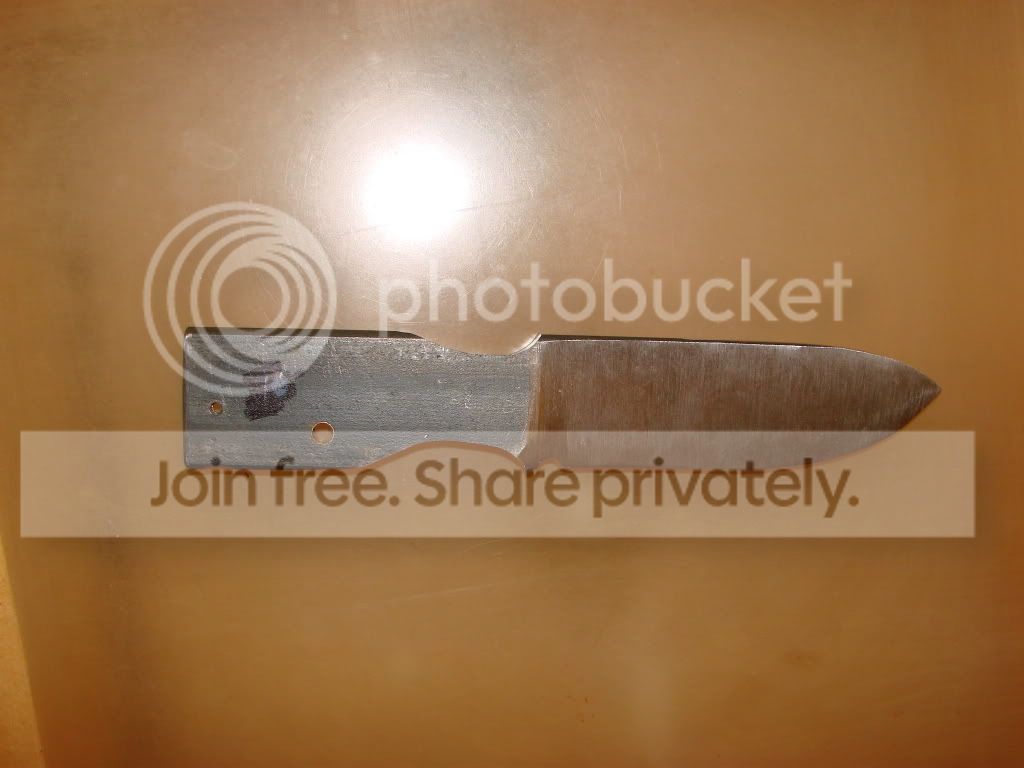
Just cut off my first chunk of 5160.

Joined
Apr 17, 2010
Messages
1,343
I recently ordered a piece of 1.25"x.25" 5160, and it came in a few days ago. I've never worked with 5160 before now.

I spent half an hour looking for a hacksaw, finally just said "screw it" and went at it with a 4" cut off wheel on an air angle die grinder.

Man but this stuff grinds nicely! I'm really excited about starting in on the machining and grinding on this tomorrow.

I'm setting up the layout marks on it right now. Hopefully this will turn into a "beefy" 1/4" thick FFG PSK-style fixed blade. If it turns out halfway decent I'll post some pics before I send it out for heat treatment.
 
Go to the last bathroom that you spent a considerable amount of time in doing some business. The hack saw should be right on top of the latest copy of Blade magazine and there is probably a pair of safety glasses sitting next to it by the black smudge you left on the counter top!:p:D

Have fun with that bar, post up some results!
 
Go to the last bathroom that you spent a considerable amount of time in doing some business. The hack saw should be right on top of the latest copy of Blade magazine and there is probably a pair of safety glasses sitting next to it by the black smudge you left on the counter top!:p:D

Have fun with that bar, post up some results!

:D I use a full face shield, not safety glasses. And it goes into a dust cover as soon as I'm done with the grinder.

The fact of the matter is I haven't had to use a hacksaw very often for a long time, and they all got moved to the "unused tool" storage space in the barn. Since the barn is a 200 yard slog through a muddy field away from the shop, I kept looking to see if I could find an extra hacksaw that got left in the house or shop somewhere.

I should be able to start the belt grinding today after I do a little hogging around the edges.
 
Okay. I'm running into a bit of a problem here. The stock I am working with is 1/4" thick from McMaster Carr. I assume it is a tough spring temper, because it is easily cut with a file, and grinds nicely, but is hard enough to damage some tools. After I drilled one hole with no issues before starting to grind, when working on the second hole after some roughing it destroyed a titanium nitride coated 9/64" bit after I drilled a smaller pilot hole with no issue.

I've only worked with various stainless and some 1095 before(all rather thinner than 1/4") and never had a problem using TiN coated HSS bits. Should I buy a bunch of cobalt screw machine drill bits for working with steels like this (probably spring-temper) 5160? Perhaps should I get TiN coated cobalt bits, even?

Here's a picture of the piece as it is now, for the curious:
DSC02510.jpg


All I've done so far is hogging, no finish work at all yet.
 
What are you using to drill with. Spring steel requires a much slower speed than most realize. 1000rpm might be too fast for some of these steels. A good rigid drill press is a must to make the TIAN drill bits worth the difference in price. IF you are using a hand drill go a slow as possible and use a cutting oil. If you can cut it with a file you can drill it at the proper speed. Good luck and keep on grinding.
 
I was using a Buffalo drill press with the belt on the 800 RPM pulleys, and was using a sulfur cutting oil. The other speeds available are 1500 RPM and 3000 RPM, which I thought would be too fast, and you seem to agree on.
 
My machine shop training has been almost all OJT. That being said, when it comes to drilling steel, slower is just about always better than fast. I seldom drill at speeds above 600 rpm on a drill press, in metal. Much slower with bits over 1/2 inch. I haven't had much luck with the TiN bits either.They seem to like different speeds and feeds than the HSS that I normally use, and sometimes even seem to perform better with little to no lube. I do try to stay away from any of the black oxide colored bits. Many of the ones I used were improperly ground or something, as they either wouldn't cut at all or burned up/broke very prematurely.
I'd be looking into modifying that press to run alot slower. Maybe adding a 2:2 step down between the motor and the first pulley. I'm sure it'll be a PITA and won't be pretty, but the benefits of having it slower will be worth it. And It will probably be cheaper than a new press with the lower speeds.
 
Assuming you meant a 2:1 step down ratio rather than 2:2, that would give possible speeds of 400, 750, and 1500 RPM. Would these be useful speeds for drilling in most of the stock used in making heavier duty knives?
 
Try removing the mill scale before drilling, your drills will thank you.
I soak the steel in ferric chloride for about 30 minutes then use a wire brush to remove scale. Vinegar works too, but is slower/longer soak. Scale will not only ruin files, drill bits, and hacksaw blades, but will even ruin ceramic grinding belts in short order.
 
Assuming you meant a 2:1 step down ratio rather than 2:2, that would give possible speeds of 400, 750, and 1500 RPM. Would these be useful speeds for drilling in most of the stock used in making heavier duty knives?

I think that is what was meant, and yes, those speeds would work much better.
 
I have had this problem when working with 5160 too. The steel was 5160H purchased from two seperate sources. One hole would drill just as annealed steel should and another would dull the bit and scream like the steel was not fully annealed. When I messed up a couple band saw blades I started cutting my stock with a cutoff saw and re-annealed the pieces before proceeding any further. Since I have been doing this I have had no problems.
Always remove the scale from 5160, I have found hairline fractures in 5160 that were not noticable with the mill scale on. At first I thought this was just a bad batch from the mill but after doing some research on the web I found where others have noticed the same using 5160.
 
Try removing the mill scale before drilling, your drills will thank you.
I soak the steel in ferric chloride for about 30 minutes then use a wire brush to remove scale. Vinegar works too, but is slower/longer soak. Scale will not only ruin files, drill bits, and hacksaw blades, but will even ruin ceramic grinding belts in short order.

It seems to me we should throw away the steel and make our knives from just the mill scale.

- Paul Meske
 
It seems to me we should throw away the steel and make our knives from just the mill scale.

- Paul Meske

Iron oxide (mill scale) is used in the glassworking industry as a polish. Unfortunately it is rather fragile when it is not backed by unoxidized steel... Kind of like obsidian, it holds an edge forever, until you try to use it, then it chips and/or shatters.
;)
 
Back
Top