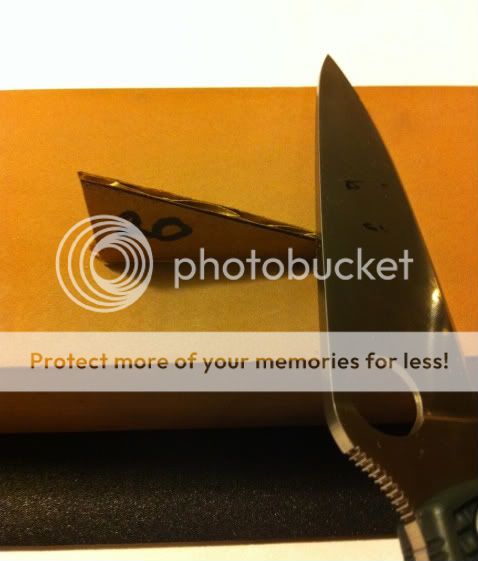
For what it's worth, your knife doesn't have to be at 20 degrees. Rarely are the factory bevels that consistent, anyway. Most manufacturers 'recommend' a certain angle for their blades, but that's always based on the assumption it's in that ballpark to begin with (it often isn't). If your edge looks like it has a decent bevel on it already (sharp, and relatively symmetrical from side-to-side), then focus on keeping the blade at whatever angle is necessary to maintain flush contact with your stone. The best way to do that, is to mark the bevels with a black marker (Sharpie, for example), and then make a pass or two on your stone. Look to see where the ink comes off, that'll tell you what adjustment needs to be made with the angle. If the ink comes off at the very edge, but not further up on the bevel, that tells you the angle is a bit too high. Conversely, if the ink comes off at the shoulder of the bevel, but not at the very edge, that means the angle is a bit too low. Adjust accordingly, until you see you're consistently removing the ink across the entire bevel, from edge to shoulder.
It's possible, maybe even likely, the angle will be at least slightly different on each side. That's why it's best to focus on maintaining flush contact with each side, so long as the mis-match in angle isn't too extreme. If that's the case, your choice is to either reprofile to even it up (big job), or send it back to the manufacturer to have it resharpened. If you haven't actually bought one yet, try to get your hands (and eyes) on one to inspect the edge, before you buy it. Look to make sure the bevels look even & symmetrical. A new knife with a truly good factory bevel will be MUCH easier to maintain, down the road.
Edit:
Almost forgot. Just wanted to say, 'Welcome!

'