
- Joined
- Jan 2, 2004
- Messages
- 174
I received this knife as part of a passaround being conducted by Walking Man. Since it will “pass” through the hands of 9 others over the next few months, my review will leave plenty of holes for them to fill. In fact, I wont spend any time on cutting performance, which is awesome, and instead I’ll try to give my impressions on the design and feel of the knife.
BTW, passarounds are the best medicine if you have knife fever. I encourage everyone to try one out sometime, just lurk on the passaround part of the forum and eventually something you like will appear.
Specs
(Note all measurements are my own and should be considered approximate):
KAI Model # DM-0500
Overall length: 12.75 inches
Blade length: 8 inches
Handle material: Ebony Pakkawood
It comes with a bamboo stand for display.
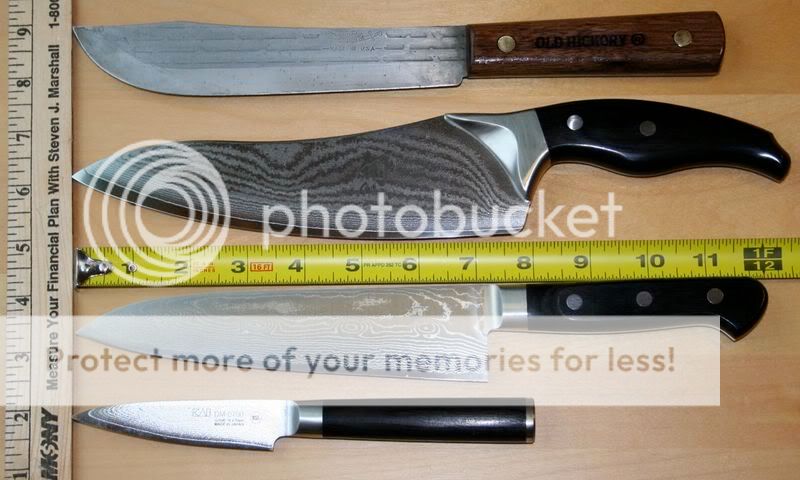
Group photo for size comparision:
Ontario Old Hickory 7” Butcher’s knife
Shun Onion
Hattori HD-6 Chef 180mm
Shun Classic 3.5” Paring
The first time I saw pictures of the Shun Onion I can remember thinking that it had a touch too much “Klingon” in the design for me. Now that I’ve had my hands on it and lived with it for a week, I realize that those design elements are not just for looks but also for brilliant ergonomics.
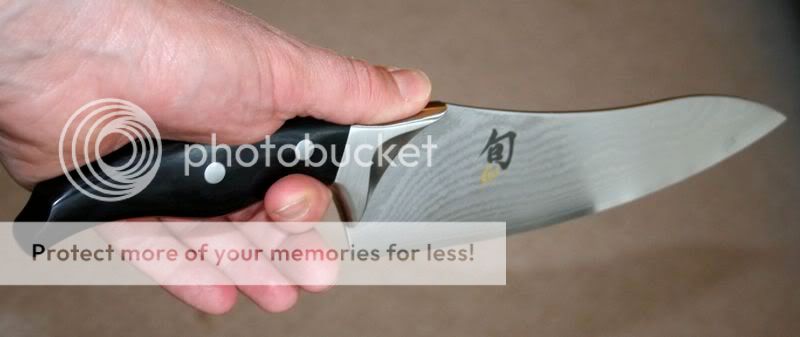
Yes it is blade heavy, but not as much as I thought. This picture shows the approximate balance point, just in front of the guard where many people prefer it.
(Note: Not only was this a very unscientific way of showing the balance point, it’s also a stupid way of finding it. The palm of my hand should have been on top of the blade to avoid a possible trip to the emergency room.)
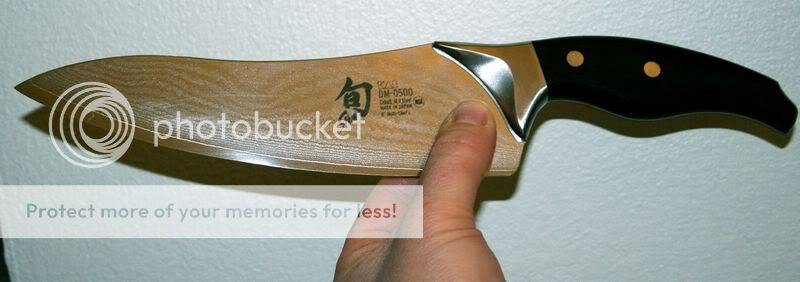
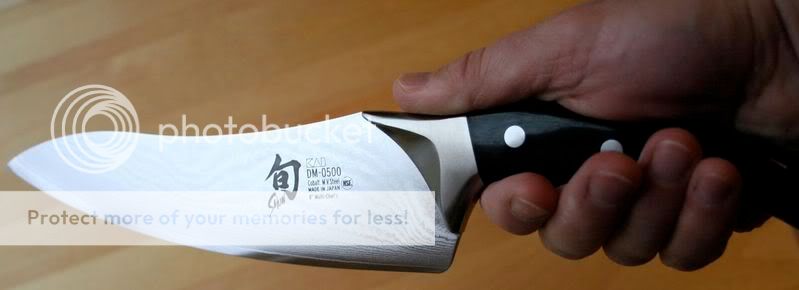
This shot shows the handle. It is contoured to fit your palm and comfortably counter the blade. Notice how the tang extends approximately ¾ of the way through the handle.
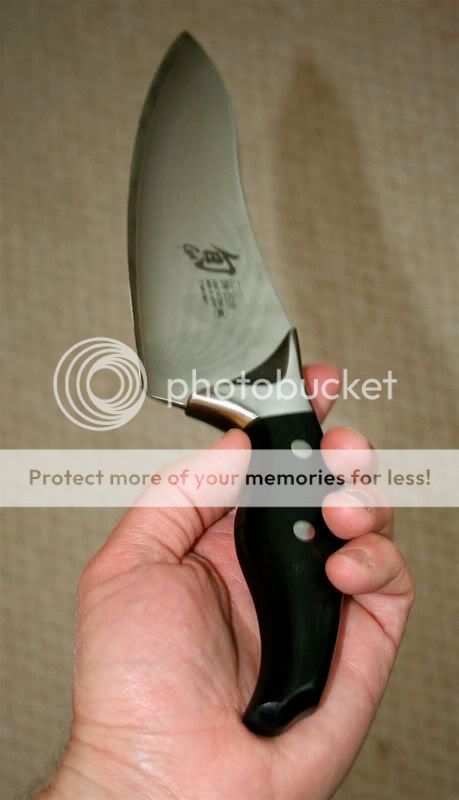
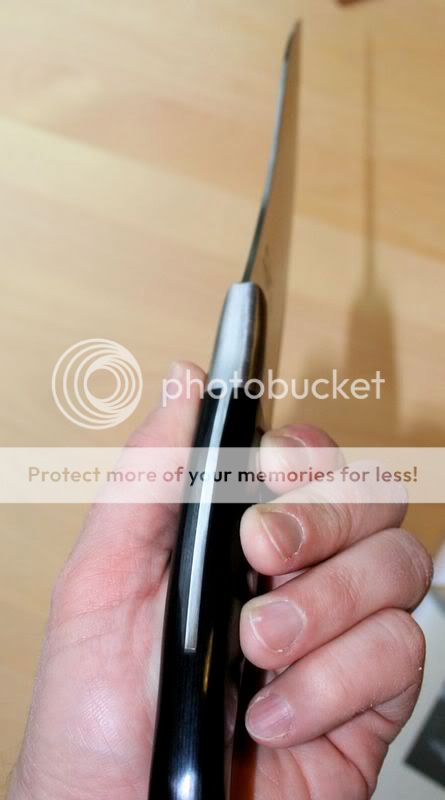
The handle felt very comfortable in either hand.
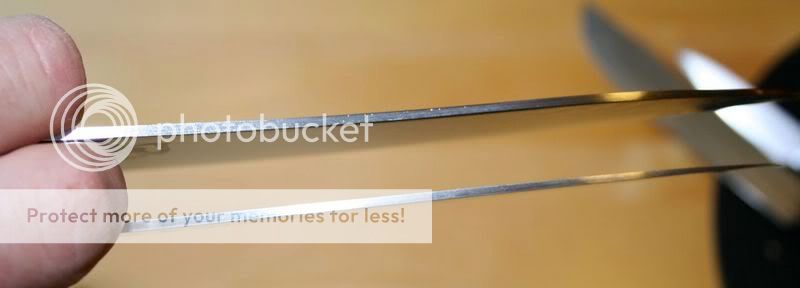
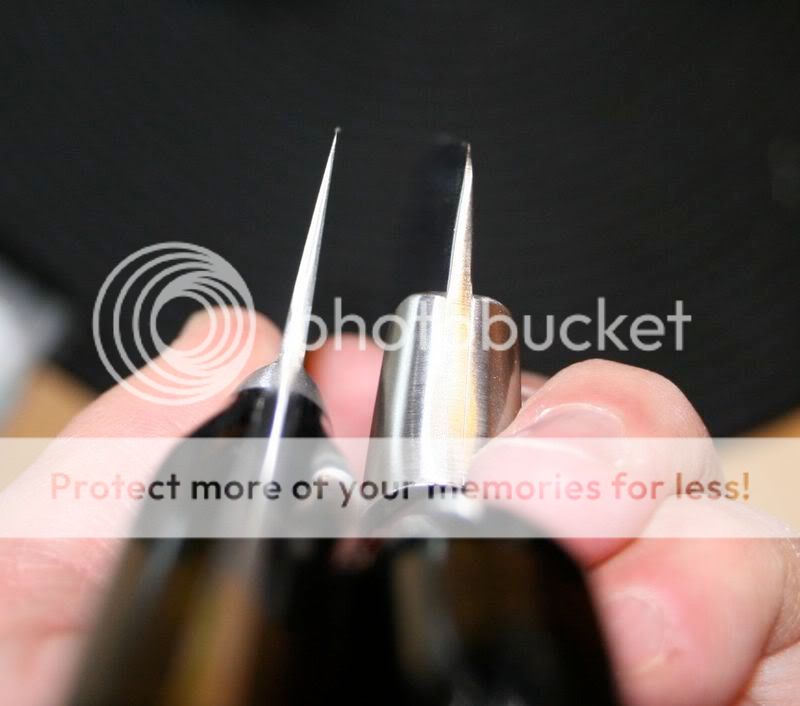
The only knife I have that is even close to the class of the Shun Onion is my Hattori HD-6, which I dearly love. These pictures compare blade thickness at the spine and the business end. Notice how far the guard on the Shun Onion extends down the blade. (The first picture has the Shun on top. The second picture has the Shun on the right.)
I tend to “baby” the Hattori and treat it like a delicate laboratory instrument because the blade is so thin. While I was very careful with the Shun Onion (remember it isn’t mine), it really had a more robust utility feel to it.
Overall, I was thrilled to have the Shun Onion for a week. It’s truly a showpiece for anyone’s kitchen.
BTW, passarounds are the best medicine if you have knife fever. I encourage everyone to try one out sometime, just lurk on the passaround part of the forum and eventually something you like will appear.
Specs
(Note all measurements are my own and should be considered approximate):
KAI Model # DM-0500
Overall length: 12.75 inches
Blade length: 8 inches
Handle material: Ebony Pakkawood
It comes with a bamboo stand for display.
Group photo for size comparision:
Ontario Old Hickory 7” Butcher’s knife
Shun Onion
Hattori HD-6 Chef 180mm
Shun Classic 3.5” Paring
The first time I saw pictures of the Shun Onion I can remember thinking that it had a touch too much “Klingon” in the design for me. Now that I’ve had my hands on it and lived with it for a week, I realize that those design elements are not just for looks but also for brilliant ergonomics.
Yes it is blade heavy, but not as much as I thought. This picture shows the approximate balance point, just in front of the guard where many people prefer it.
(Note: Not only was this a very unscientific way of showing the balance point, it’s also a stupid way of finding it. The palm of my hand should have been on top of the blade to avoid a possible trip to the emergency room.)
This shot shows the handle. It is contoured to fit your palm and comfortably counter the blade. Notice how the tang extends approximately ¾ of the way through the handle.
The handle felt very comfortable in either hand.
The only knife I have that is even close to the class of the Shun Onion is my Hattori HD-6, which I dearly love. These pictures compare blade thickness at the spine and the business end. Notice how far the guard on the Shun Onion extends down the blade. (The first picture has the Shun on top. The second picture has the Shun on the right.)
I tend to “baby” the Hattori and treat it like a delicate laboratory instrument because the blade is so thin. While I was very careful with the Shun Onion (remember it isn’t mine), it really had a more robust utility feel to it.
Overall, I was thrilled to have the Shun Onion for a week. It’s truly a showpiece for anyone’s kitchen.
