Kershaw 14C28N owners, do your edges nick/fold easily?

Joined
Dec 8, 2010
Messages
340
I'm on my third Kershaw 14C28N knife.

I absolutely love this steel for its ability to take a shaving sharp edge with little effort. That said, I'm on my third knife using 14C28N, and every one has had trouble with getting folds/nicks in the edge. FYI, the hardest thing I cut is plastic clamshell packaging, and the most abrasive is cardboard.

All three knives have been used with their factory bevel and strop, and only resharpened using a steel to realign the nicks, and a strop to tune the edge back in. In rare cases where the edge folds badly enough, I'll use a fine stone to take the burr off.

Is Kershaw's factory angle too steep for this steel and the hardness they're treating to?

By "too steep" I don't mean they've made a mistake... I mean, is it too steep for use as a utility edge?

The factory bevel they use combined with the factory strop means that every one of the three knives I've gotten has been literally as sharp as a straight razor. This latest knife was so sharp I could literally shave my face with it, and I've NEVER had a pocketknife I was able to do that with the factory edge.

What I'm wondering, is whether the bevel they use to get that amazing edge also makes the edge somewhat fragile in certain situations. What's strange is that my cheaper, Chinese made Kershaw chill with 8CR13MOV does not have the same problem... that edge is very sharp but somewhat bulletproof compared to the USA 14C28 knives I've gotten. In fairness, the Chill isn't quite as sharp as the 14C28's either.
 
I've never had a problem with 14c28n folding or chipping on me during use? Are you sure you aren't coming into contact with something hard like a staple or whatever is in the clamshell packaging during use?
 
I've never had a problem with 14c28n folding or chipping on me during use? Are you sure you aren't coming into contact with something hard like a staple or whatever is in the clamshell packaging during use?

Not as far as I know... I'm extremely careful almost to the point of paranioia, because I'm a minimalist with sharpening my knives, and hate having to tune the edge uneccesarily. I usually inspect very carefully for staples, and am careful when cutting packages not to hit the blade on any of the contents.

For example, today was my first day with the new knife at work. I cut open two heat-sealed clamshell packages, several blister packs, a couple carboard boxes sealed with normal clear tape, and opened up a few envelopes.

At the end of the day when I sat down at my computer to wrap things up, I inspected the edge hoping to see perfection, instead I see three distinct nicks... they were bad enough that they caused the knife to catch as I was drawing it across my steel to realign the edge.
 
no, they don't nick very easily. i had one i was hacking away at wood with, and it is just fine.
 
Not as far as I know... I'm extremely careful almost to the point of paranioia, because I'm a minimalist with sharpening my knives, and hate having to tune the edge uneccesarily. I usually inspect very carefully for staples, and am careful when cutting packages not to hit the blade on any of the contents.

For example, today was my first day with the new knife at work. I cut open two heat-sealed clamshell packages, several blister packs, a couple carboard boxes sealed with normal clear tape, and opened up a few envelopes.

At the end of the day when I sat down at my computer to wrap things up, I inspected the edge hoping to see perfection, instead I see three distinct nicks... they were bad enough that they caused the knife to catch as I was drawing it across my steel to realign the edge.

Wow, that's really strange. Rolls are usually caused by grazing something hard while you are in a cutting motion. Nicks are usually the result of either pushing down into something as hard or harder than the blade steel or when the blade slightly twists while cutting some harder materials. I've tried to cut tightly wrapped plastic tie wraps and because I twisted the blade ever so slightly it has caused a chip in the blade.
 
Wow, that's really strange. Rolls are usually caused by grazing something hard while you are in a cutting motion. Nicks are usually the result of either pushing down into something as hard or harder than the blade steel or when the blade slightly twists while cutting some harder materials. I've tried to cut tightly wrapped plastic tie wraps and because I twisted the blade ever so slightly it has caused a chip in the blade.

Ok, I think I may have it sorted, I just benched the blade and got it tuned in. I did a test cut on another clamshell, and it "nicked" the blade again. The good thing is I think it helped me see what is going on.

On all of the Kershaw's I've gotten, they grind both sides of the blade to an even bevel, then do a fairly heavy strop on one side, but not the other.

I think what happened, at least on the knives I've gotten, is that this method formed sort of a semi-wire edge.

When I started working on the blade just now, I aligned it first with a steel... I noticed that on the strop side, the steel would glide fine right over the nicks, but on the non-strop side, it got caught on them... which means the nicks were all leaning to one side (actually "rolls" would probably be more accurate at this point). That points to blade geometry issues, not blade steel or hardening.

The second clue was that it formed a light burr on the opposite side when I steeled the strop side, but when I steeled the non-strop side, it formed an extremely sharp burr on the strop side.


I kissed both sides very lightly on a fine stone to correct the edge, then stropped the hell out of both sides. The blade easily came back to the shaving sharpness it was out of the box... except this time, when I cut the same exact clamshell in the same area, the edge didn't bat an eye.


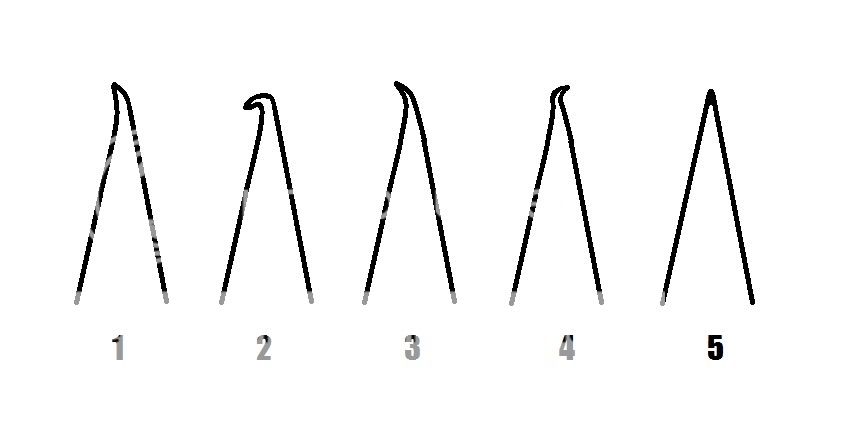
I'm going to mspaint a couple drawings real quick and edit them in to this post.

edit: Here, I just did one drawing.

I numbered the different blade states. In the drawing, we're viewing a closeup on the bevel only, sectional view. The Kershaw factory strop is always on the right side in the diagrams.

1. Factory state of blade. The factory strop created a thin edge that was slightly biased towards the non-stropped side. This set the tone for the direction the edge rolls would occur during a cut.

2. Blade after "nick" occurs, which is probably actually a rolled edge as shown. The rolls all went in one direction, which was opposite of the factory strop. Since the edge was already biased to one side, the mechanical strength of the edge was significantly reduced, which is why the rolling of the edge occured even when cutting "soft" materials.

3. Blade after steeling the factory strop side. The edge was already slightly curved in this direction, so it didn't form a substantial burr.

4. Blade after steeling the side opposite the factory strop. The steel is pushing against the curve, so it ends up bending back upon itself, and forms a significant burr.

5. After regrinding and stropping.


All profiles were confirmed with a jeweler's loupe. They aren't exactly as shown in the picture, it was the best representation I could do in MSpaint.

kershaw.jpg


Disclaimer: I am not in any way claiming that Kershaw's method of sharpening is flawed or inferior. Their knives are consistently sharp right out of the box. I am only attempting to explain why the edge of my knife was so fragile, so that I can correct the problem. I can say, the factory final edge polish/strop was much heavier on this knife than those I've seen in the past.

edit2:I also have to add, the hand ground bevel on this knife is SUPERB. Amongst the best I've seen on a production knife. Very symmetrical and uniform. It was the first thing I saw once I got the knife out of the box. I think this problem was caused solely by a bit of heavy handed stropping/final polishing of the edge.
 
Last edited:
I've seen what you refer to with the final finish of the actual edge.

Sometimes, the logo-side of the knife hasn't had its burr completely polished off, causing a bias.

Reading your post and explanation, all I can conclude is that you had that micro-edge / wire edge roll into the logo-side direction due to cutting hard material. My solution would be to finish the knife (for me, using my paper wheels) so that both are polished. Then I don't have the wire rolling around.
 
Your edges will only get better the more your use and sharpen the blade too. Thats one problem with doing all your edge work with just a steel and a strop. You're never really taking hardly any metal off but instead just realigning and polishing. When you keep bending your edge to one side and correcting it it weakens it. If you use your fine stone like you ended up doing more it would make for a stronger edge. Also once you get enough metal off of the edge to get down into the virgin steel you should see better performance. Many times when manufacturers sharpen knives in a factory setting they create too much heat (from friction) against the belt sander and it actually negatively effects the performance of the outer steel. Usually you can get through that not so great steel in a few sharpenings and things will improve quite a bit.

Also I know what you mean in that Kershaw puts a greater polish on the right side bevel. It looks like they get a light microbevel when they sharpen the right side no matter how hard they try. I own about 25 Kershaws and they all have this except the very old ones. This isn't meant to put down Kershaw in any way though. They also have the best factory edges of any company I've ever seen. They are usually very even, straight and sharp.
 
Your edges will only get better the more your use and sharpen the blade too. Thats one problem with doing all your edge work with just a steel and a strop. You're never really taking hardly any metal off but instead just realigning and polishing. When you keep bending your edge to one side and correcting it it weakens it. If you use your fine stone like you ended up doing more it would make for a stronger edge. Also once you get enough metal off of the edge to get down into the virgin steel you should see better performance. Many times when manufacturers sharpen knives in a factory setting they create too much heat (from friction) against the belt sander and it actually negatively effects the performance of the outer steel. Usually you can get through that not so great steel in a few sharpenings and things will improve quite a bit.

Also I know what you mean in that Kershaw puts a greater polish on the right side bevel. It looks like they get a light microbevel when they sharpen the right side no matter how hard they try. I own about 25 Kershaws and they all have this except the very old ones. This isn't meant to put down Kershaw in any way though. They also have the best factory edges of any company I've ever seen. They are usually very even, straight and sharp.

I believe they do this to keep the toothy edge. If they polished both sides, people might not perceive the edge as sharp because you could only really know via fingernail testing. Most people who buy Kershaws want their knives to cut aggressively as well, hence the "Tooth."
 
Back
Top