Kick Me! (or...why are some kicks not like the other?)

Joined
May 26, 2011
Messages
630
I may be an anomaly, but the small pen blade is my most used blade on a jackknife. As such, it gets sharpened the most. Over time, the pen blade can eventually become proud of the handle, at which point one can simply file the kick down so that the tip drops back inside.
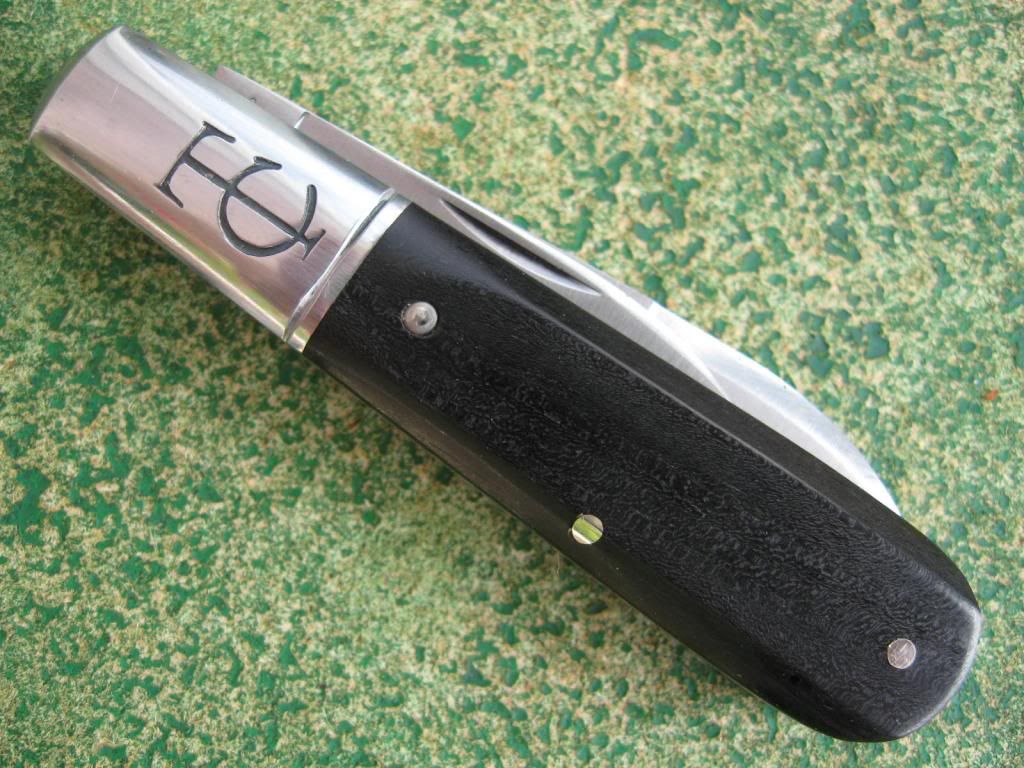
A few of my knives have no kick to speak of on their pen blades. My GEC 15s and this 48 being an example. When I got the 48, it was perfect in every way except for the pen being a little too proud. I sent it to GEC and they got it back to me very quickly and I am more than satisfied, but if the knife had a standard kick I could have performed the operation myself.
Does anyone know the reason for this kickless design? Does it in fact lower the lifetime of the knife in terms of sharpening cycles? This knife has more life left in it than I probably do, but it's a theoretical question--

IMG_2536.jpg
 
If I'm not mistaken there is a kick,it's just under the bolster.
You can see it when you close the blade about 45 degrees.
I don't know the reason for the different kicks & if I'm not mistaken you should be able to sand it down,the trouble is keeping the blade open/closed in just the right position to allow clearance to the hidden kick.

Here is an example,right where the red dot is.
I don't know why it wouldn't work but haven't tried it yet so if anyone can confirm it'll work on this type kick that would be great.
I need to lower this pen blade a bit to get to the main's nick better,but being such an old Cutco Schrade I've been hesitant.

3aade907-9cd6-4ba4-a135-3b31dda1b0bc.jpg
 
That's interesting, Mykel.
I think you might be on to something--
It does seem like it would be much more difficult to file, however.
I wonder if it's aesthetics or mechanics that determine this difference?
 
That's interesting, Mykel.
I think you might be on to something--
It does seem like it would be much more difficult to file, however.
I wonder if it's aesthetics or mechanics that determine this difference?
It makes no sense to me so hopefully someone with more knowledge on the matter will chime in.
I find if I hold the knife at an angle with the bolster & partially open blade on the table top it is stable enough to have at it with a small diamond file.
 
I have a diamond jack, and a couple of Charlows, and have wondered the exact same thing. I do like the look of the smaller kick, but when I tried filing the kick on my Barlow I noticed it was very difficult. I think I need to get a fine tipped diamond file to do the job. I have also noticed that the pen blade pushes into the handle much more easily with this style of kick, and I had a problem on my diamond jacks pen where it slapped on the backspring when I closed it. (easy fix though, Just a slivver of leather pushed into the reccess under the pen)
 
I don't know the reason for the different kicks & if I'm not mistaken you should be able to sand it down,the trouble is keeping the blade open/closed in just the right position to allow clearance to the hidden kick.
...haven't tried it yet so if anyone can confirm it'll work on this type kick that would be great

confirmed, I agree with your comments on the difficulty of accessing the spot that pivots on the backspring
I lowered this sheepfoot, and also the pen by filing both kicks with a dremmel. The pen was very difficult to do a clean job on without marking the bolster, and because of the fact that the blade is not at a half stop when the kick is exposed, so it can move while youre working on it, unless you secure it somehow.

IMG_8674.PNG

IMG_8670.JPG

IMG_8675.PNG


fwiw, to people that consider filing kicks, the penalty is a sunken backspring. To avoid that, consider reshaping the spine of a proud blade, instead of filing the kick
 
Does anyone know the reason for this kickless design?

I don't but would be interested to know the answer, as I thought it odd they went w/ kickless pen blades on Charlies SFO 48s, whereas on their 1st run of 48 "jacks" they used pen blades with a conventional kick. I wonder if it's just easier & less fine tuning for a puched out kickless pen blade than one with a conventional kick.
 
fwiw, to people that consider filing kicks, the penalty is a sunken backspring. To avoid that, consider reshaping the spine of a proud blade, instead of filing the kick

True, but if you just take a smidge off, I mean just basically kissing it with a file like I've done in the past, you'll not notice the backspring sinking any. I had to do that to a single blade wharncliffe GEC 25 to get the tip down so it would'nt poke skin.
 
On a well-designed knife, the backspring won't always sink when filing down the kick. The key is if the spring does/doesn't rest against the cam of the tang when closed. If the contact between the two is flush and solid at all points in the blade's opening/closing travel, and stays along the turning radius of the tang's cam, it likely won't sink much, or at all, if the kick (which is well forward of the cam's turning radius) is filed down. I never fully understood this, until filing down the kick of the sheepsfoot blade in my Queen stockman. Took a LOT of steel off the kick (1mm depth or so), as the blade sat very high, with it's spine ~1/8" or so above the spine of the clip blade; I lowered it to be essentially flush (see 3rd, 4th pics below). Even after that, the spring didn't sink noticeably, if at all; this is because the end of the spring was always in direct contact with the tang's cam, which therefore prevented the spring from moving inward with the reduction in the kick's height.

This is obviously something that needs to be examined on a per-knife basis, to look at how the spring rests against the blade tang's cam (or not), before filing/grinding on it. Open & close the blade, and watch to see how the spring rises & falls; look for it to stop falling very shortly before the blade fully closes (ideally), which should indicate the full extent of it's travel is limited by the tang's cam, and not by the kick itself. If the kick is the only limit, you might see the spring continue to sink as the blade closes, followed by it rising or bouncing a little bit when the kick makes contact. That's when I'd expect to see the spring sink, if the kick is further ground down. This would also be an issue on very old & worn knives, which have had a lot of material worn away from the tang's cam and from the inside face of the spring at the point of contact.

On my Queen stockman, the filed kick of the sheepsfoot can be seen at left in the first pic; note the expanded width of it, as compared to the spey's kick on the right. Both were essentially equal in width and height, prior to grinding (I used a Dremel). 2nd pic shows the springs at the sheepsfoot end, after filing. If any drop occurred, it was obviously minimal.

David
 
Last edited:
Interesting, David. I can say that I do not notice any sinking of my spring as a result of the work GEC did in lowering my pen blade. I'm still interested in why it has this design, though. I only see it on my 15s and this 48 Diamond Jack. I have read that on the first run of 15s with the spear blade main, the pen was designed to be pushed down into the handle to access the spear. However, no such action is needed on the Diamond Jack, so I am left perplexed...
 
I just lowered the blades a tiny bit on my new #15 easy open. It has that weird kick on the pen, and I just barely touched it with a needle file while holding it open at 45 degrees. I lowered the main wharncliffe a bit more. Being an easy-open, it's still very easy to open :D
I suppose the spring may have lowered a hair, I can just feel it with my fingernail, but that really is a cosmetic thing that doesn't bother me. Not as much as it's more comfortable to have the blade lower.
 
I have read that on the first run of 15s with the spear blade main, the pen was designed to be pushed down into the handle to access the spear.

I agree that when the Spear Point Charlow with Pen Blade came out, the long pull on the Spear Point Primary blade was hidden by the pen. Two things were done to make access to the long pull easier.

1. A Swedge was put on the pile side of the pen blade, to allow the fingernail to reach behind the pen. This was the pattern that put the pen blade in front of the Primary blade, so both nail nicks were on the mark side of the knife.

With this setup, it was pointed out that once you get your finger nail into the long pull, you can leverage the pen blade to sink, by pressing with the thumb on the pen blade while lifting the Primary blade.

I then became aware that all of my knives, multiple brands of Barlows with 2 blades including Russell, Camillus, Remington, Boker, and GEC, had the "feature" of being able to press on the pen blade and it would sink deeper into the pocket. It turns out the same is true for all of the primary blades.

2. A run of Spear Point Charlows was made with the Pen blade behind the primary, and the nail nick of the pen blade was on the pile side. This completely solves the problem of access to the Primary blade long pull. But there was a majority of people that thought having the nail nicks all on the mark side was "prettier" to look at.

What followed were Charlows with Clip Point and Sheepfoot blades, both of which sit much higher out of the pocket than Spear Point blades. This pretty much eliminated the access problem to the long pull nick of the primary blade, even though the back half of the pull, toward the tang was hidden by the pen blade, you could at least get to the front edge of the long pull.

Then came the Spey bladed Charlows. The spey blade sits deeper in the pocket than any of the other styles mentioned. None of the Spey Charlows were offered with a Pen blade, instead, the two blade versions put the Spey in front, and a clip point behind, both with nail nicks on the Pile side. There was no access problem to the nail nick of the Clip blade, since the Spey blade sits so low, and the spine of the clip angles upwards.

Now back to the question of why one style of kick was chosen over another.

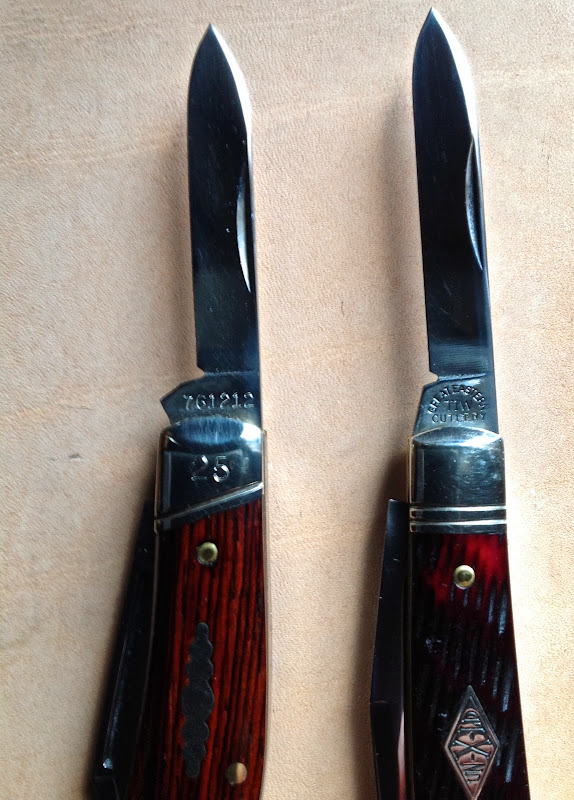
The kick on the right allows the blade to sink more easily into the pocket, if the spine of the blade is pushed down while the thumbnail is in the nail nick of the primary blade. However, if I press hard enough, even flat kicks can be made to press on the back spring when pressure is applied to the spine of the blade.

So I would say, that the tapered kick shown on the right in the photo above, makes it easier for the pen blade to sink into the pocket if the thumbnail is used as a lever when reaching into the nail nick of the primary blade behind the pen.

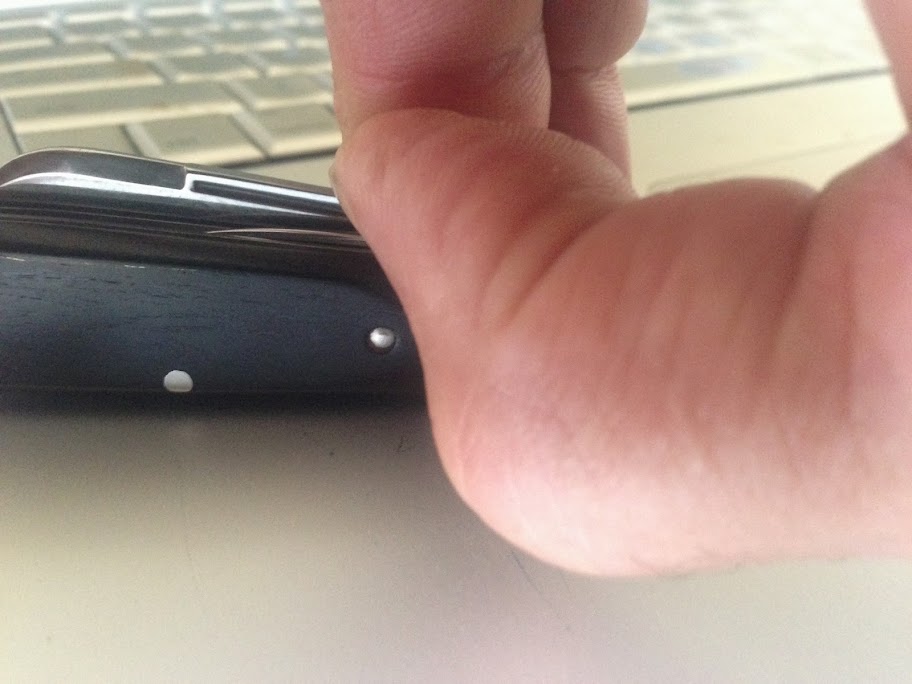
Maybe this picture will help illustrate. My thumb nail is in the primary long pull, and I am using the same thumb to squash the pen into the pocket.

IMG_8680.JPG


Try this, pull out some of your two blade knives, and while the blades are closed, press on the spine of the pen blade. You will see that you can make the pen blade sink deeper into the pocket, if you apply pressure to the spine.

So my conclusion is that the tapered style kick on the pen blade makes it easier for someone to get the pen blade to sink more easily, in order to get the primary blade open, if leverage is used against the pen blade while the thumbnail is in the primary nail nick behind the pen.

Of course none of this pressing on the pen blade to access the primary nail nick is required if the knife is designed with the pen blade behind the primary, and with the pen blades nail nick on the pile side. That is how my Case Peanut is setup, pen behind. I favor that arrangement.

So to me, the Spear Point Charlow with pen behind, and its nail nick on the pile side is a Grail knife.

IMG_1859_zps5d5a48db.jpg
 
Last edited:
That's a good explanation, Jon. And on some of the 15s it makes sense. I personally never had a problem opening my first-run spear 15, but each knife is different, and I may have just lucked out. I still think I would prefer the easier access to the kick should need arise, but the replies to this thread have taught me that, should I need to lower it, there is indeed a way...
 
A lot of pen blades on antique knives are "kickless", and that is why we decided to do the pens that way.
I asked GEC about adjusting them, and, (as described on the telephone) they have a fixture they can place the knife into, which holds the blade at the right angle, so they can touch the "kickless" kick* (as so nicely displayed in others' posts) just enough to lower the resting position slightly.


*Kinda like my wallet where I have "moneyless" money!
 
So my conclusion is that the tapered style kick on the pen blade makes it easier for someone to get the pen blade to sink more easily, in order to get the primary blade open, if leverage is used against the pen blade while the thumbnail is in the primary nail nick behind the pen.
Great post Jon,thanks for the explanation.
I hadn't noticed,but the pen does indeed get leveraged down a bit when I stick my thumb nail into the nick of the main on my Schrade Barlow.
 
To be honest even after all of the differing reasons, I think the pen blades on my Charlows and Diamond jack just look nice. They look a bit finer than pens with conventional kicks.
 
A lot of pen blades on antique knives are "kickless", and that is why we decided to do the pens that way.
I asked GEC about adjusting them, and, (as described on the telephone) they have a fixture they can place the knife into, which holds the blade at the right angle, so they can touch the "kickless" kick* (as so nicely displayed in others' posts) just enough to lower the resting position slightly.


*Kinda like my wallet where I have "moneyless" money!

Charlie--I'm loving the knife. Glad to hear there is an historical aspect to this design. I don't think I will ever learn all there is to know about this hobby. And that's one of the things I like about it...
 
Back
Top