Knife design

Joined
Feb 12, 2011
Messages
2,520
I've ordered some steel from Aldo so I'm starting my knife designs.
Avsppm012.jpg

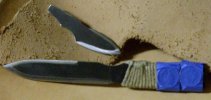
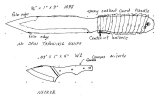
The first is a No-Spin throwing knife. The parameters were set after reading Ralph Thorns book on No-Spin throwing. The false edges, finger indents, cord handle are in place to help move the center of balance rearward. Also, to allow me practice on grinding a knife. I am using 1095 and W2 because water or air quench is required at this time and these seem to be the least costly options.

The second is a small neck knife. Again using a simple saber grind for training.

Any comments/suggestions are welcome
 
Who will do your heat treating?

Outsourcing? OK, nevermind.


DIY? I suggest 1084 from Aldo, also probably even cheaper

and
Even though 1095 and W2 are in the W water quench class, the thin sections of knives being water quenched have a high failure rate.
By that I mean cracking and shattering in the quench.
Use oil even for water quench steel.

1095 and W2 are hypereutectic and need very FAST oil such as parks 50 or Houghton K
1084 is a eutectic steel which is less fussy about that.

Read Kevin Cashon s sticky posts on the 3 steel types for details.


If you are DIY the HT, I would see if Alco can catch the order before he ships and change it to 1084
 
Last edited:
Who will do your heat treating?

Outsourcing? OK, nevermind.


DIY? I suggest 1084 from Aldo, also probably even cheaper

and
Even though 1095 and W2 are in the W water quench class, the thin sections of knives being water quenched have a high failure rate.
By that I mean cracking and shattering in the quench.
Use oil even for water quench steel.

1095 and W2 are hypereutectic and need very FAST oil such as parks 50 or Houghton K
1084 is a eutectic steel which is less fussy about that.

Read Kevin Cashon s sticky posts on the 3 steel types for details.


If you are DIY the HT, I would see if Alco can catch the order before he ships and change it to 1084

I didn't consider outsourcing the HT before reading your post. Thanks for the input.
It might be DIY depending on how my test pieces fare and unless I grind out some really great knives.
I really struggled with 1084 vs 1095, and at one time I had picked 1084 but oil quench is not an option at this time. I am going to try the two step approach to quenching. 1 - 2 second water quench followed by air or plate quench to the martensite end temperature. This should reduce the incidence of stress fractures from rapid, uneven martensite formation. I am prepared for the 'ping of destruction' but I hope to avoid it. My intention is to try some uncut, smaller test pieces before trying the blades. If my test pieces fail then outsourcing the HT is the best option.

I'll work on W2 the after I develop some skill on grinding bevels. Depending on my experience with the 1095 and the quality of my blades I may very well send them out for HT. I haven't seen a TTT diagram for W2 or read much information on heat treating this steel.
 
Sure looks to me that the point of balance will be ahead of yhe handle area. Peruaps make this oversize and then grind on the back end after the edge grinds have been done. Frank
 
First - I agree that unless the tang is very thick and there is a lot of resin in the cord, the POB will be forward of the sketch arrow.

Second - Why use 1095 and try for an extremely hard ( and probably cracked) blade for a thrower. Throwers need to be tough, not hard. Use 5160 or 1084 and quench in canola oil. Temper at 500F .

Third - 1095 is a water/oil quench steel...never an air quench. If you do an interrupted quench then you water/oil quench the steel and allow it to finish cooling in air/plates, but the quench is in the water or oil.

Fourth - Why do you say oil is not an option. Are you doing this in your bedroom where mom won't find out? :)
Use canola oil and you will be fine for most normal steels. Even 1095 will work to some degree in canola.
 
You gotta love the man. Stacy's worth listening to. 5160, 1084 or 1075 for a thrower would do the trick. There's a lot of carbon you don't need in the 1095. Canola would work for any one of these.(I hope Kevin ain't looking!)
 
Sure looks to me that the point of balance will be ahead of yhe handle area. Peruaps make this oversize and then grind on the back end after the edge grinds have been done. Frank
I second that. No way will that balance point work, maybe if you drill holes in the blade.
 
You read the book and have a plan for the thrower so I will say, "work your plan".

However... IF... the thrower doesn't balance as expected the cord wrap is a good place to bolt some extra weight on and cover it with the wrap.

I think the handle design on the neck knife will work OK. I'll bet you made a full size pattern out of coardboard and tweaked it that way?????

Thanks for sharing.

- Paul Meske
 
"Sure looks to me that the point of balance will be ahead of yhe handle area. Peruaps make this oversize and then grind on the back end after the edge grinds have been done. Frank"

"First - I agree that unless the tang is very thick and there is a lot of resin in the cord, the POB will be forward of the sketch arrow."

"I second that. No way will that balance point work, maybe if you drill holes in the blade."

"However... IF... the thrower doesn't balance as expected the cord wrap is a good place to bolt some extra weight on and cover it with the wrap.
I think the handle design on the neck knife will work OK. I'll bet you made a full size pattern out of coardboard and tweaked it that way?????

Thanks for sharing.

- Paul Meske "


These are all good points - I haven't done a cardboard mockup. I think I'll see if I can get a piece of A36 flat bar and cut a pattern out. I could remove more stock by changing to a dagger type pattern and then if needed add a couple of strips of lead to the end of the handle.


"Fourth - Why do you say oil is not an option. Are you doing this in your bedroom where mom won't find out?
Use canola oil and you will be fine for most normal steels. Even 1095 will work to some degree in canola."


I have access to a small muffle furnace and a kiln. They belong to a friend and are not in a location where an accidental flash fire because I screwed up the oil quench is in any way acceptable. The consequences could go well beyond scorching the hairs on my arms. I shouldn't pass up the opportunity to work with this equipment.

"You gotta love the man. Stacy's worth listening to. 5160, 1084 or 1075 for a thrower would do the trick. There's a lot of carbon you don't need in the 1095. Canola would work for any one of these.(I hope Kevin ain't looking!)"

I had looked at 1075 as a real good steel for throwers. But not as good for other patterns. If I am successful at making 3 or 4 throwers, I'll want to try my hand at making other patterns. I should be able to toughen up the 1095 by tempering longer and at a higher temperature. Maybe try to convert some of the RA into lower bainite. I am hoping to temper the throwers to HRc 50 - 55 unless a lower hardness is advisable.

I would have went with 1084 and canola if the circumstances regarding the use of the kiln and furnace had been different. Thanks for the good advice. I'll try to pick up some mild steel for a mock up to work on the balance point this weekend.
 
I picked up some 3/16 and 1/8 hot rolled bar stock this weekend and cut my mock ups.
You all were right on with regards to the balance point. I spent 3 - 4 hours on the thrower, taped 4 quarters to the end, and I'm still 1/4" shy of my desired balance point. If I can find some soft lead sheet I'll try that. I'll cut out another one of these over Thanksgiving and eliminate the bottom finger groove.
The feel of the neck knife came out well. A small piece of steel like that heats up surprisingly fast on the grinder. I'll deepen the rear finger groove a little and use this for my template. I think I will use a file to cut the bevels on the neck knife as I don't have good control on the grinder.

KD1.jpg

Thanks again for the help and suggestions.
 
I'm not sure why you think canola oil will have a flash fire, but that is far less likely than the forge creating a fire.
If his shop will accommodate the forge and its exhaust, it will accommodate an oil quench. I would only do a full quench if inside, as it has much less smoke. Have you asked your friend what quenchant he uses?
A metal container with a couple gallons of canola will be just about as safe as a water quench....and far more likely to succeed. When cooled off, pour the oil back in the jugs and re-use it for a year or more.

As far as steel choice goes, 1084 will make any knife that 1095 will, and be virtually the same. Until you gain some equipment and skills, 1084 will probably make a better knife.
 
I'm not sure why you think canola oil will have a flash fire, but that is far less likely than the forge creating a fire.
If his shop will accommodate the forge and its exhaust, it will accommodate an oil quench. I would only do a full quench if inside, as it has much less smoke. Have you asked your friend what quenchant he uses?
A metal container with a couple gallons of canola will be just about as safe as a water quench....and far more likely to succeed. When cooled off, pour the oil back in the jugs and re-use it for a year or more.

As far as steel choice goes, 1084 will make any knife that 1095 will, and be virtually the same. Until you gain some equipment and skills, 1084 will probably make a better knife.

My friend is not a knifemaker. He works with ceramics and glass and the kiln and muffle furnace are both electric. He is interested in learning new things and thus the invite.
 
An electric forge can cause just as much fire as one heated by other means. 1500 degrees is 1500 degrees. That light about anything flammable on fire. Perhaps electric is more dangerous because without a flammable heat source one is not expecting fire to be possible.

Canola oil adds next to nothing to the equation.
 
Back
Top