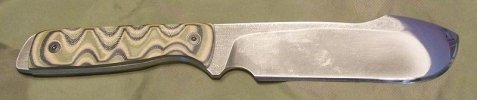
Knife Handle Poll: What Type Do You Make?

What kind of knife handles do you prefer?

  • I prefer Scales

    Votes: 0 0.0%
  • I prefer Hidden Tangs

    Votes: 0 0.0%
  • I prefer some other type of handle

    Votes: 0 0.0%
  • I have no preference

    Votes: 0 0.0%

  • Total voters
    0
Joined
Feb 5, 2010
Messages
3,911
I'm starting this poll based on an observation that I'd like to confirm statistically. Please indicate what type of knife handles you prefer to make. Post a reply, if you like, explaining your reasons... or not, as you see fit. Mostly, I'm just curious about the percentages.

- Greg
 
I prefer making Full tang knives because they are easier for me, I do Like hidden tang knives and work on them from time to time in hopes they get easier for me as some point.
 
I prefer to make hidden tangs but actually make more with scales because hidden tangs are a real pain to fit on thin bladed kitchen knives (where all my files are thicker than the tang).
 
I like to do scales with the pommel exposed, a slight variation of the full tang.

example
 

Attachments

  • poon tip 006.jpg
    poon tip 006.jpg
    22.3 KB · Views: 48
For those who don't already know, I prefer hidden tang. I tried doing scales once, but wasn't happy with the results. the issue for me is that most of my knives are Damascus, and once I etch them I don't want to "sand to fit" once the scales are attached, as that removes the etch of the tang. It never really occurred to me that one way was easier than the other... just that one way works better with damascus than the other. ;)
 
Tang style is usually a bit of a progression.

Many folks start with a full tang, full thickness. It just needs to be profiled, drilled, and the scales simply can be drilled with the tang as a guide.

Going to tapered tangs is a step up as it requires grinding or machining the taper, and a little bit of fixturing to PROPERLY drill the holes through the scales with the tang tapered.

A hidden tang adds the need to file or machine guard shoulders in the blade, as well as a slot in the guard material. These two things are what hold a lot of folks back from trying a hidden tang. I know it held me back for awhile. Of course there are exceptions to this, like how some Loveless style makers cut guard shoulders in their FULL tang and slide the guard on from the tip of the blade.

98% of the time I prefer a hidden tang as it allows me to shape the handle material however I choose at the time of shaping--- where as a full tang's overall handle shape is going to be set at the time of profiling and drilling the tang. Also with carbon steel blades, I can encase the tang this way, so it's not exposed to the oils/blood/crud that the tang would be exposed to in a full tang.

All this is, to me, is not an argument about one being better than the other--- just what's suited to the individual knife.

 
Last edited:
Probably 90% of my knives are full tang, 2/3 or more of those are fully tapered. I confess that making guards for hidden tang knives isn't my favorite endeavor... one day I'll get a mill and learn to use it, perhaps that will make slotting them easier or at least more accurate.

A couple years ago I did a similar poll in the W&SS forum about bushcraft knives, and was somewhat surprised by two things... first that carbon-steel fans did not mind the steel exposed along a full tang. Almost to a man they said they'd either let it patina just like the blade or sand it off if it got any rust on it. And second, that there is a huge "consensus" that hidden tang knives are inherently much weaker than full tangs. I don't agree with that; a well-designed hidden tang can be extremely strong, to the point that the difference would be hard to measure. Conversely, I've seen full-tang knives that were so full of holes there was actually less steel there than a typical hidden tang.

All this is, to me, is not an argument about one being better than the other--- just what's suited to the individual knife.

Right on. It's like stainless vs. carbon... there are excellent steels in both categories. A maker at a show asked me which I preferred, I simply said "whichever the customer wants" :)
 
Good points James. :)

I often get requests about full tangs because many folks are convinced somewhere along the line that full tangs are like tanks and that hidden tangs are like chicken bones. A lot of this comes from the fact that many people have not seen something like the ABS performance test done.... something in which I've never seen a hidden tang snap off in the midst of. And also many cheaper grade, production made, hidden tang knives have a tang that looks like a ground down #2 pencil. :eek:

Which is, of course, retarded. ESPECIALLY if it's an air hardening steel which is going to be on the brittle side of things in a funky cross section to begin with.

I've had many folks extolling one or the other of the tang styles, and when I ask them about heat-treatment they look at me with a blank stare.... :rolleyes: :foot: :)

That heat-treat part seems kind of important too. ;) :D
 
I've been playing around making a hidden tang with 2 scales. I route a pocket in both side and sandwich the tang. This allows the front of the handle to be curved.
11.jpg

IMG_0080.jpg
 
Last edited:
What is this 'heat treating' thing that everyone seems hung up on?? :)

I like to make both styles. Sometimes one is a nice change from the other. I've been doing a bunch of full tangs with tapers lately. My milling machine is feeling neglected. Better slot some guards soon.
 
Thanks for the answers, everyone. I appreciate the insights. Keep them coming.
 
I'm the "other" guy.... lol.

I'm not sure where to classify my favorite handle/tang type. Is it a full tang with a handle wrap? or, A hidden tang under coiled hemp? I grind a recess for the cord to lay in.
 
Last edited:
I like hidden tangs the best because once I'm finished with the blade I can wrap it up and then just concentrate on the fittings and handle.
 
I've been playing around making a hidden tang with 2 scales. I route a pocket in both side and sandwich the tang.

That's referred to as a mortised tang construction, and is an excellent way to build a handle. The idea is, it's less likely to crack or warp because the two halves can shift a little bit without pulling apart.

My first couple projects back in HS were done that way... not because I knew what I was doing but I just didn't have the tools to drill a solid handle out; did the whole thing with a pocket knife, file and sandpaper :o. One is a K-bar blade that has pounded many a tent stake and is still just fine today.
 
I do both, but must admit that on the hidden tangs I have used other materials like corian and bone to start off, and am working towards copper and stainless. Just got some thin warding files, so that will help I think. Larry
 
I prefer full tang with scales and Japanese style wraps.
 
Back
Top