knife with multiple steels?

Joined
Sep 11, 2010
Messages
2,846
So ive been thinking about the few traditionals again and thinking about the purpose or at least how I use my multi bladed buddies and the idea of different steels used for each would be interesting and greatly helpful. like a peanut. main blade would be D2 as main course item cutter with the pen blade as a razor and in something like 1095. Has anyone seen this or also had this thought?
 
I don't think I would want a knife with two different steels just because of maintenance issues. The blades would wear down at different rates due to how they sharpen. The advantage of having a stainless or near stainless blade would be negated because you still have to keep the other one from rusting. As far as knives that do have different steels, I believe Case made a CV Stockman at one time that had a stainless punch instead of the spey blade.
 
The only example I've seen is an A.G. Russell 'Premium Scout' knife. It's a scout/camp knife, with a 154CM main spearpoint blade, and the auxiliary tools (bottle opener/screwdriver, can opener and punch) were made of a more 'typical' stainless, maybe 420/440-series, or similar. In a scout knife, I think this is a more legitimate mix, as the supplementary tools don't need to be made with very fine edge-holding in mind, so they can be blanked from lesser steels and hardened much more conservatively.

I seem to recall reading a post here a while back, of Case knives occasionally escaping the factory with mixed Tru-Sharp & CV blades, most likely due to an accidental mix-up in production. Many of their models are available in both steels separately, so I could see it happen.

Aside from the above-mentioned scout knife, I don't think I've even seen or heard of custom makers deliberately mixing different blade steels in one knife, much less a production maker. In a small pocketknife especially, I'd think most would view it as overkill or unnecessary, and not worth the trouble to manufacture. And someone who's a sharpening novice might not appreciate D2 very much, if they can't use the same tools to sharpen it as they use for a simple carbon steel blade in the same knife. It's much simpler for a maker to build their production line around one chosen steel, so they don't have to worry about the variabilities of blanking, machining and heat-treating multiple different steels, some of which are much harder on the tooling used to make them. If someone were to do it, I'm certain it'd be ridiculously expensive. May as well order a custom-made, for the money spent. And if doing that, I'm sure a custom maker could recommend a single steel that'd serve all needs with ease. The edge bevel itself is really what makes the difference. Assuming a quality steel, it can be ground thinner for a razor on one blade, and thicker for a harder-use blade. In fact, in the example you've given (D2/1095), I'd just take the D2. It's rust-resistant, great at edge-holding, and it takes an extremely fine edge (to a razor if you want). Best of all worlds.
 
I saw a Case Stockman in a catalog a while back that had both Tru-Sharp and CV blades in the same pattern. IIRC, the main blade was CV, and the secondary blades were Tru-Sharp. I'll see if I can dig up the pattern #.

~Chris
 
great info guys, thanks.

Obsessed with Edges - I see what your saying, too expensive, production problems, etc. However your last statement "I'd just take the D2. . . . it takes an extremely fine edge (to a razor if you want). Best of all worlds." How are you able to do that? I'm more or less decent at sharpening and when I really get down to it, none of my D2 edges have been hair whittling sharp, unlike all of my other knives and steels. I was always under the impression that it was more of a "leave at 700-1000grit" steel to have that toothy edge it holds forever it seems, not the razor sharp edge you speak of, most likely its my inexperience but I'd like to hear your side of it as it were.
 
great info guys, thanks.

Obsessed with Edges - I see what your saying, too expensive, production problems, etc. However your last statement "I'd just take the D2. . . . it takes an extremely fine edge (to a razor if you want). Best of all worlds." How are you able to do that? I'm more or less decent at sharpening and when I really get down to it, none of my D2 edges have been hair whittling sharp, unlike all of my other knives and steels. I was always under the impression that it was more of a "leave at 700-1000grit" steel to have that toothy edge it holds forever it seems, not the razor sharp edge you speak of, most likely its my inexperience but I'd like to hear your side of it as it were.

D2 is one that will get there, but persistence is what it's all about. It takes a while up front, especially if compared directly to something like 1095. For a while, I was in the same mind as most others, in that it seemed as if it'd never quite get sharp enough. I have a Queen Country Cousin that I initially re-bevelled using a DMT diamond hone. That put a nice, toothy edge on it, which was great (and it bit me almost immediately, while I was still working on it). But after that, I used wet/dry sandpaper to convex it, running it up through 2000 grit and following that with stropping on leather with Simichrome polish. The more I worked at it, the finer and finer the edge got. And as I've found new methods for stropping (using balsa or hardwood, with DMT diamond paste), it takes it up another notch. That convexed edge is the first one I've done that really pops hair. It convinced me that the steel itself is very much capable of shaving/hair-whittling, but it's fairly easy to assume it won't, if one stops short of really finishing the job. This is true of any steel, but it takes longer to get there with D2. The upside is, it also takes much longer to dull that edge, once it's in place. Once it's there, it's quite easy to maintain, IF you don't fall behind on it. I pick that knife up occasionally, to use it as a 'test case' for trying out a new technique or compound or whatever. Almost without exception, it still manages to refine even further.

 
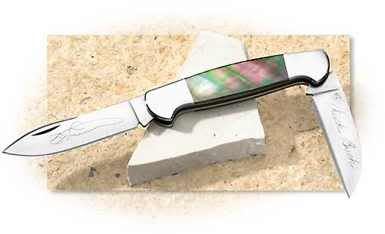
AG Russell has a two-bladed slipjoint that was a collaborative design between him and Chuck Buck, I believe. Two premium steels, like VG-10 and S30V or something. A clip point and a wharncliffe blade I think. Sorry, my memory is a little fuzzy on the details.
 
Yup, A. G.'s collaboration with Buck has 154CM for the spear and S30V for the wharncliff. A beautiful "Canoe Moose" with a large blade at each end, with available black lip pearl or India stag scales.
 
Looks like the buck 308 has now joined my ever growing want list, thanks guys.

Obsessed with Edges - well if persistence is key, its time to break out the stones and get to work! Thanks,for advice, and balsawood with stropping compound is pretty interesting, ill have to try it sometime
 
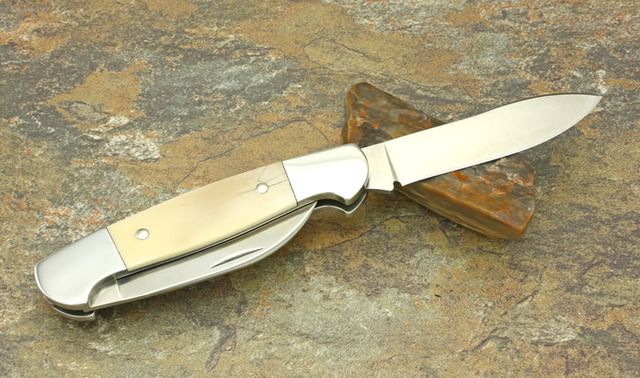
Those 308s were made in three versions. I believe online currently featured at AG is the stag. Also in black pearl, I have a factory second in Ivory with a split from scale rivet. The others are pretty rich for my blood. Each blade is signed, Chuck Buck on one and AG Russell on the other........ 300Bucks

From catalog
Indiastag.jpg

BlackPearl.jpg

From me
Canoe5.jpg
 
Last edited:
D2 is one that will get there, but persistence is what it's all about. It takes a while up front, especially if compared directly to something like 1095. For a while, I was in the same mind as most others, in that it seemed as if it'd never quite get sharp enough. I have a Queen Country Cousin that I initially re-bevelled using a DMT diamond hone. That put a nice, toothy edge on it, which was great (and it bit me almost immediately, while I was still working on it). But after that, I used wet/dry sandpaper to convex it, running it up through 2000 grit and following that with stropping on leather with Simichrome polish. The more I worked at it, the finer and finer the edge got. And as I've found new methods for stropping (using balsa or hardwood, with DMT diamond paste), it takes it up another notch. That convexed edge is the first one I've done that really pops hair. It convinced me that the steel itself is very much capable of shaving/hair-whittling, but it's fairly easy to assume it won't, if one stops short of really finishing the job. This is true of any steel, but it takes longer to get there with D2. The upside is, it also takes much longer to dull that edge, once it's in place. Once it's there, it's quite easy to maintain, IF you don't fall behind on it. I pick that knife up occasionally, to use it as a 'test case' for trying out a new technique or compound or whatever. Almost without exception, it still manages to refine even further.

I'll second the fact that D2 can get SHARP with some work. I used to have a queen mini hunter that would shave hair and bit me every other day. I sharpened mine with the same method, XC diamond stone, 1000-1500-2000 grit wet/dry, and i stropped on Mother's Mag. On my way to getting a second one, regret selling it off.
 
I seem to recall reading a post here a while back, of Case knives occasionally escaping the factory with mixed Tru-Sharp & CV blades, most likely due to an accidental mix-up in production. Many of their models are available in both steels separately, so I could see it happen.

I just got a 3-dot Case Trapper in the mail with a stainless clip and CV spey. I was certainly surprised.
 
Years ago I had an OT 80T, the clip and spey blade were the usaual 1095 and the sheepsfoot was 440A. I figured it was a Friday knife that got put togeather a little to quick, and to close to the UH parts bend! I wish I would have kept it now!
 
While I don't know the reason for it, I own a Parker Frost gunboat from the '70's that has carbon spear and sheepfoot blades while the spey is apparently stainless. I also own an older Boker copperhead that has a stainless clip blade while the skinner is carbon. Could it be a mistake or was there a reason? Herb
 
I have also seen a few case patterns with tru sharp and cv mixed . May be a sfo for a certain knife superstore in TN tho.
 
Benchmade made a knife, I believe the switchback that had an axis lock and a S30V main blade with a small slip joint knife on the spine. I think the secondary blade was 440C. It was an Osborne design.
 
Back
Top