
-
The BladeForums.com 2024 Traditional Knife is available! Price is $250 ea (shipped within CONUS).
Order here: https://www.bladeforums.com/help/2024-traditional/
You are using an out of date browser. It may not display this or other websites correctly.
You should upgrade or use an alternative browser.
You should upgrade or use an alternative browser.
Kramer
- Thread starter protodoc
- Start date



Kohai999
Second Degree Cutter
- Joined
- Jul 15, 2003
- Messages
- 12,554
I like Bob very much and wish him the best.
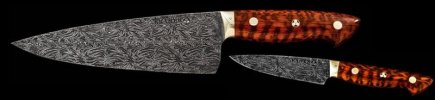
Snakewood and brass on a chef's knife is self-indulgent to the absolute utmost....both materials a completely reactive, and snakewood ups the ante by being almost volatile on a using knife due to lack of stability.
I have watched slabs of seasoned snakewood crack due to this instability, and although it is visually stunning material, the tradeoff is not worth it imo.
From an exotic hardwood supplier: "Much of the wood has inferior or no figure, but the small amount that has attractive figure is exported. We sell only figured pieces that have high density of figure unless specifically marked otherwise. All snakewood has at least minute hairline cracks. We take the extra step of soaking some pieces in cyanoacrylate to minimize or eliminate any cracking. Fortunately, if cracks do occur, they can be hidden completely if caught early. We do not recommend attempting to dry snakewood, as this almost always leads to cracking. Being dense, the water content is already very low. To be successful, always have superglue and hardener on hand, cover the piece with plastic completely when not working on it, and seal it completely with a finish that does not allow moisture transmission. Needless to say, the wood should never be allowed to get overly heated or left in direct sunlight."
Because chef's knives ALWAYS spend some time in moisture, I made the above comments, and snakewood frequently does not respond with desired results to stabilization.
Best Regards,
STeven Garsson
Snakewood and brass on a chef's knife is self-indulgent to the absolute utmost....both materials a completely reactive, and snakewood ups the ante by being almost volatile on a using knife due to lack of stability.
I have watched slabs of seasoned snakewood crack due to this instability, and although it is visually stunning material, the tradeoff is not worth it imo.
From an exotic hardwood supplier: "Much of the wood has inferior or no figure, but the small amount that has attractive figure is exported. We sell only figured pieces that have high density of figure unless specifically marked otherwise. All snakewood has at least minute hairline cracks. We take the extra step of soaking some pieces in cyanoacrylate to minimize or eliminate any cracking. Fortunately, if cracks do occur, they can be hidden completely if caught early. We do not recommend attempting to dry snakewood, as this almost always leads to cracking. Being dense, the water content is already very low. To be successful, always have superglue and hardener on hand, cover the piece with plastic completely when not working on it, and seal it completely with a finish that does not allow moisture transmission. Needless to say, the wood should never be allowed to get overly heated or left in direct sunlight."
Because chef's knives ALWAYS spend some time in moisture, I made the above comments, and snakewood frequently does not respond with desired results to stabilization.
Best Regards,
STeven Garsson
Last edited:

Interesting, I did not know that snakewood was so temperamental. It is probably safe to assume that these knives won't spend much (any?) time in the kitchen. I usual find it to be a pity if objects are not used for their intent but maybe in this case it is just as well.
Beautiful knives never-the-less and I wish I could afford a Kramer chef's knife.
Beautiful knives never-the-less and I wish I could afford a Kramer chef's knife.

- Joined
- Oct 28, 2006
- Messages
- 13,363
Very good for Bob.
Whether this offering/windfall is his or from the secondary market he and the entire customs community benefiits from it.
Bob has done his share and much more to heighten the awareness of custom knives.
In addition, it's great to see such a good guy doing so well.
Whether this offering/windfall is his or from the secondary market he and the entire customs community benefiits from it.
Bob has done his share and much more to heighten the awareness of custom knives.
In addition, it's great to see such a good guy doing so well.
Last edited:

This set did not come from the secondary market. Since it is impossible to get onto Bob's wait list he auctions items from time to time directly to the public.
Win - Win situation.
Here is a link to the auction for nicer pictures:
https://auction.kramerknives.com/detail.asp?id=15
I think you may have to register to see the pictures.
Win - Win situation.
Here is a link to the auction for nicer pictures:
https://auction.kramerknives.com/detail.asp?id=15
I think you may have to register to see the pictures.
- Joined
- Oct 28, 2006
- Messages
- 13,363
This set did not come from the secondary market. Since it is impossible to get onto Bob's wait list he auctions items from time to time directly to the public.
Win - Win situation.
Here is a link to the auction for nicer pictures:
https://auction.kramerknives.com/detail.asp?id=15
I think you may have to register to see the pictures.
By secondary market, I meant perhaps someone who had previously ordered/purchased the knife from Bob had auctioned it off on eBay as opposed to Bob auctioning it off on his site. You didn't mention in your opening post where or how the auction had taken place.
There's quite a few folks out there who have purchased knives from Bob at very reasonable prices. A friend just received one from a several year old order recently for under $2,000.00.