Latest Sword

Stacy E. Apelt - Bladesmith

ilmarinen - MODERATOR
Moderator
Knifemaker / Craftsman / Service Provider
Joined
Aug 20, 2004
Messages
38,480
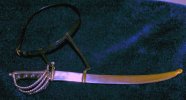
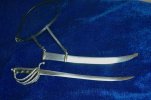
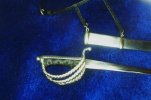
This is the fella that I ran through my finger.

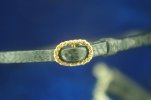
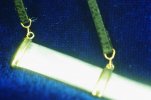
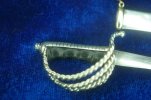
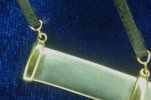
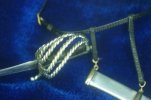
Forged 1095 blade, fully heat treated. Silver hardware and scabbard. Gold trim and belt buckle. Ebony grip.The sword is 4" long. The "D" rings and snaps are functional.
 

Attachments

  • Infantry Sword 005.jpg
    Infantry Sword 005.jpg
    59.6 KB · Views: 197
  • Infantry Sword 008.jpg
    Infantry Sword 008.jpg
    64.4 KB · Views: 208
  • Infantry Sword 011.jpg
    Infantry Sword 011.jpg
    62.5 KB · Views: 137
  • Infantry Sword 019.jpg
    Infantry Sword 019.jpg
    24.6 KB · Views: 130
  • Infantry Sword 020.jpg
    Infantry Sword 020.jpg
    43.3 KB · Views: 115
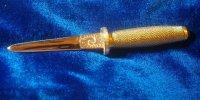
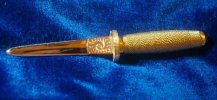
A few more and a couple of the gold dagger.
 

Attachments

  • Infantry Sword 016.jpg
    Infantry Sword 016.jpg
    56.9 KB · Views: 49
  • Infantry Sword 021.jpg
    Infantry Sword 021.jpg
    51.8 KB · Views: 40
  • Infantry Sword 022.jpg
    Infantry Sword 022.jpg
    44.1 KB · Views: 42
  • Infantry Sword 027.jpg
    Infantry Sword 027.jpg
    72.7 KB · Views: 88
  • Infantry Sword 028.jpg
    Infantry Sword 028.jpg
    60.9 KB · Views: 68
I have no idea how you got the wrap on the handle for that dagger but it's perfect!

Out of curiosity what exactly are you using to forge these things? I can't see you taking a 3.5 lb hammer and going to work on these things.
 
I do some of the forging on the standard anvil ,using hammers from 4oz. to 1Lb. The finish work I do at the jewelers bench. I have a 6" round, anvil and use hammers from 1oz. to 4oz. The heat source is a torch flame. HT is done with a magnet and eye. Water quench on most blades. I loose one now and then, but in these thinnesses cracks are very few. Besides some profiling work done on a Wolf 1"X10" belt grinder ( my mini-KMG) most everything else is done by hand with files, stones, and paper.

The wire on the dagger is two different twists. It starts with a two-tone twist of red and white gold. Then it switches to a yellow twist, and finally back to the red/white twist.There are no hidden ends. The different twists are welded to each other with no visible change ( besides the color). It is all done by hand, and I agree ,....it came out stunning. This was one of those things that happened by a miscalculation. I had done a test twist in silver and measured how much it would require to wrap the handle;e. I then twisted the gold wire. However, I decided to make it a tighter twist. The resulting wrap was then too short.......so I added to both ends with another piece I had twisted as an experiment. I spent 500-600 hundred dollars in wire doing test twists before I got what I wanted. The test pieces will end up in all sorts of decorative items, or get scrapped if gold stays high.
 
I do the preliminary forging on the standard anvil using 4oz. to 1lb. hammers. The finish work is done at the jewelers bench on a 6" round, polished face anvil. The hammers used are from 1oz. to 4oz.. The rough profiling is done on a Wolf 1X10" belt grinder ( my mini-KMG) and the rest is by hand with files, stones, and papers. HT is done with a magnet and by eye. Quench is normally water. I loose one now and then, but in these thinnesses cracking is normally not a worry. Most of these swords are quite sharp. I leave the blades a sort of matte finish, as polishing such small things seems to blur the details and also doesn't look right in general. All hardware is assembled as if it were full size....threaded tangs and pommels, slotted and soldered guards, drilled out and fitted hollow handles, etc.

The gold handle on the red gold dagger is wrapped in two different twists. It starts with a two-tone twist and then changes to a yellow twist, and finally back to two-tone. It is done by hand, and I agree, it came out really nice. The ends of the different twists are welded together. The bolster and butt collar are angle-notched so the twist comes off them without a gap.

 
Back
Top