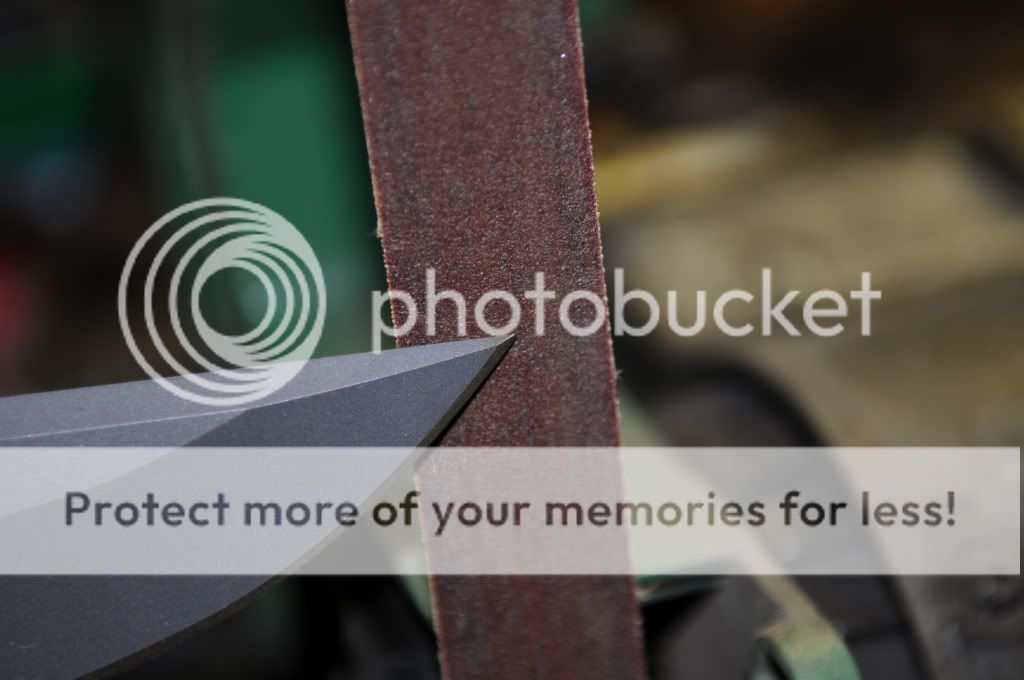
...... when you get to the tip you relieve pressure and lift it off the belt as you make the pass....
+1
....The most important thing that I found about finishing a tip is...never slide the tip off of the belt with pressure still applied.
Once I get about this far over...
...I either reverse directions and lift away near the handle or pull straight away at the tip. What rounds off a tip is when you slide the knife off the belt with pressure applied. The belt will move forward and round off the tip as it passes by.
This sounds pretty close to how I do it. But, for me, my technique seems to differ a bit depending on belt stiffness and blade size/shape.
For me, it has become more of a feel thing that I am not as specifically conscious about.

I guess I use enough variety in belts that it might be more about the belt stiffness than technique to me. So, hard for me to describe.
So, sorry if my thoughts are not concise on this. But, I will try.
Ultimately, as most have read and heard: "Practice" is the key. Practice allows you to learn your technique with your equipment, your belts and your shapes, sizes of blades and different types of steel. There are just way too many nuances and variables to explain in writing.
Grinding on a HF 1"x30" is VERY different than grinding on a 1"x42" Delta SA180, or 1"x42 Kalamazoo, or 2"x72" KMG or industrial Burr King, etc.
I have a 4"x36" that I have had for years for wood-working and only recently learned is WAY better for grinding flats. Whereas, trying to use my platen on my 1"x30" (for quite a few years now) has been a frustrating experience (at best) with mostly less than desirable results - and LOTS of practice and just the right touch, technique and LUCK to get semi-acceptable flat / platen results.
Similarly, using 40,50,80,100 grit Heavy weight belts is VERY different than using 320 grit and even MUCH more different is some of the very fine flexible micron belts. Takes practice.
I "Think" from what I have found is that on the lighter grit belts especially, but any highly flexible belt contours too much for tips and wraps around the tip of the blade when you pass the tip over the belt. So, similar to the picture shown above, I find I keep my tips shaped better if I just get the tip onto the belt and allow a good majority of the tip of the blade to help hold the belt more flat... if that makes sense. Especially if the belt is flimsy or flexible and when doing final sharpening steps, I don't run my tips fully through and not fully off the belt.
If profiling the edge (prior to sharpening) and if on a stiff belt, I sometimes do.
But, if not running the tip all the way through, the problem is that the tip ends up not grinding at the same rate as the rest of the edge - because of less contact time. So, "sometimes" you have to slow down a bit when reaching the tip to get similar edge uniformity. ... = Practice.
I generally start a pass from the plunge line and move towards the tip. But, sometimes if having tip issues, I will start at the tip and move towards the plunge line.
*** Note: "SPOT" sharpening doesn't work well. :thumbdn: - This tends to mess up uniformity of the grind.
With practice, sometimes you can "blend" or slightly taper some passes. But, generally it requires full to nearly full passes to maintain grind uniformity. If blending a pass, slowly let off pressure.
The coarser grits or certain stiff quality papers seem to work better at not damaging the tip as the stiffer don't wrap and contour around the tip.
Also, when sharpening and using flimsy/flexible belts, I use much lighter pressure all the way through. As the flimsier lighter weight belts convex to the edge much easier than the stiffer belts.
320 grit is pretty fine if doing significant re-profiling. 320 WILL re-profile and if just learning, it is actually a pretty good grit to learn on other than not being very stiff. 220 isn't bad for learning either.
But, many blades need significant re-profiling and I think 320 is a bit too fine and too slow for the amount of re-profiling needed on some knives. 320 will eventually get the job done. But, it is a slow grit.
While in the learning stages, the different grits are catch 22.
The finer grits are naturally slower at removing metal. So, you don't make as big a mistakes as fast. But, if trying to re-profile with fine grits, at some point you get to want the material to be removed faster and if trying to make the 320 work faster, you try to use more pressure or hold the blades on the belt too long. This can cause change in edge profile (convex shape) and can heat up the blade faster.
But, if just spending a bunch of time with 320, it is often hard to want to go down to 220 or 150... because then you have to work back up to 320 and beyond. So, it feels like and often is wasted time and effort.
It takes "practice" to know how and when to use the different grits as well.
.... So, at some point, part of the "Practice" is to work with different grits.
A lot of people seem to think coarser grits cut cooler. I am not sure.
I find that pressure is the main factor in heat.
So, I think that as belts wear-out, we use more pressure to get similar results which equats to more heat.
Or, say for 320 grit to remove metal as fast as 220 grit, require more pressure = more heat. Coarser grits remove more metal faster with less pressure. But, pressure can still be used on the coarser grits and heat can develop VERY fast on those as well.
I can sharpen and re-profile edges without over-heating my blade and not needing to dunk. Just by using light pressure.
But, can make any grit belt heat up a blade with more pressure... and need to dunk.
I still think having a water dunk bucket around is a good idea as a rule - even when you get to a point where you feel you can touch up an edge without getting the blade hot.
------------
Another thing worthy to consider is tool height, tool orientation and belt direction.
I started out learning on a Delta 1"x30" (similar to the HF). I ground with the tool on it's base belt direction down and edge down for a long time.
But, Mike Stewart swears by grinding edge into the belt. IMO - I think this works VERY well on grits about 220 and coarser and primarily when doing significant blade shaping and re-profiling. But, you DO need to know what you are doing. So, I personally only recommend this technique after having some decent experience with edge NOT grinding into belt direction.
You have to maintain proper angle, proper blade "touch" to the belt and not have frayed belts.
If you do this technique wrong, the most common issue is cutting your belt - which happens pretty quickly and sometimes a bit violently = very unsettling.
I always make sure I hold my blades pretty securely and have never had a blade pulled out of my hand. I don't think belts are so highly prone to grab a blade and yank it from your hand. But, it does seem very feasible.
For me, when I have had belts cut, I believe it has been because I tilted the edge of the blade into the sides of a worn belt. The sharp edge catches a corner and slices through it in a VERY fast instant. So, putting the blade to the belt at the right angle is important - if grinding into the direction of the belt.
But, putting the blade to the belt at the right angle to begin each pass is also important to help avoid making marks that you don't want on parts of the blade where you don't want bad marks. :thumbup:
The coarser grits and stiffer belts seem to keep the blade riding above the grits.
But, once I go to finer grits or more flexible belts, I don't cut into the belt direction any more.
***** Never grind/cut into the direction of a LEATHER belt!!!!! A leather belt WILL grab the edge and WILL yank the knife out of your hand and won't easily slice through.
**** Also, From everything I have read, the BUFFER is VERY DANGEROUS and VERY prone to grabbing a blade and yanking out of your hand. Buffers have been the cause of MANY (possibly MOST) serious accidents in the knife-making world. So, I tend to avoid buffers and don't recommend them for sharpening. Buffers are designed for polishing anyway. NOT sharpening. I am sure with the right buffing wheel and some practice you could polish an edge well. But, I think there are better and safer ways if you use the right equipment.
If you do it right, grinding edge into the belt allows you to see what you are grinding better. .... especially if you have the tool oriented more ideally.
The 1"x30" grinders are not designed for knife-makers. They are designed for wood-working and simple steel grinding. And the design works fine for that.
I have tried a few different tool orientations and belt directions to see what provides optimum results (for me). I can't say what is best for others.
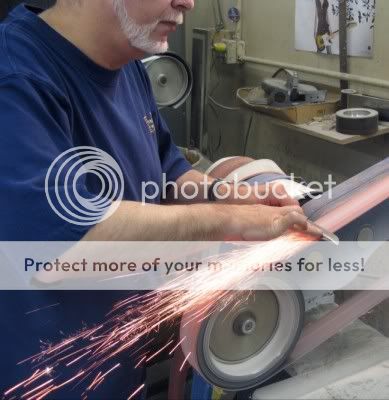
But, this is a pic of Mike Stewart grinding edge into belt:
The belt tool height is ideal IMO. The angle of the tool/belt is ideal:
- you can easily hold the knife across the belt,
- the orientation is good for helping maintain proper blade angle/orientation, I like one hand to hold the handle and the other hand to guide the blade (the above orientation is better for me - allows better control),
- you see what you are doing as well as possible and
- sparks fly behind and away.
Ideally, you learn to switch hands and move the knife across the belt in right to left and left to right motions for each side.
Now, for my preferences, (first) I wish I could actuaully afford that type of grinder set-up. But, also, take the above and change the belt direction for sharpening.
Now granted, the above grinder is a high end 2"x72" (probably $2000 belt grinder or more ??? - Looks like a Burr King) and designed to be used in multiple positions and "Stable" in those positions. And a 1"x30" and most other similar sized and price belt sanders are designed to be used belt direction down. Some 4"X36" tools can be used horizontally in either direction or veritically with belt direction down. But, I am just suggesting: don't feel like you have to use a tool ONLY one way. ... since it was probably designed for different uses other than knife grinding.
But, if you change the orientation of a tool that is only designed to stand a certain way, make sure it is stable, secure and safe. - You can't lay some belt sanders certain ways or just prop on a block.
Also, consider removing unneaded parts. If you have a little table on your belt sander, consider removing. On a 1"x30" belt sander, I would probably just go ahead and remove the platen. I have been able to use the platen on my 1"x30" for some things. But,.... they are not the best tools for flat grinding.
------------
$7.00 each per practice blade is pretty decent, but considering they are still trash, I would look for even cheaper at a local Dollar Store.
Another option, and one that give a broader scale of practice on the belt sander, is "Cheap" edger blades. They come in different sizes, but I think about 8.5" is pretty common. Edger blades are square and don't give sufficiently good practice at rounding the curve of a knife belly. But, buy some 80 grit belts (or 40 or 50 grit online) to shape the blade to a bit of a curve. Then practice completely profiling a square edge all the way to sharp.
Ultimately, this IS a practice makes perfect learning curve. :thumbup:
I agree with Richstag on machetes to a point. They are large blades and cheap, so they offer a fair amount of grinder time for cheap steel. And BEST of all is you can find out how AWESOME a good machete can be as a tool once you have put a good convex edge on it. - As Richstag said, the Ontario machetes are good. They are carbon steel. The Tramontino's are also good. I have tried a couple stainless machete's and ultimately have NOT found them to perform as well as the carbon ones.
My most recent machete acquisition was a bit more expensive. But, at about $50 with a nice leather sheath, my Condor El Salvador came with an AWESOME edge! :thumbup: ....
Problem with the Condor is that you can't really improve the edge for sharpening practice.

But, now... if I can get that kind of an edge on a $50 machete.....
(hint!....)
Anyway, there is one issue with machete's. They are larger and a bit harder to keep steady at first. And their blade shape might not be like your knife shape. So, I recommend a variety of sizes and shaped blades.
I didn't learn from a pro, so I don't know how everyone else does it, but I can't concure with Silverdragon on his tip method:
... make sure the tip is pointing straight down (or pretty close) by the time you get to it.
That doesn't work for me. And I don't see how it would work.
Even if staying perpendicular to the edge line, most knife tips don't even come up much more than 45 degrees from inline with the blade at most on choppers and often 30% or MUCH less on many smaller pointy knives.
The only sharpened tools I know of I would sharpen with "tip pointing straight down" is a chisel... or Razel....
But, ... if you wan't a chisel tip on your knife.
Further, I am not even convinced that you need to sharpen with the belt perpendicular to the edge the entire way. I often find myself just slightly tilting my blade as I go around the belly of a blade and tip.
------------
There are a LOT of good threads on some of the different forums.
Here is a good one over at Scrap Yard:
http://www.scrapyardknives.com/ubbthreads/showflat.php?Cat=0&Number=183198&page=0&fpart=1&vc=1
Here are some good Belt Sander Sharpening videos:
http://backyardbushman.com/?page_id=68
Good luck.
.












 ... O.. Man.. .this is going in the "BAD" direction.