Leather under sandpaper

Joined
Jul 5, 2009
Messages
305
I made my first strop this week and it works fantastic!!! It got me thinking that it might be able to clamp some sandpaper over the leather to create a sharpener. Has anyone done this and if so how does it compare to a mouse pad?

-Paul
 
I've done it and like it better than using most mousepads. Another alternative, if you don't want loose sandpaper grit sneaking into your leather, is to use sandpaper over a telephone book.
 
I've done it and like it better than using most mousepads. Another alternative, if you don't want loose sandpaper grit sneaking into your leather, is to use sandpaper over a telephone book.

I didn't even think of loose grit from the sandpaper, thanks.
 
I like sandpaper on top of a National Geographic or even a Cosmo or a Vogue...hard glossy paper. My wife get's mad if her mags are crinkly or wet so I use Cosmo sparingly.
 
Put the sandpaper on top of 'Blade' magazine. It works better than any other. Obviously. :)


Stitchawl
 
use sandpaper over a telephone book.

I like sandpaper on top of a National Geographic or even a Cosmo or a Vogue...hard glossy paper. My wife get's mad if her mags are crinkly or wet so I use Cosmo sparingly.

What benefit do you get from using magazines, phonebooks, etc. instead of something much harder and flatter, like the edge of a counter top or a piece of glass? I wouldn't think the mags and phonebooks are soft enough to convex, so aren't you then just wanting the hardest, flattest and most stabile suface you can find?
 
I've used it and it works fine. You will need a wide selection of grits if you plan to rebevel any knives and take them to a mirror polish. I'd suggest a piece dedicated to sandpaper and another dedicated to stropping. Leather allows you to push harder without rounding the edge.
 
What benefit do you get from using magazines, phonebooks, etc. instead of something much harder and flatter, like the edge of a counter top or a piece of glass? I wouldn't think the mags and phonebooks are soft enough to convex, so aren't you then just wanting the hardest, flattest and most stabile suface you can find?

It depends on the type of edge you want to produce. For a v-grind edge (flat bevel), a harder surface like wood, mdf, glass, etc. works best. If you want to convex your edge, something a little softer is usually best (although the experts can and do sometimes convex on stones or glass w/sandpaper). A magazine or phonebook does have a little bit of give to it, so it'll produce at least a slightly convex edge. Even with leather, the thickness of it makes a difference in how much convex you'll get. It's a matter of degrees, depending upon how much convex you want.
 
It depends on the type of edge you want to produce. For a v-grind edge (flat bevel), a harder surface like wood, mdf, glass, etc. works best. If you want to convex your edge, something a little softer is usually best (although the experts can and do sometimes convex on stones or glass w/sandpaper). A magazine or phonebook does have a little bit of give to it, so it'll produce at least a slightly convex edge. Even with leather, the thickness of it makes a difference in how much convex you'll get. It's a matter of degrees, depending upon how much convex you want.

+1 :thumbup:

It's all about whether you want a convex final edge or not.
 
I think a convex edge would simplify the sharpening process for me. Right now I am using my sharpmaker for my secondary bevel, free handing the micro bevel and then stropping. I can get a hair popping edge (sometimes) but that's 3 different motions. While sharpening a convex edge every motion and angle is the same plus there is no need to worry about a micro bevel. If leather works as well as a mouse pad I will use that just because it looks better and should be more durable.

Thanks for all the responses,
-Paul
 
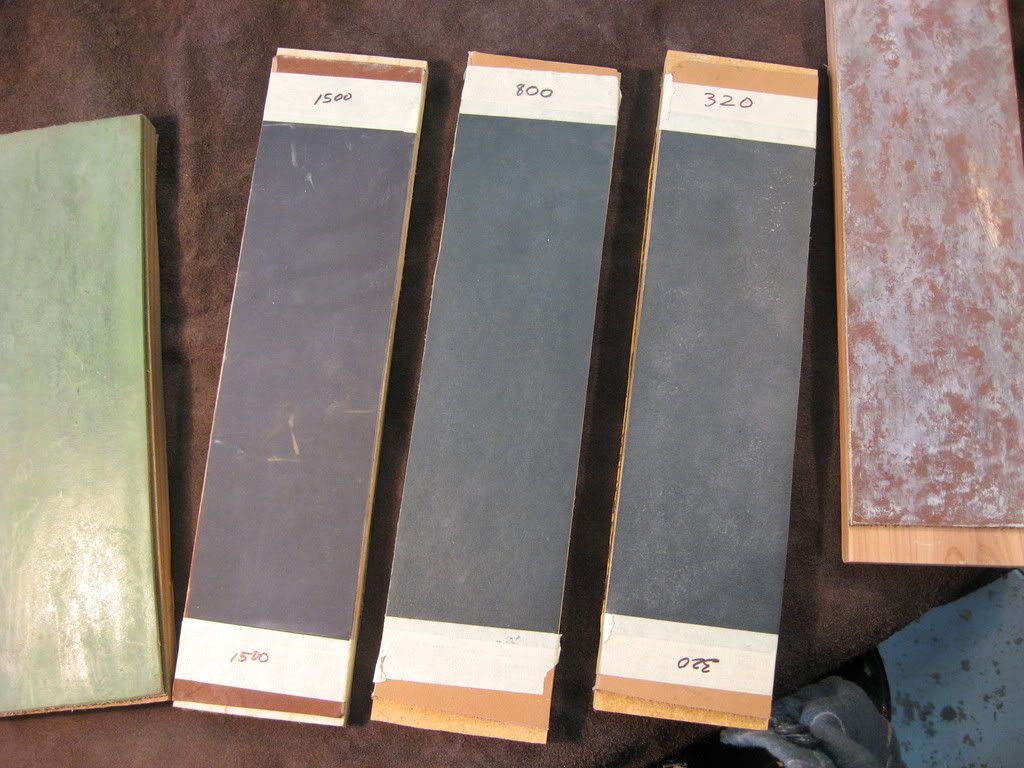
leather glued to wood, then covered with sandpaper: that's exactly how I sharpen my convex grinds. I use 600, 800, 100, 1500, and 2000. The 1500 and 2000 gets the most use, because the coarser grades are normally not needed.

Each of these is a piece of wood approx 3" x 11" x 3/4" with 8oz leather glued on. Then the sandpaper is taped at each end. The second photo is the reverse side of each sharpening "strop".

convex-02.jpg


IMG_1439.jpg
 
Back
Top