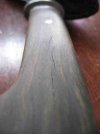
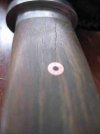
Lignum Vitae handle is splitting...help...

Joined
Oct 27, 2005
Messages
2,527
I sold the chopper in the photograph to a fellow bladeforums member. While hacking with it, he noticed that the handle is beginning to crack on the underside (actually 3 small cracks running the length of the handle from front to back). I've offered to rehandle it, or take it back with a full refund.

The lignum is not stabilized. It is a hidden tang, with one pin through the handle and tang. I used JB Weld, being careful to not completely fill the void because of the way JB Weld expands slightly when it cures.

Now, for my questions:
  • Has anyone had issues with lignum vitae cracking?
  • I made the knife in the Portland, Oregon area. The knife is up in Moose Jaw, Saskatchewan Canada, with is in the southern central part of that providence. I'm not familiar with the weather there, but wonder if it would swell too much and crack in that location. The rest of the lignum in my shop, that came from the same piece checks out at 6% moisture on my new "mini-LIGNO E/D" moisture meter. The moisture meter was a birthday gift to me that I just received in the last week!! Happy birthday to me!!!
  • I'm wondering if the one handle pin would have created a slight pivot point, that would lead to stresses that could crack the handle. Would two handle pins have been better?

I don't have any photos of the cracks. I've requested some from my customer.

Any other feedback from those of you that have used lignum vitae? This is the first time that I've used it on a hidden tang knife handle. I had previously only used it on full tang knives.
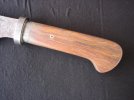
 

Attachments

  • IMG_1733.jpg
    IMG_1733.jpg
    98.5 KB · Views: 262
JB weld expands as it cures? That is news to me. I figured it would have something like the approximatly .003" in/in shrickage like other filled epoxies. I wonder what the mechinizem is. Strange.


To my understanding, there are two types of lignum vitae. The real stuff, which is now protected and not available, and a "new" type, which isn't real lignum vitae. From the color, it looks to me like you have the "real" stuff, which I haven't worked with.
 
JB weld expands as it cures? That is news to me. I figured it would have something like the approximatly .003" in/in shrickage like other filled epoxies. I wonder what the mechinizem is. Strange.


To my understanding, there are two types of lignum vitae. The real stuff, which is now protected and not available, and a "new" type, which isn't real lignum vitae. From the color, it looks to me like you have the "real" stuff, which I haven't worked with.

I've had that lignum for over 15 years. I got it from an amish lumber company in Ohio a long time ago.

As far as JB expanding, I learned that from no other than Bruce Bump.
 
I'm really surprised to hear of it splitting. I suppose any wood can, though.

You can still find lignum vitae (guaiacum officinale) lumber, but it's rare. Most places substitute verawood (bulnesia sp.) as it is very similar.
 
Moose Jaw would be real dry this time of year,much drier than where you are, unless the river flooded this week:eek: Cheers Ron.
 
Is it possible that the crack was at a point in the wood where you may have drilled too thin? I've had wood crack before, but only during the cutting/shaping/drilling, because I did something wrong.
 
Scott, I did a slab handled knife using it when I first started making. It was beautiful and parts of it looked like tiger eye. I took a look at the knife the next day and it had several complete cracks. First and last time I used it. I've got another piece of it, you welcome to have. :D
 
Could you rub some wood glue into it then clamp it to close the crack? then rub the glue all over it as a protecvtive/preventative coating?

Jason
 
I gets super dry in winter here in Saskatchewan. It is -40 for months and the houses get really dried out from running the furnace. I have a humidifier the size of R2D2 and it barely makes a dent. I have noticed some elk horn and deer antlers shrinking a bit and I could see some shrinkage in lignum.

Beautiful knife by the way! Greatto know people in my area are buying some nice ones.
 
I was mistaken. It's actually in Alberta. My bad. I sent to shipments to Canada at about the same time and mixed the addresses up in my head.
 
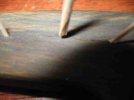
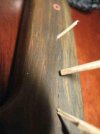
Attached are some photos. Those are toothpicks slipped into the cracks for a size comparison. Any suggestions?
 

Attachments

  • IMG_3894.jpg
    IMG_3894.jpg
    7.2 KB · Views: 113
  • IMG_3895.jpg
    IMG_3895.jpg
    24 KB · Views: 121
  • IMG_3900.jpg
    IMG_3900.jpg
    8.1 KB · Views: 105
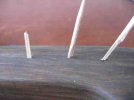
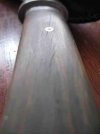
Three more photos of the cracks. It looks like it split at the pin due to shrinkage of the lignum. It even looks like the pin is standing up proud above the surface of the lignum now. Crap!
 

Attachments

  • IMG_3904.jpg
    IMG_3904.jpg
    18.8 KB · Views: 80
  • IMG_3905.jpg
    IMG_3905.jpg
    18.5 KB · Views: 73
  • IMG_3906.jpg
    IMG_3906.jpg
    19.4 KB · Views: 96
Well damn---I'm holding a recently-acquired lignum vitae handled knife right now and worrying about the wood! [Mine's a full tang green river style with 1095 blade by Jeff Morgan of Santee, CA.]

I wonder if the lignum vitae is just so darn hard/brittle that any stress from something like your pin starts a crack? I wish I could offer some useful advice but I at least want to thank you for alerting me to keep an eye on the handle of my knife.

Thanks,

DancesWithKnives
 
Would soaking it in Minwax wood hardener help? Then I guess I would just fill the gap with super glue and buff.
 
If the pin is proud the wood has dried out, not uncommon in winter in Canada.

The crack appears to originate at the pin. This could indicate that the pin is putting stress on the scales,,either peened or if a loveless bolt that is too tight.

I would refit new scales with a looser fit on the pin, do not peen or over tighten the pin. The wood will still shrink and expand with changes in the weather but that is inevitable.

George
 
I thought that this Lignum was supposed to be so great for scales. I have a whole bunch of the Argentine Lignum that I'm still letting dry....looks like some more expensive firewood. :grumpy:
 
I have some and have seen the same problem. Personally I think its the way the "wax or oil " in the handle wood reacts when it is sanded. It a very waxy wood. It tends to clog up the belts which in turn make wood much hotter than normal while sanding. As oils migrate because of the heat some portion get drier than others and the cracks occur. Have not really come up with a solution other than hand shaping with files then sanding. To bad it a really nice wood. my 2 cents.
 
I work with exotics all the time and those cracks are not stress cracks from using knife...they are shrinkage cracks from the environment. I have exotics that are almost 40 yrs old and will still move upon machining and a little time in a different environment. Sometime you just need to stay away from certain woods...true ebonies, snakewood, lignum vitae, among others. Heat is also a great influence at maching time for future movement.
 
I didn't get it hot at all during shaping. I did most of the handle shaping with files, doing it the hard way. I'm always real careful about putting heat into my handles. The pin is not peened. It's a mosaic pin that I was able to just slide right it. I didn't even have to tap it in with a hammer. I try to loose fit my pins.

I'm thinking I'll send the rest of what I have out for stabilization. Lignum is on Chuck Bybee's list of woods that haven't been tested yet. I'll probably call Mike at WSSI before sending it in, to see if he's ever stabilized Lignum yet and find out how well it handled the stabilization process.
 
I have used it on a few knives. It always seems to crack at some point in time so i quit using it. Save yourself the time it cannot be stabilized you can put it in a pail of water for months and it will be the same as when you put it in. It is one of the few woods that will not float because it is too dense.

Bob
 
Back
Top