Liner lock folder with Ironwood

Joined
Feb 17, 2008
Messages
8,287
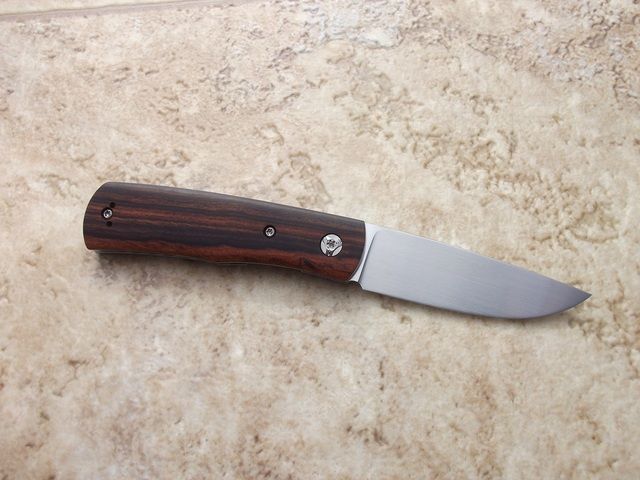
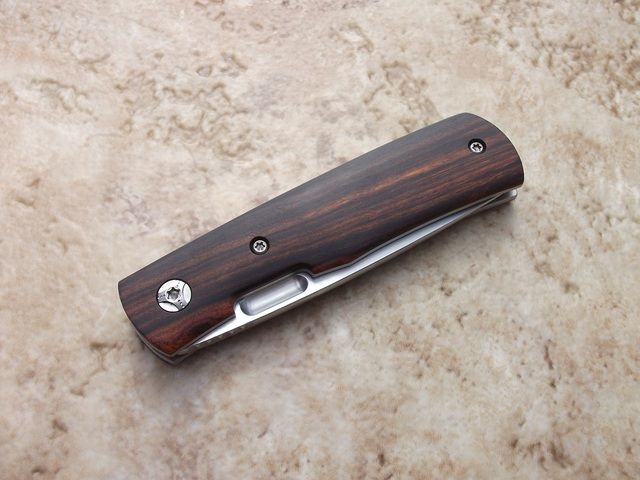
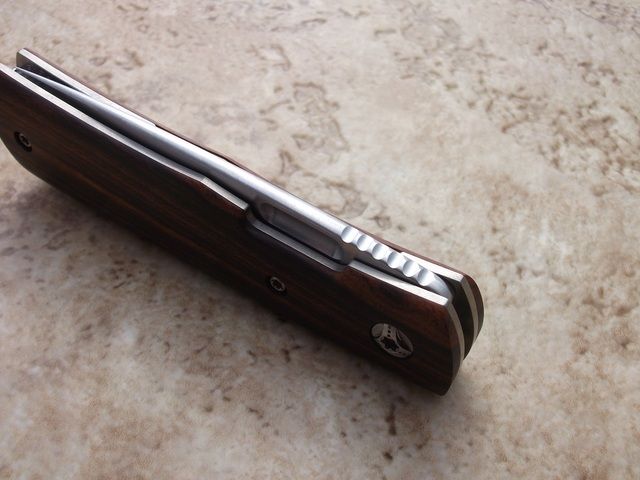
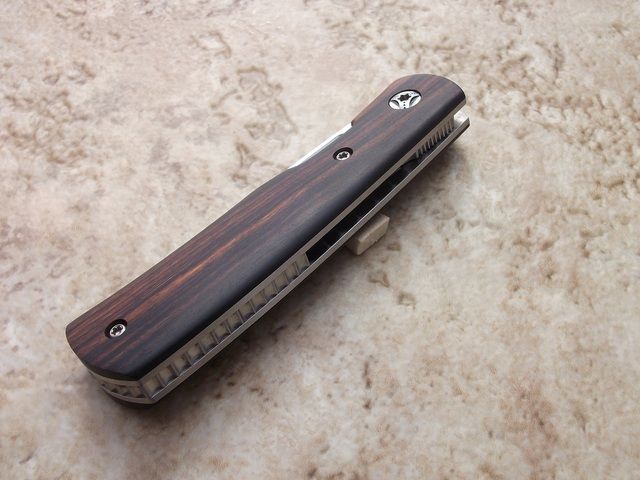
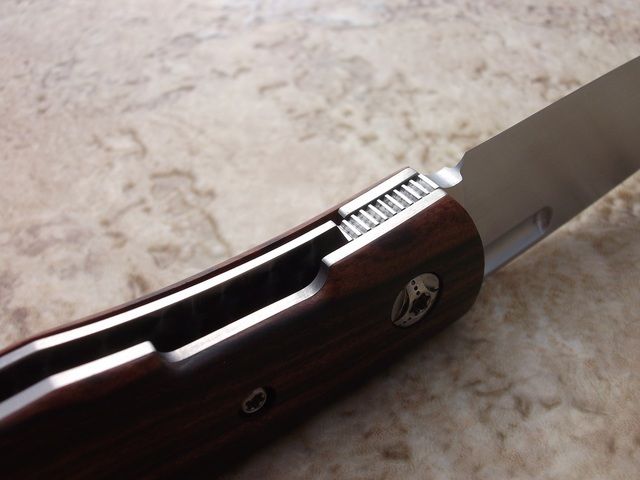
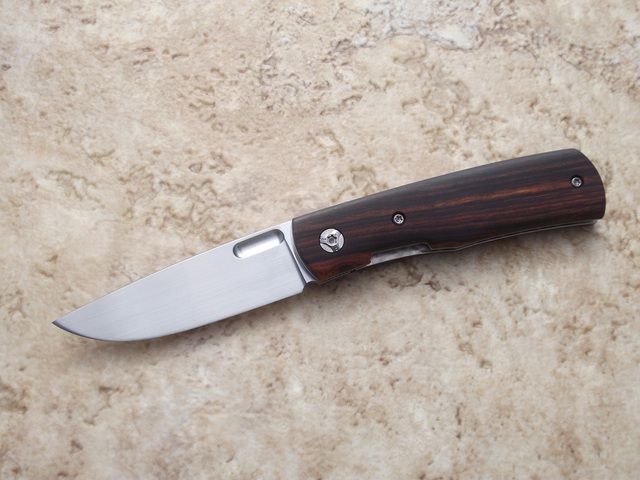
Here's a folder I just finished up. It's set up for a pocket clip, which I have and the appropriate screws for attaching it, hence the extra little holes by the rear screw hole. But I didn't put it on there because I really don't like pocket clips. :) I think they distract from the look and flow of the knife and are almost always in the way. But the option is there for the future owner.

Specs:
80CrV2 steel
Rounded spine and rounded thumb grip, very nice grip but very comfortable
Desert ironwood scales
Titanium pivot screws and handle screws
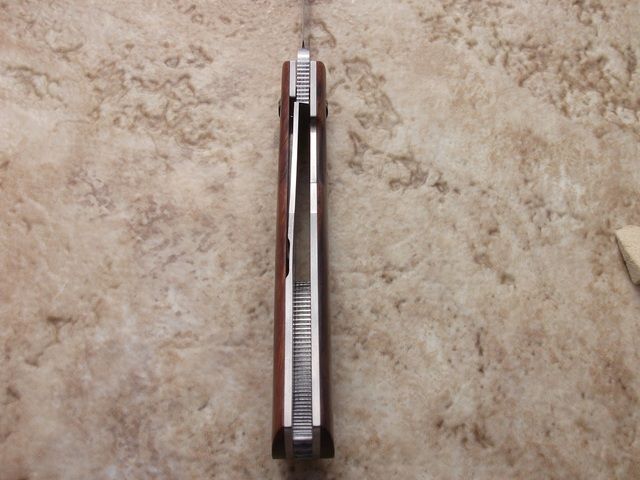
.065" thick titanium liners, jeweled
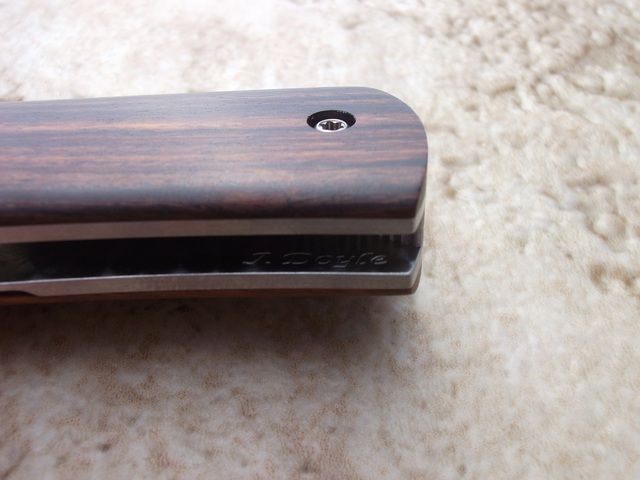
416 stainless backspacer fileworked inside and out, outside matches the spine and inside matches the bottom of the ricasso area

All comments, discussion and critique welcome.


John, Like where this is heading. Hopefully will get to take a look at this one next weekend.


Thanks for sharing your work

Bing
 
Beautiful as always John!
The only part i think may be an issue is the coined inside of the spacer... but since the knife is a take down it will allow cleaning of the coining easily :)
 
Very clean simple lines. Definitely one of the more elegant modern folders I've seen.
 
john - that is one slick little knife. The attention to detail is impressive. I always like your work. Not over-the-top. Just a well-made, and lightly-adorned, knife.

I am making a batch of bushcraft knives for a wedding party. They have to be economic yet durable and have the handmade quality. I am going with 80CrV2 for them. I have been learning more about this steel, and enjoying it. It is some tough stuff, and still manages to do quite well with edge holding.

Not as good as O1, W2, or 52100, but tougher and far better edge than L6.

(edited to clarify: O1, W2, and 52100 are better at edge holding but 80CrV2 is more resistant to breaking and chipping. L6 is more resistant to breaking and chipping than 80CrV2, but 80CrV2 is much better at edge holding). So, for a knife that needs to be extremely durable, and also hold a good edge, and be easy to sharpen in, "field," conditions, 80CrV2 is my current choice.

I know that you know all of that stuff. What I am leading to is... would you mind sharing your heat treatment approach to this steel? I think you are a fine craftsman, and I am interested to know how you go about working with this one. As I said, I am making 9 bushcraft blades from this steel, and I want to make sure I get input from several others who use it.

take care,

kc
 
Last edited:
Thanks Kevin. I wouldn't mind sharing my experiences with the steel. I've worked with it for quite a while now. I bought quite a bit when Chuck Bybee first started carrying it and was the only place that I knew of to get any.

I've never worked with O1 or L6. I've used 52100 only a couple times early on my my knife making. I use w2 a fair amount these days and I would say that your assessment of 80CrV2 is on par with what I've experienced.

***DISCLAIMER***- I am not a metallurgist and I've never had any samples sent out for any kind of tests by professionals. I have a pretty good understanding of the various stages of heat treating and thermal cycling applications for the steels I work with and I have done a lot of real world cutting tests. I have VERY good accurate heat control with my high temp salt tank.

80CrV2 is the finest grained and by far the toughest steel I've ever worked with. Compared to W2, I would say it holds it's wicked sharp edge not quite as long as W2. For me though, it's been pretty close. However, after that wicked sharp, shaving edge is gone, it holds it's sharp, working edge longer than anything I've used. I've been extremely impressed with it's ability to keep cleanly slicing abrasive things like cardboard and sisal rope long after it ceases to shave arm hair.

I tend to leave all my blades a little on the hard side as I view knives as slicing and cutting tools, not chopping and hacking tools (though knives suitable for that purpose like camp knives and bowies of mine will chop just fine).

80CrV2 has a fairly wide and high range of austenitizing temps. 1540 F.- 1610F. given for one source. I don't go quite that hot.

Basically, for a blade like this folder that was ground and not forged, I start by giving it a true normalizing at 1650F. for a 10 min soak. Then I do a critical temp thermal cycle followed by one or two subcritical thermal cycles. Just bringing to an even temp and letting cool in still air.

Then I do all my pre heat treating drilling and grinding. Then I do a couple thermal cycles at critical or just below (usually both) more as a stress relief than anything else. Then for austenitizing, I bring the blade up to 1520F. and soak for 10 minutes and quench. That's a bit lower than the suggested range but there is really nothing that stands out in the chemical make up of the steel to me that warrants temps over 1550F.

After the quench I temper in the oven at 325F. for the first cycle and bump the temps up from there to my final desired hardness which is usually from about 340F.-375F. depending on the blade and it's application.

I've been fairly amazed at how difficult it is to break fully hard, as-quenched coupons of this steel with absolutely no tempering and also how well blades of this steel will hold hold a REALLY fine, thin edge even in really hard use. Metallurgically I can't explain the things I've just stated. Looking at the chemistry of this steel, it shouldn't be as good as it is. I mean it's a very suitable and very good steel, don't get me wrong but there's nothing extraordinary about it's chemical make up. It has the carbon range of 1084, a slightly higher chromium content than 5160 and the vanadium content on par with most w2. Yet it will out perform them all on edge holding and toughness, with the exception of the ultra fine edge holding of w2 mentioned above.

Other bladesmiths I've spoken to have reported very similar findings with it. Again, this is not professional advice. It's just been my experience with it and the description above is what works for me, in MY shop. Others' methods may, and likely DO vary.
 
John,
thanks for the honest and detailed answer. I think I am going to re-do my first blade. I austenized at 1500, soaked for 10min, and then quenched in canola. Then, I tempered in oven for 2 1-hour cycles at 450F.

I am afraid this will be too soft. I am going to austenize higher, 1540F, and temper at 400F.

thanks for the information. Lovely knife.
kc
 
This folder is beautiful.
But... where is stop pin?
 
Back
Top