Is the standard liner lock as safe as other blade lock designs? I like the Benchmade Axis lock as well as the Ball Bearing blade lock design on some Spydercos, the SOG Trident lock and even the Gerber F.A.S.T. Draw as they all allow blade unlocking without placing a finger in the path of the closing blade. The Axis Lock and the Spyderco BB Lock are even fully ambidexterous. Even the large Wenger Swiss Army knives I have with liner locks for the main blade include a button or slide which disengages the liner lock for blade closure w/o having to place a finger in the blade path. Should such a operating mechanism be incorporated into all liner lock knives or am I concerned about something that most users consider a non-problem?

-
The BladeForums.com 2024 Traditional Knife is available! Price is $250 ea (shipped within CONUS).
Order here: https://www.bladeforums.com/help/2024-traditional/
You are using an out of date browser. It may not display this or other websites correctly.
You should upgrade or use an alternative browser.
You should upgrade or use an alternative browser.
Liner Lock Safety?
- Thread starter tatfiend
- Start date
- Joined
- Jan 2, 2013
- Messages
- 1,508
Assuming the liner lock is properly manufactured, 99% of injuries with them are probably due to user error. Safeties are not needed and only add unnecessary complexity to the knife. That being said, the CRKT Autolawks does provide a lot of piece of mind due to the thinness of the liners.
- Joined
- Aug 31, 2009
- Messages
- 2,696
depends on you and the knife, I guess. Most of my liner and frame lock knives either have a slight choil, or just an unsharpened portion of the tang which is the only part of the knife that will contact your thumb when closing. A knife that is fully sharpened up to the handle *might* be able to cut your thumb, for instance the Spyderco Tenacious. However, for me it's not an issue as it simply hits my thumb nail. If people activate the lock in a different way with their flesh in a vulnerable spot that could be different. I've never had an issue.
Most of the time the blade never comes anywhere near my thumb, it's easy enough to disengage the lock, let the blade rotate a hair so the lock won't re engage, then move your thumb and complete the process. But like I said, even if I get in a hurry and let it hit my thumb, it just hits my nail and cuts nothing.
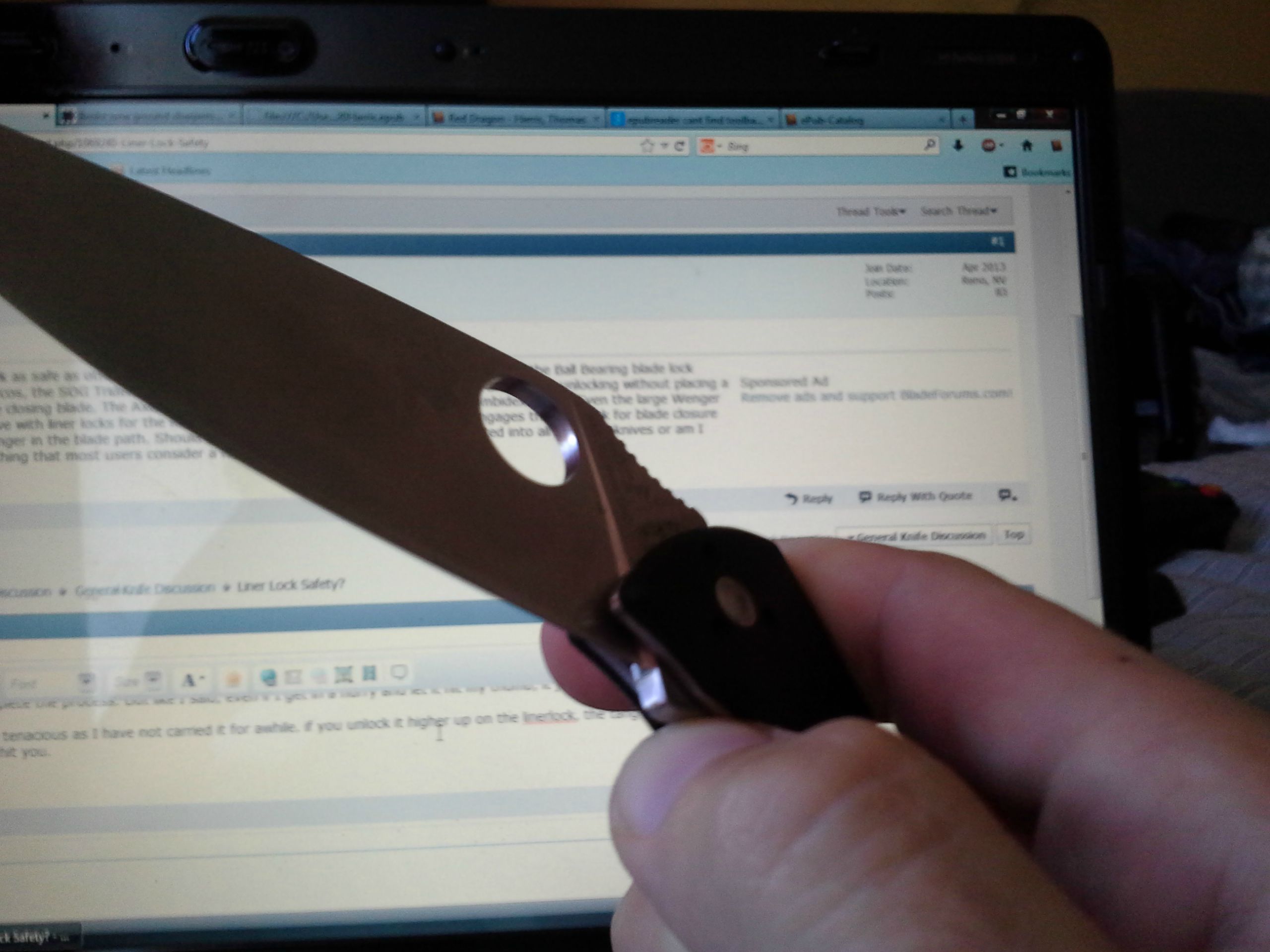
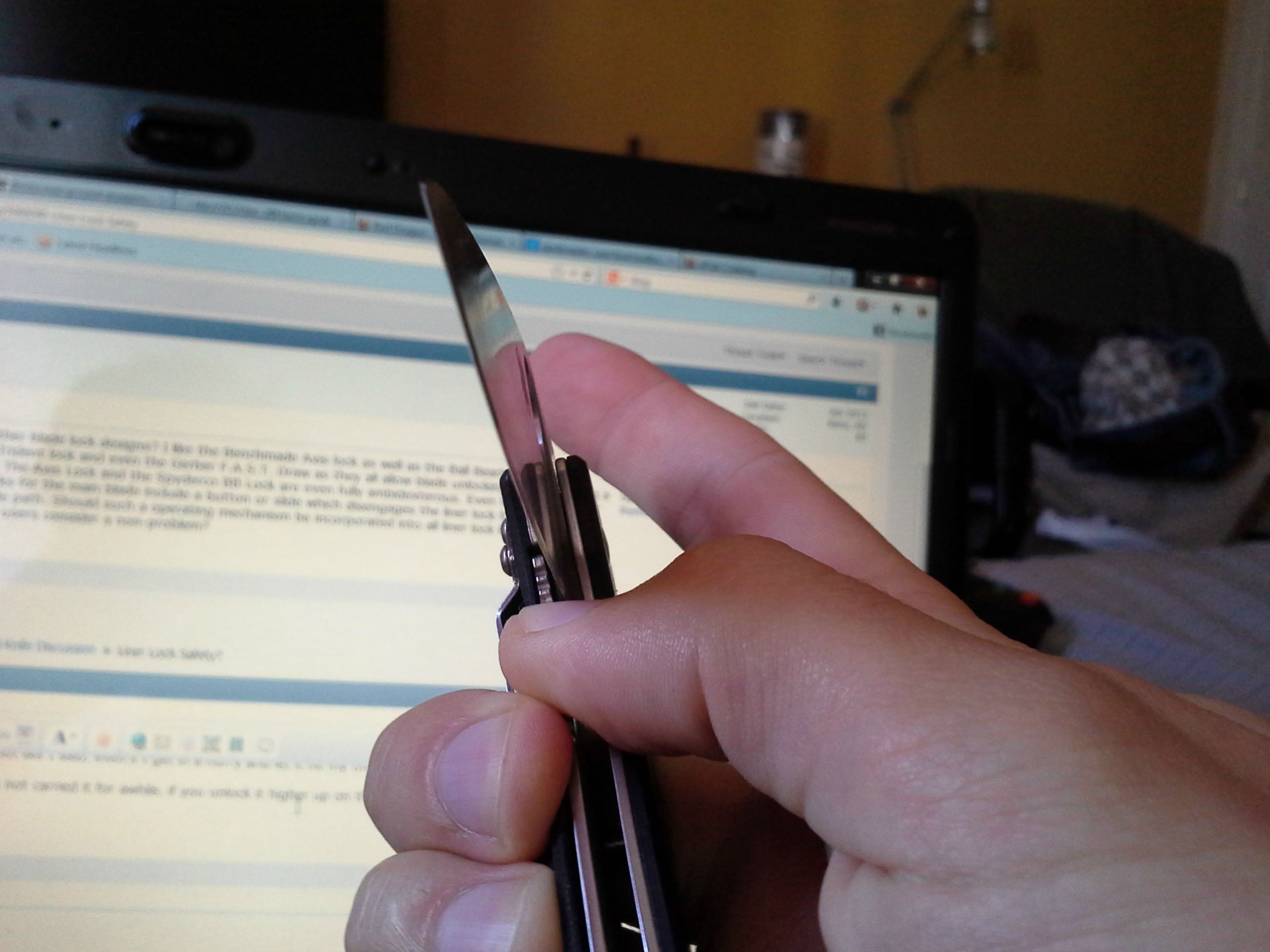
actually just tried my tenacious as I have not carried it for awhile. if you unlock it higher up on the linerlock, the tang is the part that hits your thumb. If you unlock it lower then the blade could hit you.
Higher up - Tang hits thumb, no issue
Lower down - Blade hits thumbnail. Potential issue if your thumb is rotated so the flesh is exposed.
Most of the time the blade never comes anywhere near my thumb, it's easy enough to disengage the lock, let the blade rotate a hair so the lock won't re engage, then move your thumb and complete the process. But like I said, even if I get in a hurry and let it hit my thumb, it just hits my nail and cuts nothing.
actually just tried my tenacious as I have not carried it for awhile. if you unlock it higher up on the linerlock, the tang is the part that hits your thumb. If you unlock it lower then the blade could hit you.
Higher up - Tang hits thumb, no issue
Lower down - Blade hits thumbnail. Potential issue if your thumb is rotated so the flesh is exposed.
Last edited:
Never fully trust any lock, ever.
If you want to full-strength stab a knife, get a fixed-blade.
It depends on the knife, but I usually get cut once or twice while becoming accustomed with closing the particular knife. After building some muscle memory, cuts while closing become very rare. I don't see any glaring problems with the knives... only problems with myself.
If you want to full-strength stab a knife, get a fixed-blade.
It depends on the knife, but I usually get cut once or twice while becoming accustomed with closing the particular knife. After building some muscle memory, cuts while closing become very rare. I don't see any glaring problems with the knives... only problems with myself.


Assuming the liner lock is properly manufactured, 99% of injuries with them are probably due to user error. Safeties are not needed and only add unnecessary complexity to the knife. That being said, the CRKT Autolawks does provide a lot of piece of mind due to the thinness of the liners.
I have a big CRKT and I don't think I would trust its standard liner lock. I hold the knife in my hand and watch the liner as I push on the blade- the liner slides sideways across the blade tang against the LAWK lever.

Locutus D'Borg
Platinum Member
- Joined
- Dec 1, 2012
- Messages
- 5,222
Splurge and buy well-crafted knives. And use them properly. They will be safer. Most problems, as stated above, are user error, not equipment failure. People have been using slip joints (no locks) for decades with relatively few injuries. This obsession with locks that will withstand a sledgehammer is beyond my comprehension.
Locutus;
Not worried about locks that are necessarily the strongest possible, just locks which are ambidexterous and as safe as possible from the blade closure operation point. So far to me the best blade locks from that standpoint I am aware of are the BM Axis lock and the Spyderco Ball Bearing lock.
While I agree that most cuts while closing a lock knife blade are user error related that does not seem to stop vampire ambulance chasing tort lawyers from dragging companies into court.
Not worried about locks that are necessarily the strongest possible, just locks which are ambidexterous and as safe as possible from the blade closure operation point. So far to me the best blade locks from that standpoint I am aware of are the BM Axis lock and the Spyderco Ball Bearing lock.
While I agree that most cuts while closing a lock knife blade are user error related that does not seem to stop vampire ambulance chasing tort lawyers from dragging companies into court.
- Joined
- Aug 31, 2009
- Messages
- 2,696
back locks also keep your fingers out of harms way
- Joined
- Jan 12, 2009
- Messages
- 3,198
I personally think the safety of a liner lock system is based on the relationship of the user to the knife.
If you think a liner lock or any other kind of lock makes the knife safe, you are wrong. If you think a lock makes a folder into a fixed blade, you are dangerous to yourself.
Instead of thinking of the lock on any knife as a safety device (like a safety on a gun) many now have come to think it is an integral part of the engineered design made to enhance the utility of the knife, making it a "near" fixed blade.
That being said, I use my liner lock folders in my construction work and never have I had one fail. BUT... I only use the real beefy liner locks by Kershaw, Spyderco and a couple of others. These are strong, heavy locks and they don't move easily if you come into contact with them during use. I got a Gerber knife on a give a away a few years back and it had the thinnest liner lock I had ever seen. As suspected, I was able to bend the lock bar with little problem, then it became disengaged all the time. I hear of liner lock failures, but almost without exception it is a design failure (lockbar sticks out into the grip) or the lock bar is flimsy and wears out, making the knife dangerous to use.
If you are worrying about any folding lock failing, find a knife that has a device that is not in your way or easy to deploy when the knife is in use. My favorite right now is the Cold Steel Tri-ad lock, which is nothing short of remarkable. The ergos on the knife are great (American Lawman) and it would be nothing short of impossible for me to disengage the lock without a lot of directed effort to do so. As it is, it takes me two hands to do it now.
Robert
If you think a liner lock or any other kind of lock makes the knife safe, you are wrong. If you think a lock makes a folder into a fixed blade, you are dangerous to yourself.
Instead of thinking of the lock on any knife as a safety device (like a safety on a gun) many now have come to think it is an integral part of the engineered design made to enhance the utility of the knife, making it a "near" fixed blade.
That being said, I use my liner lock folders in my construction work and never have I had one fail. BUT... I only use the real beefy liner locks by Kershaw, Spyderco and a couple of others. These are strong, heavy locks and they don't move easily if you come into contact with them during use. I got a Gerber knife on a give a away a few years back and it had the thinnest liner lock I had ever seen. As suspected, I was able to bend the lock bar with little problem, then it became disengaged all the time. I hear of liner lock failures, but almost without exception it is a design failure (lockbar sticks out into the grip) or the lock bar is flimsy and wears out, making the knife dangerous to use.
If you are worrying about any folding lock failing, find a knife that has a device that is not in your way or easy to deploy when the knife is in use. My favorite right now is the Cold Steel Tri-ad lock, which is nothing short of remarkable. The ergos on the knife are great (American Lawman) and it would be nothing short of impossible for me to disengage the lock without a lot of directed effort to do so. As it is, it takes me two hands to do it now.
Robert
Metal Made Fox
BANNED
- Joined
- Sep 28, 2011
- Messages
- 1,222
I like liner locks for their simplicity and ease of closing. However I wouldn't feel too safe with one. There is a Russian guy on youtube who does many torture tests on expensive folders like Emersons and ZT's and in every test he always does 5 spine whacks for each knife. There has never been one liner lock knife that has ever made it past 5 spine whacks in his videos, they all fail miserably. He even tested a CRKT with the Autolawks feature and the lawks feature broke within the second spine whack.
Now granted, spine whacking a knife is misuse of it and I don't think you will ever encounter yourself in a situation where you will have to spine whack with your folder. However, it kind of makes me uneasy knowing that liner locks fail with a slight impact. He also tested a Recon 1 with the Tri-Ad lock. That one survived like a boss without getting any blade play. Hell it even broke the wood he was hitting it on.
Regardless I will still continue to buy liner locks as some of the nicest knives out there are made with liner lock mechanisms.
Here is the video of the CRKT breaking. Start at around 7:35 for the action.
[video=youtube_share;zfVBSW7tO9k]http://youtu.be/zfVBSW7tO9k?t=7m35s[/video]
Now granted, spine whacking a knife is misuse of it and I don't think you will ever encounter yourself in a situation where you will have to spine whack with your folder. However, it kind of makes me uneasy knowing that liner locks fail with a slight impact. He also tested a Recon 1 with the Tri-Ad lock. That one survived like a boss without getting any blade play. Hell it even broke the wood he was hitting it on.
Regardless I will still continue to buy liner locks as some of the nicest knives out there are made with liner lock mechanisms.
Here is the video of the CRKT breaking. Start at around 7:35 for the action.
[video=youtube_share;zfVBSW7tO9k]http://youtu.be/zfVBSW7tO9k?t=7m35s[/video]
Last edited:
Metal Made Fox
BANNED
- Joined
- Sep 28, 2011
- Messages
- 1,222
Here is another interesting video from the same guy. (English subtitles)
[video=youtube_share;Gf4EnAENZZ4]http://youtu.be/Gf4EnAENZZ4[/video]
[video=youtube_share;Gf4EnAENZZ4]http://youtu.be/Gf4EnAENZZ4[/video]
- Joined
- Aug 31, 2009
- Messages
- 2,696
If I ever need to use the spine of my knife to hammer nails I'll be sure to leave the liner and frame locks at home, then 
In other news, Triad lock knives make horrible chopsticks. Would not recommend.
We were able to reattach the tip of my tongue, though. So there's that.
In other news, Triad lock knives make horrible chopsticks. Would not recommend.
We were able to reattach the tip of my tongue, though. So there's that.
- Joined
- Jan 12, 2009
- Messages
- 3,198
I like liner locks for their simplicity and ease of closing. However I wouldn't feel too safe with one. There is a Russian guy on youtube who does many torture tests on expensive folders like Emersons and ZT's and in every test he always does 5 spine whacks for each knife. There has never been one liner lock knife that has ever made it past 5 spine whacks in his videos, they all fail miserably. He even tested a CRKT with the Autolawks feature and the lawks feature broke within the second spine whack.
You may be missing the point in my opinion. I am with goodeyesniper on this.
I work in contruction and use my JYD Combo, occasionally my Tenacious, my Blur, and my workhorse the RAT 1 for years now. Not opening letters, breaking down cardboard, or cutting up apples. The are used to cut, slice, do a bit of light prying, and occasionally do other things that you shouldn't use a knife to do. When I am away from my truck and can't get the right tool, my knives cut shingles, cut light metal strapping, cut wire, sheetrock, fiberglass insulation, tar paper, and are often used as scrapers. All of my regular work knives have been doing this for years. Their main task is of course cutting, but then again, they are also tools that may be chosen for expediency's sake.
I don't overtax the knife, and never forget the liner lock is a safety device, not an device employed to make it comparable to a fixed blade. A folding knife is a folding knife is a folding knife. It will never, ever, be a fixed blade.
A knife isn't a hammer and using it for a shock test is just stupid.
You have my promise that after 40 years of driving nails, I could take my hammer (for another shock test) and easily break any fixed blade of comparable thickness and steel with a few well placed shots. But what would that prove? That a fixed blade might fail if abused? That a mere $10 hammer could break a $400 knife with the right test?
Think of a knife as a slicing tool, buy a quality product and all will be well.
Robert
Metal Made Fox
BANNED
- Joined
- Sep 28, 2011
- Messages
- 1,222
Guys I never said I advocated doing spine whack tests on knives. As a matter of fact I specifically said it was misusing a folder.
I agree with you midnight flyer. A folder should never be used to hammer stuff. It is simply misuse and abuse of a tool that was only designed for cutting. However a point I wanted to make clear was the fact that there are other locks out there that are much much stronger and more reliable than a liner lock. That's why I also mentioned the Tri-Ad lock. After all the OP was asking about liner lock safety. I just stated that I wouldn't be too confident in a liner lock as I would with a stronger lock.
Regardless, yes a knife should only be used for tasks that require the attention of a sharp edge nothing else.
Now granted, spine whacking a knife is misuse of it and I don't think you will ever encounter yourself in a situation where you will have to spine whack with your folder.
I agree with you midnight flyer. A folder should never be used to hammer stuff. It is simply misuse and abuse of a tool that was only designed for cutting. However a point I wanted to make clear was the fact that there are other locks out there that are much much stronger and more reliable than a liner lock. That's why I also mentioned the Tri-Ad lock. After all the OP was asking about liner lock safety. I just stated that I wouldn't be too confident in a liner lock as I would with a stronger lock.
Regardless, yes a knife should only be used for tasks that require the attention of a sharp edge nothing else.

Here is another interesting video from the same guy. (English subtitles)
[video=youtube_share;Gf4EnAENZZ4]http://youtu.be/Gf4EnAENZZ4[/video]
Very interesting video, thanks for sharing. I wonder if they all do this or if he got a bad unit. It looks like the liner needs to be contoured to the handles a little more, so it doesn't move when you grip the knife.
Metal Made Fox
BANNED
- Joined
- Sep 28, 2011
- Messages
- 1,222
Very interesting video, thanks for sharing. I wonder if they all do this or if he got a bad unit. It looks like the liner needs to be contoured to the handles a little more, so it doesn't move when you grip the knife.
I've had many and I mean MANY Emersons (including a couple of CQC-7's) in my knife collecting experience and out of all of them, only has one failed on me. It was a CQC-13 that was already beat to hell. I sent it back to Emerson and they fixed it up good as new. :thumbup:
I'm sure he just got a lemon. Every knife company in the world has a lemon slip through final inspection once in a while.

- Joined
- May 21, 2000
- Messages
- 6,277
Nothing is fool proof for a sufficiently talented fool.
Any folder can fail, especially if it is subjected to abuse.
A well made liner lock is quite safe, and should provide years of service.
A folder is not a fixed blade, and should be treated as such.
Any folder can fail, especially if it is subjected to abuse.
A well made liner lock is quite safe, and should provide years of service.
A folder is not a fixed blade, and should be treated as such.
- Joined
- Apr 12, 2009
- Messages
- 1,064
if you use your knife like a normal person a liner lock will be fine. if you do things like baton your folder through wood, try to stab it through metal, throw it, purposely try to make it fail or otherwise utterly abuse it yes it will fail. a kinfe is a tool and when used properly it will preform properly. I swear knives are the only tools that people use in completely asinine ways and then complain when it doesn't work. Knives are the only tools that people do everything they can to make them fail and them complain when they do.
Imagine of someone drove their car at redline in 1st gear until the engine shut off. you'd call them an idiot. it's the exact same thing as knife torture tests. it's like turning a blender on with steel bearings in it and letting it run until it shuts off. yeah cool you made it fail but let's be real with our tests.
Imagine of someone drove their car at redline in 1st gear until the engine shut off. you'd call them an idiot. it's the exact same thing as knife torture tests. it's like turning a blender on with steel bearings in it and letting it run until it shuts off. yeah cool you made it fail but let's be real with our tests.